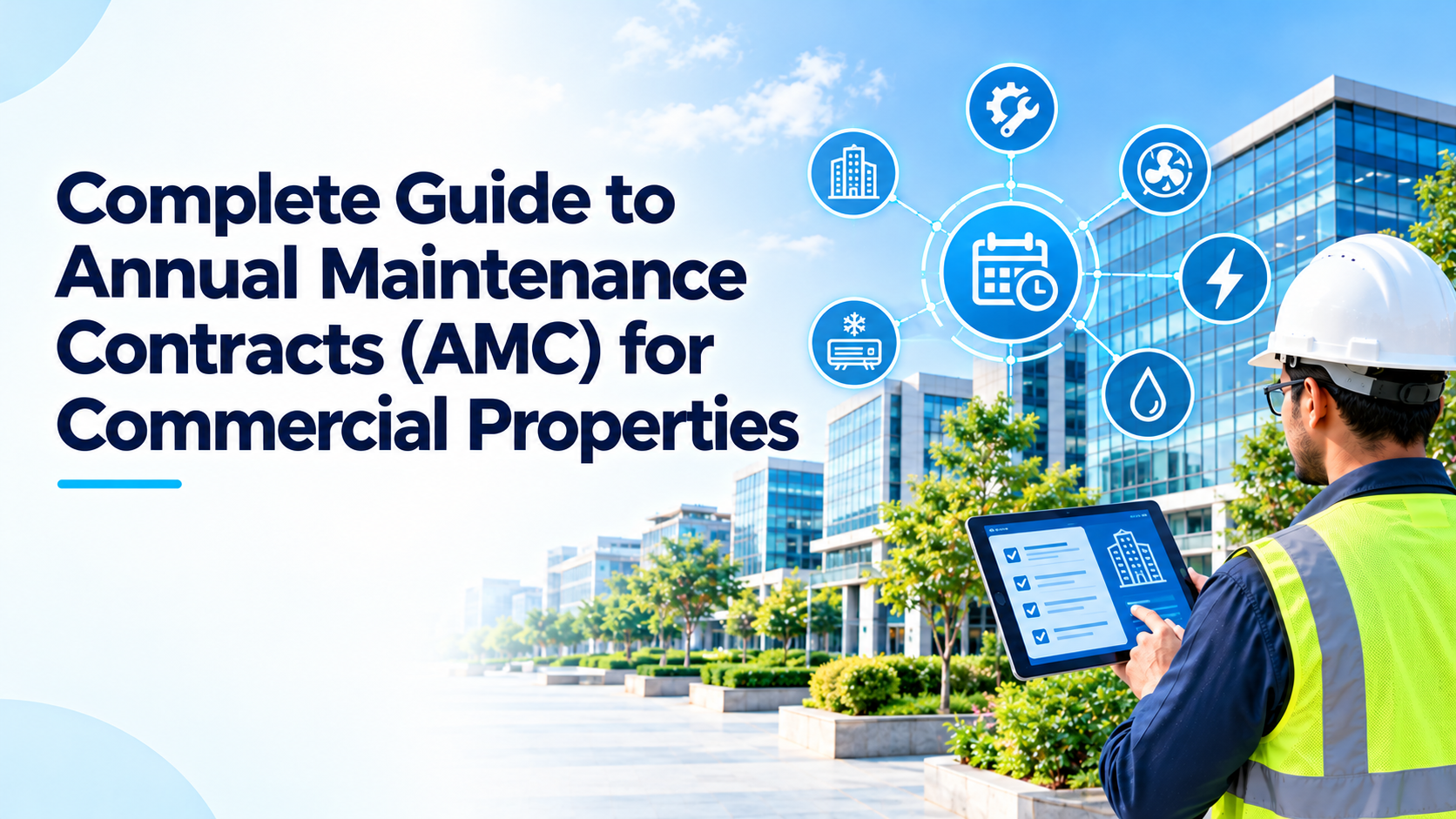
An Annual Maintenance Contract (AMC) is a yearly agreement between a commercial property owner and a service provider, where the provider handles scheduled inspections, preventive maintenance, and repairs for building systems at a fixed cost. For offices, malls, warehouses, hospitals, and factories, an AMC replaces unpredictable breakdown spending with planned upkeep that keeps equipment running and tenants comfortable.
This guide explains what an AMC covers, the main contract types, how pricing works, and how to choose the right provider for your building.
What Is an Annual Maintenance Contract (AMC)?
An AMC is a legally binding service agreement, usually valid for 12 months, in which a maintenance company commits to inspect, service, and repair specified equipment. The contract defines the scope of work, visit frequency, response times, exclusions, and fees.
Think of it as a health plan for your building. Instead of reacting when a chiller fails or a panel trips, a qualified team checks, cleans, and adjusts systems on a fixed schedule.
Why Do Commercial Properties Need an AMC?
Commercial buildings run on interconnected systems that work long hours every day. One failure can disrupt business, upset tenants, or create safety risks. An AMC helps in five ways:
Predictable costs: A fixed annual fee replaces surprise repair bills and emergency call-out charges.
Longer equipment life: Regular servicing reduces wear, so assets last longer and perform better.
Lower downtime: Preventive checks catch small faults before they become shutdowns.
Compliance and safety: Documented inspections support fire, electrical, and statutory safety requirements.
Energy efficiency: Well-tuned equipment uses less power, which reduces utility bills.
What Does a Commercial AMC Cover?
Scope varies by property type, but most commercial AMCs bundle the following systems.
System | Typical services |
|---|---|
Mechanical | HVAC servicing, chillers, pumps, air handling units, ventilation |
Electrical | Panel inspection, wiring checks, earthing tests, DG sets, UPS |
Plumbing | Pipe and valve checks, leak detection, water pumps, drainage |
Fire safety | Extinguisher refills, alarm testing, sprinkler checks |
Lifts | Scheduled servicing, safety checks, breakdown response |
Mechanical systems
Mechanical equipment is often the largest energy consumer in a commercial building. Reliable mechanical services under an AMC include scheduled servicing of HVAC units, chillers, pumps, and ventilation, along with filter changes, belt checks, and performance testing. Property managers who want one accountable team often prefer integrated mechanical solutions that combine inspection, repair, and spare parts management.
Electrical systems
Electrical faults are a common cause of unplanned outages and fire incidents in commercial buildings. Regular electrical maintenance covers panel and breaker inspection, earthing checks, and testing of DG sets and UPS systems. Pairing this with dependable electrical services for emergency repairs ensures that a fault at 2 a.m. does not turn into a week-long shutdown.
Comprehensive vs Non-Comprehensive AMC: Which Is Better?
A comprehensive AMC covers labor, spare parts, and consumables. A non-comprehensive AMC covers labor and routine servicing only, with parts billed separately.
Feature | Comprehensive | Non-comprehensive |
|---|---|---|
Labor | Included | Included |
Spare parts | Included as listed | Charged extra |
Cost pattern | Higher but predictable | Lower upfront, variable |
Best for | Critical or older equipment | New or warranty-covered assets |
Most commercial owners choose comprehensive cover for critical systems like HVAC and electrical, and non-comprehensive cover for lower-risk assets.
How Is AMC Pricing Decided?
AMC fees depend on several factors rather than a standard rate:
Property size and number of systems covered
Age and condition of the equipment
Contract type (comprehensive or non-comprehensive)
Visit frequency and response time commitments
Operating hours, such as 24×7 versus business hours
On-site staff versus visit-based support
Always request an itemised quote so you can compare providers on scope, not just price.
How to Choose the Right AMC Provider
Check experience with commercial properties similar to yours.
Verify certified technicians and in-house capability across mechanical and electrical work.
Ask for response and resolution times in writing.
Review reporting, including service logs, checklists, and maintenance dashboards.
Request client references and, if possible, visit an existing site.
Confirm spare part availability and the escalation process.
What Should an AMC Document Include?
A strong contract leaves little room for disputes. Make sure it clearly states:
Equipment list with make, model, and location
Visit schedule and scope of work per visit
Response and resolution timelines (SLA)
Inclusions and exclusions, especially spare parts
Penalty and termination clauses
Payment terms and renewal conditions
Common AMC Mistakes to Avoid
Choosing the lowest quote without comparing scope
Leaving equipment off the asset list
Ignoring exclusions such as consumables and damage from misuse
Skipping performance reviews during the year
Letting the contract lapse before renewal
Key Takeaways
An AMC is a fixed-cost yearly contract for preventive maintenance and repairs.
Comprehensive plans suit critical systems, while non-comprehensive plans suit low-risk assets.
Clear scope, SLAs, and exclusions matter more than the lowest price.
One provider handling mechanical and electrical work simplifies accountability.
Frequently Asked Questions
What is an AMC in facility management?
An AMC is a yearly contract in which a service provider performs scheduled maintenance and repairs on a property’s equipment and systems for a fixed fee.
How long does a typical AMC last?
Most AMCs run for 12 months with renewal options. Some providers also offer multi-year contracts at negotiated rates.
Is an AMC worth it for a small commercial property?
Yes. Even small properties depend on HVAC, electrical, and plumbing systems, and planned servicing is usually cheaper than repeated emergency repairs.
What is the difference between AMC and CAMC?
An AMC usually covers labor and servicing, while a comprehensive AMC (CAMC) also covers spare parts and consumables.
Can an AMC be customised?
Yes. Scope, visit frequency, and response times can be tailored to your property type, equipment, and operating hours.
Conclusion:
A well-structured AMC protects your building, your tenants, and your budget. Define the scope clearly, insist on measurable service levels, and choose a provider that can manage mechanical and electrical systems with equal competence.