
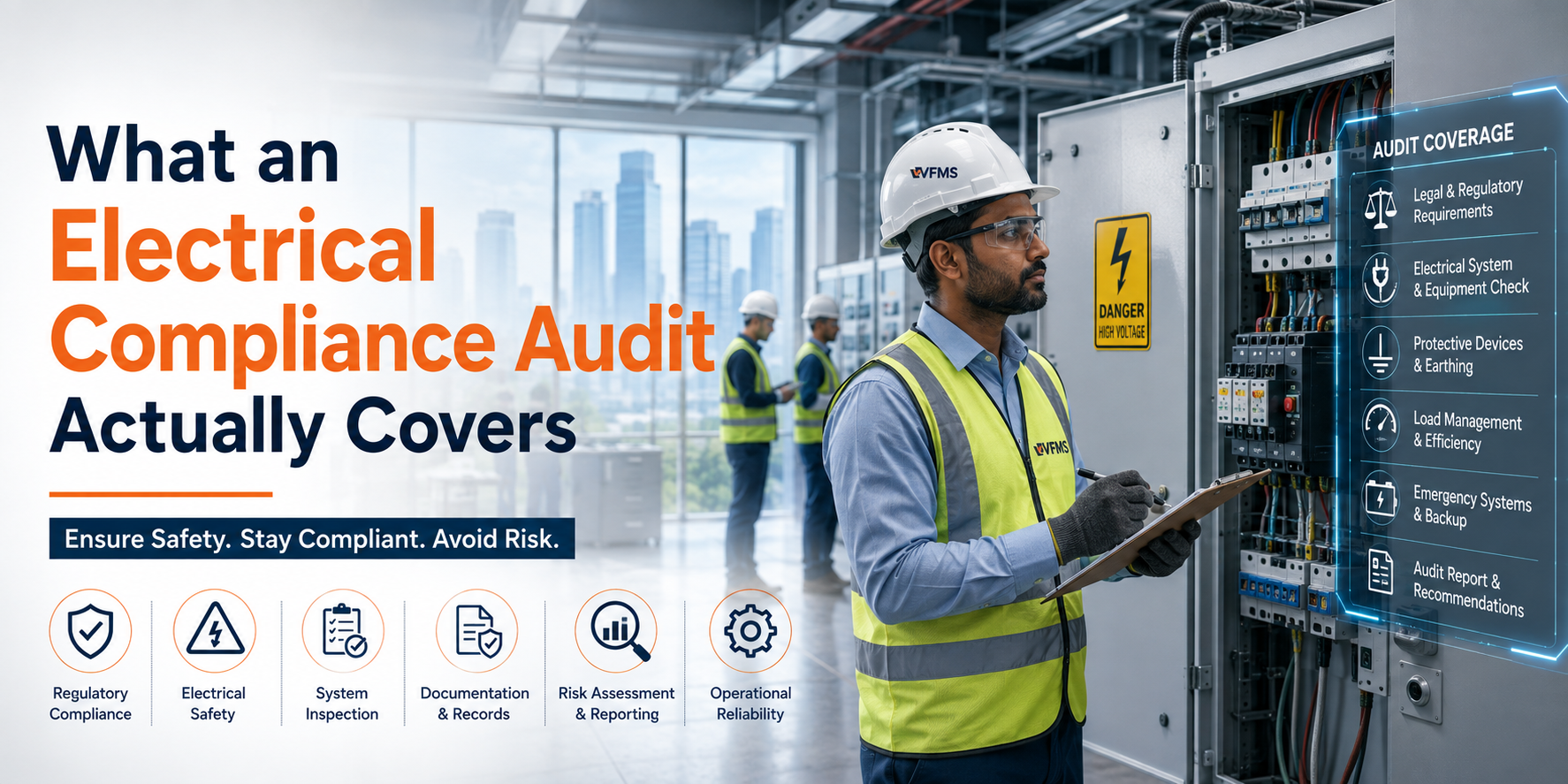
What an Electrical Compliance Audit Actually Covers
A manufacturing unit passes its fire safety inspection every year, yet nobody has checked whether its earthing resistance still meets the standard because that was never part of the audit scope. A corporate office assumes its electrical systems are “safe” because nothing has failed recently — but safety and compliance are checked very differently, and confusing the two is where most Indian businesses go wrong.
An electrical compliance audit is not the same thing as a general electrical risk assessment, and treating them as interchangeable is how gaps get missed. This guide breaks down exactly what a compliance audit checks, how it differs from a risk assessment, which regulations it verifies against, and what to expect when you bring in a professional electrician or provider to conduct one.
What Is an Electrical Compliance Audit?
An electrical compliance audit is a structured verification that a building’s electrical installation, documentation, and operating practices meet the specific requirements set out in applicable Indian electrical regulations and standards. It checks against defined, written requirements — not general judgment calls about what “looks risky.”
The output of a compliance audit is typically a checklist-style report: each requirement is marked as met, not met, or not applicable, often with reference to the specific regulation or standard clause it was checked against.
Compliance Audit vs Risk Assessment: The Difference That Actually Matters
These two exercises are often bundled together in sales conversations, but they answer different questions and produce different outputs.
Compliance Audit | Risk Assessment | |
Core question | Does this installation meet the specific written requirements of applicable regulations and standards? | What could go wrong here, and how severe or likely is it? |
Basis | Defined regulatory clauses and standards (CEA Regulations, BIS/IS codes, NBC provisions) | Engineering judgment, site conditions, usage patterns, incident history |
Output | Compliant / non-compliant findings mapped to specific clauses | Risk ratings (e.g., high/medium/low) and prioritised recommendations |
Scope boundary | Fixed — limited to what the regulation or standard actually requires | Flexible — can extend to operational, design, or usage-pattern risks not covered by any regulation |
Typical trigger | Statutory requirement, insurance requirement, lease/tenancy condition, periodic schedule | Post-incident review, expansion/renovation planning, insurance underwriting, internal safety initiative |
A building can pass a compliance audit and still carry real risk — for example, meeting minimum earthing standards while having aging cabling that a risk assessment would flag for replacement planning. Conversely, a risk assessment can surface issues that aren’t strictly non-compliant but are still worth addressing. Businesses that only run one of these two exercises are working with an incomplete picture, and it’s worth being explicit with your provider about which one you’re actually commissioning.
What a Compliance Audit Actually Checks
1. Regulatory and Documentation Review
Before any physical inspection, an audit typically starts with paperwork:
- Existing electrical installation drawings and single-line diagrams
- Previous test certificates and inspection records
- AMC (Annual Maintenance Contract) records and maintenance logs
- Load sanction documents from the electricity distribution company
- Any prior inspection reports from the state Electrical Inspectorate, where applicable
Missing or outdated documentation is itself a common audit finding — a building can have well-maintained equipment but still fail on record-keeping requirements.
2. Wiring and Installation Verification
This checks the physical installation against the Bureau of Indian Standards’ IS 732:2019 (Code of Practice for Electrical Wiring Installations), which sets out requirements for circuit design, conductor sizing, protection devices, and general wiring practice. Auditors typically verify:
- Conductor sizing and cable condition relative to load
- Circuit protection devices (MCBs, RCCBs/ELCBs, fuses) and their ratings
- Distribution board layout, labeling, and accessibility
- Segregation of circuits and appropriate use of ISI-marked components
3. Earthing System Checks
Earthing is verified against IS 3043:2018 (Code of Practice for Earthing). This typically includes:
- Earth electrode resistance measurement
- Earthing continuity across the installation
- Neutral and equipment earthing verification, particularly for three-phase systems
Earthing faults are among the most common findings in Indian commercial and industrial audits, largely because earth resistance can degrade over time due to soil conditions and isn’t always visible during routine daily maintenance.
4. Safety Measures Under the CEA Regulations
Statutory safety requirements are checked against the Central Electricity Authority (Measures Relating to Safety and Electric Supply) Regulations, 2023, which supersede the earlier 2010 regulations and set out safety requirements for the construction, installation, protection, operation, and maintenance of electrical installations in India. Depending on the size and voltage class of the installation, this can include:
- Designation of a qualified person responsible for electrical safety at the site
- Periodic testing requirements for installations above defined thresholds
- General safety provisions for low- and high-voltage apparatus
- Recordkeeping obligations tied to inspections and tests
The specific obligations that apply depend on the installation’s voltage level, connected load, and building height, so this part of an audit needs to be scoped against the CEA Regulations’ actual applicability criteria rather than assumed to apply uniformly.
5. Fire Safety Interface
Electrical systems intersect with fire safety requirements under the National Building Code of India (NBC), which addresses electrical installation requirements as part of overall building fire safety — including wiring practices, equipment placement in fire-sensitive areas, and coordination with fire detection and suppression systems. An audit typically checks whether electrical installations near fire-rated zones, escape routes, and equipment rooms follow the applicable NBC provisions alongside IS 732.
6. Load and Capacity Verification
Auditors check whether actual electrical load aligns with the sanctioned load from the distribution utility, and whether distribution boards, transformers, and DG sets are operating within rated capacity. Overloading is a common finding in businesses that have added equipment or expanded operations without revisiting their original electrical sanction.
7. Testing and Certification Status
A compliance audit confirms whether required periodic tests have actually been carried out and documented — not just whether equipment appears functional. This includes insulation resistance testing, earth continuity testing, and functional testing of protective devices, generally aligned with the testing provisions referenced in IS 732.
What a Compliance Audit Typically Does Not Cover
To keep scope expectations clear, a compliance audit generally does not include:
- Predictive assessment of future equipment failure (that’s closer to a risk assessment or condition-based maintenance review)
- Energy efficiency or cost-optimisation recommendations
- Design-stage evaluation for planned renovations or expansions
- Non-electrical fire safety systems (sprinklers, extinguishers) unless directly interfacing with electrical equipment
If you need any of the above, it’s worth explicitly requesting a risk assessment or a broader technical audit alongside the compliance check, rather than assuming one covers the other.
Who Needs an Electrical Compliance Audit
- Industrial and manufacturing facilities, where load levels and installation complexity typically fall within CEA Regulation thresholds requiring periodic testing
- Commercial buildings and office campuses, particularly ahead of lease renewals, insurance renewals, or fit-out changes
- Retail chains and warehousing operations, where multi-site consistency matters and gaps at one location can expose the whole business
- Any building changing electrical load, such as new equipment installation, added floors, or expanded operations
For example, a warehouse that has added automated conveyor systems since its last audit may now be operating closer to — or beyond — its originally sanctioned load, which a compliance audit would specifically flag against utility sanction documents.
How the Audit Process Typically Works
- Documentation review — collecting drawings, prior certificates, and maintenance records
- Site walkthrough — physical inspection of distribution boards, wiring, earthing points, and protective devices
- Testing — insulation resistance, earth resistance, and functional checks on protective devices
- Findings report — each item marked against the relevant regulation or standard, with clear compliant/non-compliant status
- Remediation plan — prioritised list of corrective actions, generally distinguishing statutory requirements from best-practice recommendations
A good electrical services provider will separate these two categories clearly in the final report, so you know what’s a legal requirement versus what’s a recommended improvement.
Choosing Who Conducts Your Audit
Not every electrician is positioned to conduct a compliance audit — it requires familiarity with the specific regulatory clauses being verified against, not just general electrical maintenance skill. When evaluating a provider, ask about:
- Experience specifically with compliance audits, not just installation or repair work
- Familiarity with the current CEA 2023 Regulations (not the outdated 2010 version some providers still reference)
- Whether findings are documented against specific standard/regulation clauses or given as general commentary
- Whether the provider offers ongoing electrical maintenance support to close identified gaps, not just the audit itself
Technical note: Electrical regulations, standards, and their applicability thresholds can be revised, and specific obligations vary by installation size, voltage class, and location. This guide provides a general overview for planning purposes — always confirm current requirements and specific applicability with a qualified electrical engineer or your local Electrical Inspectorate before acting on audit findings.
Frequently Asked Questions
Is an electrical compliance audit legally mandatory in India? Requirements vary by installation type, voltage level, and connected load under the CEA (Measures Relating to Safety and Electric Supply) Regulations, 2023. Larger or higher-voltage installations are more likely to fall under mandatory periodic testing requirements. It’s best to confirm applicability for your specific site with a qualified electrical consultation rather than assuming a blanket rule.
How often should a compliance audit be done? This depends on the applicable regulation and the installation’s classification — some installations fall under annual testing requirements under the CEA Regulations, while others follow AMC-linked schedules. A qualified provider can confirm the correct interval for your specific site.
What’s the difference between an electrical audit and an electrical safety audit? In practice, these terms are often used interchangeably, which confuses. When commissioning one, ask specifically whether the scope is a compliance check against named regulations/standards, a broader risk assessment, or both — the terminology alone doesn’t guarantee scope.
Does passing a fire safety inspection mean the electrical system is compliant? Not necessarily. Fire safety inspections check specific fire-related provisions, some of which intersect with electrical systems under the National Building Code, but a full electrical compliance audit covers a broader set of requirements, including earthing, wiring standards, and CEA safety provisions that a fire inspection alone won’t verify.
Who is authorised to conduct an electrical compliance audit? This depends on the scope and the applicable regulation — some testing and certification requirements under the CEA Regulations specify qualification criteria for the person conducting inspections. Confirm the specific qualification requirement for your installation type before commissioning an audit.
What happens if an audit finds non-compliance? The audit report should separate statutory non-compliance (requiring correction to meet legal requirements) from best-practice recommendations. Statutory findings typically need remediation on a defined timeline; your provider should help prioritise based on severity and regulatory obligation.
A compliance audit tells you whether your electrical installation meets defined regulatory and standard requirements — it doesn’t automatically tell you everything that could go wrong operationally. Knowing which one you’re commissioning, and why, is the difference between an audit that protects your business and one that just produces a report nobody acts on.
Before your next audit, confirm with your provider exactly which regulations and standards the check will be verified against, and whether you also need a separate risk assessment to cover what a compliance audit doesn’t.