
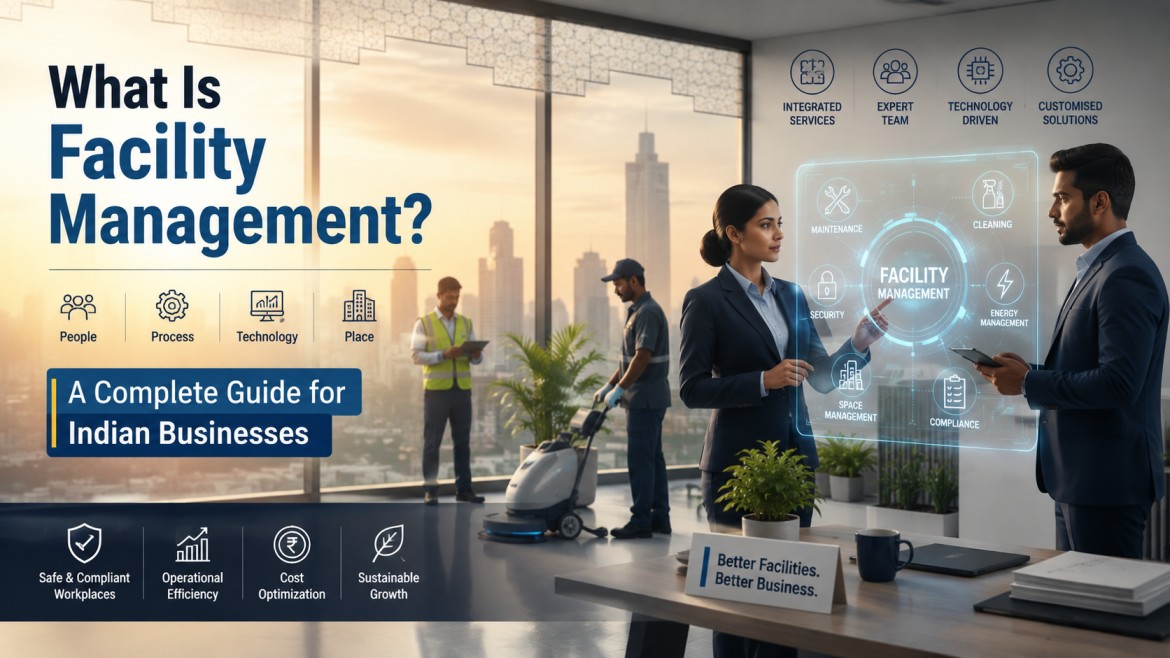
What Is Facility Management? A Complete Guide for Indian Businesses
A manufacturing unit in Pune loses two production hours because the HVAC system in the QC lab fails and nobody has an AMC contact on hand. A 40-seat office in Gurugram is paying three separate vendors for housekeeping, security, and pantry services, and none of them talk to each other. A retail chain with stores across five cities has no single view of which outlets are compliant with fire safety norms.
These aren’t edge cases. They are the daily reality for thousands of Indian businesses that treat building operations as an afterthought rather than a managed function. That gap is exactly what facility management exists to close.
This guide breaks down what facility management actually covers, how it works in the Indian context, and how to decide whether — and how — your business should outsource it.
What Is Facility Management?
Facility management is the coordinated management of a building’s people, processes, and physical assets to keep operations safe, efficient, and compliant. It covers everything that keeps a workplace running: electrical and mechanical systems, housekeeping, security, landscaping, plumbing, waste handling, and statutory compliance.
In practice, it sits at the intersection of three things:
- Hard services — the physical and technical upkeep of a building (electrical, mechanical, plumbing, HVAC, fire safety)
- Soft services — the day-to-day experience of the space (housekeeping, security, pantry, horticulture, pest control)
- Compliance and administration — statutory licenses, audits, vendor management, and documentation
A good facility management company in India brings all three under one accountable structure, instead of leaving a business to coordinate a dozen disconnected vendors on its own.
Why This Matters More for Indian Businesses Specifically
Facility management in India isn’t a copy-paste of Western FM models. A few local realities shape how it needs to work:
- Fragmented regulation. Fire NOCs, pollution control clearances, labour compliance, and municipal licenses vary by state and city, and lapses can shut down operations overnight.
- Multi-site sprawl. A D2C brand with a warehouse in Bhiwandi, an office in Mumbai, and a retail counter in Bengaluru needs consistent service standards across very different local vendor markets.
- Labour-intensive service delivery. Unlike fully automated Western facilities, most Indian buildings still depend heavily on trained on-ground staff for housekeeping, security, and maintenance — which makes workforce management and supervision central to service quality.
- Cost sensitivity alongside rising expectations. Businesses want enterprise-grade reliability but at costs that work for Indian real estate economics, especially in commercial and industrial segments.
This is why facility management in India functions less like a maintenance contract and more like an operational partnership.
Facility Management Service Taxonomy
Before comparing providers or scoping a contract, it helps to see the full landscape of what falls under facility management. Here’s how the function typically breaks down:
Category | What It Covers | Examples |
Hard Services (Technical/MEP) | Physical infrastructure and engineering systems | Electrical maintenance, mechanical (HVAC, DG sets), plumbing, fire and life safety systems |
Soft Services | People-facing, day-to-day operational services | Housekeeping, security, horticulture and landscaping, pest control, pantry/cafeteria |
Support Services | Administrative and specialist add-ons | Waste management, vendor coordination, mailroom, space planning |
Compliance & Statutory | Regulatory upkeep | Fire NOC renewals, PCB clearances, labour law compliance, audit documentation |
Strategic/Consulting | Advisory-level FM | Energy audits, sustainability planning, facility budgeting, technology integration |
Most businesses only need a subset of this taxonomy at first — usually hard and soft services — but understanding the full scope helps when scaling to integrated facilities management services later.
Types of Facility Management
1. Hard Facility Management
Hard FM deals with the physical, technical backbone of a building — the systems that, if they fail, stop operations entirely.
- Electrical maintenance: wiring, panels, DG sets, UPS systems, load management
- Mechanical services: HVAC, ventilation, water pumping systems
- Plumbing: water supply, drainage, sanitation infrastructure
- Fire and life safety: fire extinguishers, alarm systems, sprinkler maintenance, evacuation readiness
A textile export unit in Surat, for example, cannot afford unplanned downtime on its HVAC-dependent dyeing floor. Preventive electrical and mechanical maintenance directly protects production continuity.
2. Soft Facility Management
Soft FM covers services that shape the daily experience of a space, even though they don’t carry the same operational risk as hard FM.
- Housekeeping and sanitation
- Security and access control
- Horticulture and landscaping
- Pest control
- Pantry and cafeteria services
For a corporate office in a business park, soft services are often what employees and visitors notice first — and what quietly signals whether a company runs a tight operation or a sloppy one.
3. Integrated Facility Management (IFM)
Integrated facility management brings hard services, soft services, and compliance under a single provider and a single point of accountability, instead of managing five or six separate vendor relationships.
For a business running multiple sites — say, three warehouses and two corporate offices — IFM means one contract, one SLA structure, one escalation matrix, and consistent standards across locations. This is typically where the real cost and time savings show up, and it’s why more mid-sized and large Indian businesses are consolidating toward integrated facilities management services rather than piecing together single-service vendors.
Core Facility Management Services
Here’s a closer look at the individual services that make up most FM contracts in India:
Housekeeping: Daily cleaning, sanitation, washroom hygiene, and specialized deep-cleaning for commercial, industrial, and retail spaces.
Horticulture and Landscaping: Garden and green-cover maintenance for corporate campuses, residential complexes, and hospitality properties — increasingly tied to sustainability and ESG reporting.
Mechanical (HVAC and MEP): Preventive and breakdown maintenance for HVAC systems, DG sets, and mechanical equipment that keeps a facility operational.
Plumbing: Water supply systems, drainage maintenance, leak detection, and sanitation infrastructure upkeep.
Electrical Panel maintenance, load balancing, wiring safety checks, and emergency electrical response.
Security Services: Manned guarding, access control, CCTV monitoring, and visitor management — critical for warehouses, retail, and corporate campuses alike.
Pest Control: Scheduled treatments are essential for food-handling businesses, hospitality, and warehousing (often a statutory requirement, not just a preference).
Waste Management: Segregation, disposal, and compliance with municipal solid waste and hazardous waste norms.
Each of these can be contracted individually, but businesses managing more than one site usually find it more efficient to bundle them under a single facility management services agreement.
Benefits of Professional Facility Management
Operational continuity: Preventive maintenance schedules reduce the chance of a critical system failing during business hours — the difference between a planned maintenance window and an unplanned production stoppage.
Cost predictability: A structured FM contract converts unpredictable repair costs into a known monthly or annual spend, which is easier to budget against than reactive emergency repairs.
Regulatory compliance: Fire safety, pollution control, and labour compliance requirements are tracked and renewed on schedule, reducing legal and safety exposure.
Consistent service standards: A single provider managing multiple sites means the same quality benchmark applies whether it’s a Mumbai office or a Chennai warehouse.
Time saved for core business: Business owners and facility heads stop spending hours coordinating electricians, housekeeping staff, and security vendors separately, and can focus on running the business.
Better vendor accountability: One SLA, one point of contact, and clear escalation paths — instead of chasing five different vendors when something goes wrong.
Applications Across Indian Business Sectors
Facility management needs differ significantly by industry. Here’s how it typically plays out:
Sector | Primary FM Needs | Why It Matters |
Corporate offices | Housekeeping, security, HVAC, pantry | Employee experience and productivity |
Manufacturing/Industrial | Electrical, mechanical, plumbing, safety compliance | Production continuity and worker safety |
Retail chains | Housekeeping, security, multi-site consistency | Brand experience across locations |
Warehousing/Logistics | Security, pest control, electrical, waste management | Inventory protection and regulatory compliance |
Hospitality | Housekeeping, horticulture, HVAC, pest control | Guest experience and health standards |
Residential complexes | Security, housekeeping, horticulture, plumbing | Resident safety and property value |
A D2C brand’s fulfillment warehouse, for instance, has very different FM priorities (security, pest control, electrical load management) compared to its Mumbai head office (housekeeping, HVAC comfort, pantry services) — but both fall under the same FM umbrella.
In-House vs. Outsourced Facility Management
Most Indian businesses eventually face this decision. Here’s how the two approaches compare:
Factor | In-House FM | Outsourced FM |
Cost structure | Fixed salaries, benefits, training overhead | Variable/contracted cost, often lower total cost |
Expertise | Limited to what internal team knows | Access to specialized technical and compliance expertise |
Compliance tracking | Falls on internal admin/HR team | Managed by provider as part of SLA |
Scalability | Hard to scale quickly across new sites | Easier to extend to new locations |
Accountability | Direct control, but also direct liability | SLA-backed accountability with a single point of contact |
Best suited for | Very large single-site operations with dedicated FM budgets | Multi-site businesses, growing companies, cost-conscious operations |
For a single-location business with a stable footprint, in-house management can work fine. For most growing or multi-site Indian businesses, outsourcing to a specialized facility management company in India tends to be more cost-effective and lower-risk.
How to Choose a Facility Management Company in India
Not all providers offer the same depth of service. Here’s what to actually evaluate:
1. Service Range and Integration
Does the provider offer true integrated services (hard + soft + compliance), or are they primarily a single-service vendor (e.g., only housekeeping)? A narrow provider means you’re still juggling multiple contracts.
2. Multi-Site Capability
If you operate across cities, confirm the provider has genuine on-ground capability in each location — not just a head-office sales team promising coverage.
3. Compliance Track Record
Ask specifically how they handle fire NOC renewals, PCB clearances, and labour law documentation. This is where gaps cause the most legal exposure.
4. SLA Clarity
A credible provider will define response times, escalation matrices, and penalty clauses in writing — not just verbally promise “quick turnaround.”
5. Workforce Quality and Supervision
Since Indian FM is labour-intensive, ask about staff training, supervisor-to-staff ratios, and background verification processes.
6. References and Vertical Experience
A provider experienced in your specific sector (industrial vs. corporate vs. retail) will anticipate issues that a generalist vendor might miss.
7. Transparent Pricing
Understand what’s included in the base contract versus what’s billed as an add-on, so there are no surprises at renewal.
Choosing the right partner among the many facility management solutions available in the Indian market comes down to matching provider capability to your actual site complexity — not just picking the lowest quote.
Common Mistakes Businesses Make with Facility Management
- Treating FM as a cost to minimize rather than a function that protects operations and compliance
- Signing contracts without clear SLAs, then having no recourse when service quality drops
- Splitting services across too many vendors, creating coordination overhead and accountability gaps
- Ignoring compliance documentation until a license lapse forces a shutdown or penalty
- Not reviewing FM performance regularly, assuming a signed contract means the work happens automatically
Frequently Asked Questions
What is the main role of facility management? Facility management ensures a building’s physical systems, services, and compliance requirements are managed proactively, so operations run safely and without disruption.
What is the difference between facility management and property management? Property management typically focuses on leasing, tenant relations, and rent collection. Facility management focuses on the day-to-day operational upkeep — maintenance, safety, housekeeping, and compliance — of the space itself.
Is facility management the same as maintenance? No. Maintenance is one component of facility management. FM also includes compliance, vendor coordination, soft services like housekeeping and security, and strategic planning around space and cost.
How much does facility management cost in India? Costs vary widely based on site size, service scope (hard services only vs. fully integrated), location, and staffing intensity. Most providers price based on site square footage, headcount required, and service frequency, so it’s best to get a scoped quote rather than rely on industry averages.
Should a small business outsource facility management? For a single small office, basic in-house arrangements (a housekeeping vendor, an AMC for electrical/HVAC) may suffice. As a business adds sites or scales headcount, outsourcing to an integrated provider generally becomes more cost-effective than managing multiple vendor relationships internally.
What industries need facility management the most in India? Manufacturing, warehousing/logistics, corporate offices, retail chains, and hospitality have the highest FM dependency, since operational continuity, safety compliance, and multi-site consistency are all central to how these businesses run.
What should be included in a facility management contract? A solid contract should specify the exact scope of services, response time SLAs, escalation procedures, staffing details, compliance responsibilities, and pricing structure — including what counts as an add-on versus what’s covered in the base fee.
Facility management isn’t a back-office line item — it’s the operational layer that determines whether a business runs smoothly or constantly firefights. For Indian businesses navigating fragmented compliance requirements, multi-site operations, and labour-intensive service delivery, getting FM right means fewer disruptions, predictable costs, and a workplace that actually supports the business instead of quietly working against it.
Whether you’re evaluating your first outsourced housekeeping vendor or consolidating a multi-site portfolio under one integrated provider, the right starting point is the same: map out your actual service needs against the taxonomy above, and choose a partner whose capability matches your site complexity — not just their sales pitch.