
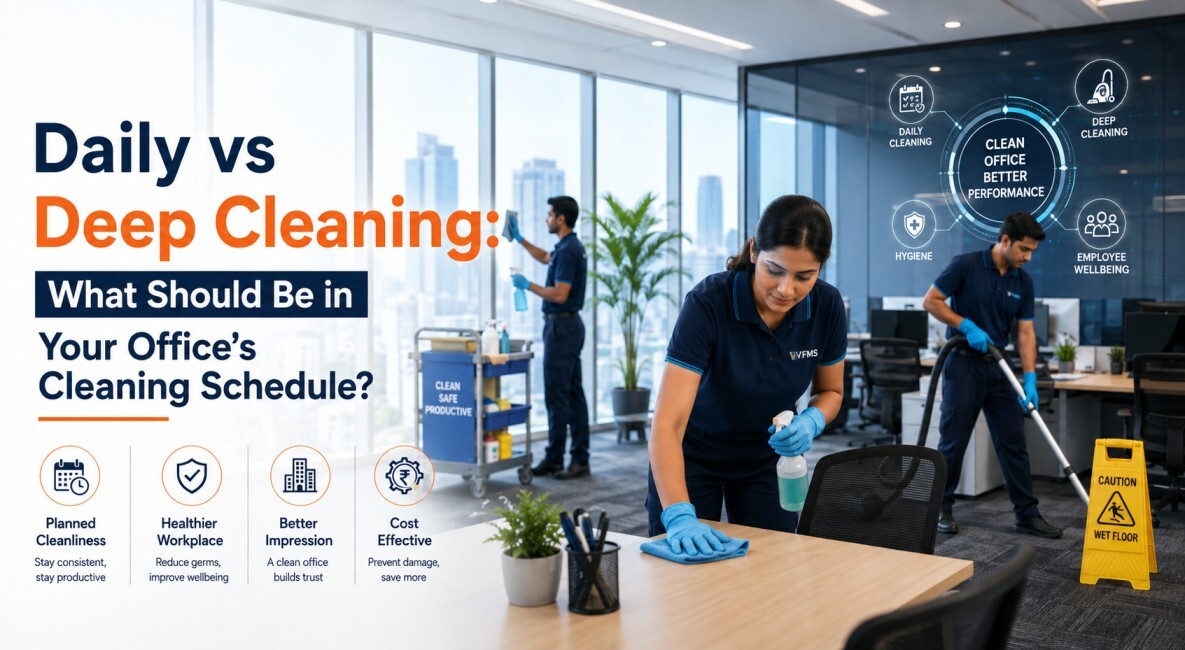
Daily vs Deep Cleaning: What Should Be in Your Office's Cleaning Schedule?
A washroom that gets wiped down every hour can still fail a hygiene audit if the grout hasn’t been scrubbed in three months. A lobby that looks spotless every morning can still have HVAC vents caked in dust that nobody’s checked since the office opened. This is the gap most offices miss when they rely on generic house cleaning services without a clear schedule — daily cleaning keeps a space looking clean; deep cleaning keeps it actually clean, safe, and compliant.
The confusion between the two is the most common reason office cleaning schedules fail. Either everything gets treated as a daily task (expensive and unnecessary), or deep cleaning gets skipped entirely until something visibly breaks down (dirty grout, musty carpets, a pest complaint). Neither is a real schedule — it’s guesswork.
This guide lays out exactly what belongs in daily cleaning versus deep cleaning, gives you a frequency matrix by area and risk level, and includes a downloadable checklist you can hand to your housekeeping team today.
Daily Cleaning vs Deep Cleaning: The Core Difference
Daily cleaning maintains visible hygiene and order — the tasks that need to happen every single working day to keep a space usable and presentable.
Deep cleaning addresses what daily cleaning can’t reach — the buildup that accumulates under desks, inside grout lines, behind equipment, and within HVAC systems. It’s scheduled, not reactive, and it’s what actually protects indoor air quality, surface longevity, and hygiene compliance.
Daily Cleaning | Deep Cleaning | |
Purpose | Maintain daily hygiene and appearance | Remove accumulated dirt, allergens, and buildup |
Frequency | Every working day (sometimes multiple times) | Weekly to monthly, depending on area |
Typical tasks | Sweeping, mopping, desk wiping, bin emptying | Carpet extraction, grout scrubbing, upholstery cleaning, vent dusting |
Who usually does it | On-site housekeeping staff | Specialised deep-cleaning teams or scheduled contractor visits |
Impact if skipped | Visible dirt, clutter, unpleasant odour | Hidden hygiene risk, allergen buildup, faster wear on assets |
Most offices in India rely on a housekeeping services provider for the daily layer and either forget or under-budget for the deep cleaning layer — which is where problems quietly build up.
Why a Structured Schedule Matters More Than “Cleaning More”
Adding more daily cleaning hours doesn’t fix a deep-cleaning gap, and running deep cleans too often wastes budget on areas that don’t need it. A good schedule matches frequency to two things:
- Footfall — how many people use or pass through an area each day
- Risk level — how much a lapse in hygiene there could actually cost you (health risk, compliance exposure, asset damage)
A server room, for instance, has almost no footfall but a high risk level — dust here damages equipment, so it needs specialised, careful deep cleaning even though almost nobody walks through it daily. A washroom has both high footfall and high risk, so it needs the most intensive schedule of all. This is the logic behind the frequency matrix below.
Cleaning Frequency Matrix: By Area, Footfall & Risk Level.
This matrix isn’t one-size-fits-all — a 20-person office and a 500-person campus will scale frequencies differently — but it gives you the right starting logic: match effort to how many people use the space and how much a lapse there would actually cost.
What Should Be in Your Daily Cleaning Checklist
Daily cleaning should focus on tasks that directly affect how usable and hygienic a space feels within a single working day:
- Sweeping and mopping high-traffic floors (entrance, corridors, pantry)
- Wiping desks, tables, and shared surfaces
- Emptying and replacing waste bins
- Cleaning and restocking washrooms — multiple rounds through the day, not once
- Sanitising frequently touched surfaces: door handles, switches, lift buttons
- Spot-cleaning glass doors and reception areas
- Basic litter removal from parking and outdoor areas
If your team is only getting through half of this list consistently, that’s usually a staffing or supervision problem, not a scheduling one — and it’s worth flagging with your provider before adding deep-cleaning tasks on top.
What Should Be in Your Weekly and Monthly Deep Cleaning Checklist
Deep cleaning tasks are less visible day-to-day but matter more for hygiene, air quality, and asset lifespan:
Weekly
- Under-desk and cable area cleaning at workstations
- Glass wall and whiteboard deep cleaning in meeting rooms
- Grout scrubbing and exhaust fan cleaning in washrooms
- Full carpet vacuuming
- HVAC vent grille dusting
Monthly
- Carpet shampoo or extraction cleaning
- Upholstery deep cleaning (reception, meeting rooms)
- Pantry exhaust chimney degreasing
- Floor polishing in lobby and common areas
- Full interior and exterior window cleaning
- Pest control treatment across all zones
- HVAC filter cleaning coordination with the mechanical/MEP team
Some of these — HVAC filters especially — sit at the boundary between housekeeping and mechanical maintenance, so it’s worth confirming with your facility management provider who owns each task before it falls through the cracks.
Sector-Specific Considerations
Not every office needs the same emphasis. A few adjustments worth making based on your business type:
- IT/corporate offices: prioritise workstation and server-room deep cleaning; carpet extraction matters more here than in open industrial spaces.
- Banks and financial institutions: frequently touched surfaces and secure zones need higher sanitisation frequency, along with strict access-controlled deep cleaning windows.
- Retail and hospitality: entrance, reception, and washroom standards directly affect customer perception — these should never slip to monthly-only deep cleaning.
- Manufacturing and warehousing: floor and parking area cleaning intersects with safety compliance (spill cleanup, oil stains), so this often needs a dedicated schedule separate from office-area cleaning.
In-House Team vs Professional Housekeeping Services
A small single-floor office can often manage daily cleaning with a couple of in-house staff. But deep cleaning — carpet extraction, grout treatment, exhaust degreasing — usually needs specialised equipment and trained crews that most in-house teams don’t have.
This is why many businesses split the model: keep daily upkeep in-house or with a basic vendor, and bring in professional house deep cleaning service support on a scheduled weekly or monthly basis. For multi-floor offices or facilities with high footfall, it’s usually more efficient to consolidate both under one house cleaning provider so daily and deep cleaning run on a single coordinated calendar instead of two disconnected schedules.
Building the Schedule: A Practical Starting Approach
- List every area in your office and tag it by footfall (high/medium/low) and risk level (high/medium/low) using the matrix above as a starting reference.
- Assign daily tasks to each high-footfall area first — these can’t slip without becoming visibly obvious.
- Slot deep-cleaning tasks into a weekly or monthly calendar, not an “as needed” list — undated tasks are the ones that get skipped.
- Name an owner for each task category, whether that’s an in-house supervisor or your outsourced provider’s site lead.
- Review monthly — footfall patterns change (a new hire, a client-facing event, monsoon season), and the schedule should flex with them.
To make this easier to put into practice, use the downloadable checklist below — it includes a ready-to-print daily task list and a separate weekly/monthly deep-cleaning tracker with status columns your team can fill in.
Download: Office Cleaning Schedule Checklist (Excel)
Frequently Asked Questions
How often should an office be deep cleaned? Most offices need weekly deep-cleaning tasks (carpet vacuuming, glass surfaces, grout scrubbing) and monthly intensive tasks (carpet shampoo, upholstery cleaning, exhaust degreasing). High-risk areas like washrooms and pantries may need deep attention more frequently.
What is the difference between house cleaning and housekeeping services? House cleaning typically refers to the physical cleaning tasks themselves — sweeping, mopping, sanitising. Housekeeping services is the broader function that includes cleaning plus supervision, staffing, scheduling, restocking, and quality control across a facility.
Can daily cleaning replace deep cleaning? No. Daily cleaning maintains surface-level hygiene but can’t remove buildup in carpets, grout, upholstery, or HVAC systems. Skipping deep cleaning leads to hidden hygiene and air quality issues even if the office looks clean day to day.
What areas need the most frequent cleaning in an office? Washrooms and pantries need the highest frequency due to combined high footfall and high hygiene risk, followed by entrances, reception areas, and frequently touched surfaces like door handles and lift buttons.
Should small offices bother with a formal cleaning schedule? Yes. Even a 10-15-person office benefits from separating daily and deep-cleaning tasks on a calendar — it prevents the common failure mode of daily cleaning being done consistently. In contrast, deep cleaning gets forgotten for months.
Do house cleaning services cover deep cleaning too? It depends on the provider. Some offer daily cleaning only, while full-service providers offer integrated home cleaning services or corporate housekeeping bundle daily upkeep and scheduled deep cleaning under one plan — which is usually more consistent than coordinating two separate vendors.
A clean-looking office and a genuinely hygienic office aren’t always the same thing. Daily cleaning handles what’s visible; deep cleaning handles what accumulates out of sight but still affects health, air quality, and asset life. The businesses that get this right aren’t necessarily spending more — they’re just matching cleaning frequency to actual footfall and risk, instead of treating every area the same way.
Use the frequency matrix and checklist in this guide as your starting template, adjust it to your office’s actual layout, and review it every few months as usage patterns shift.