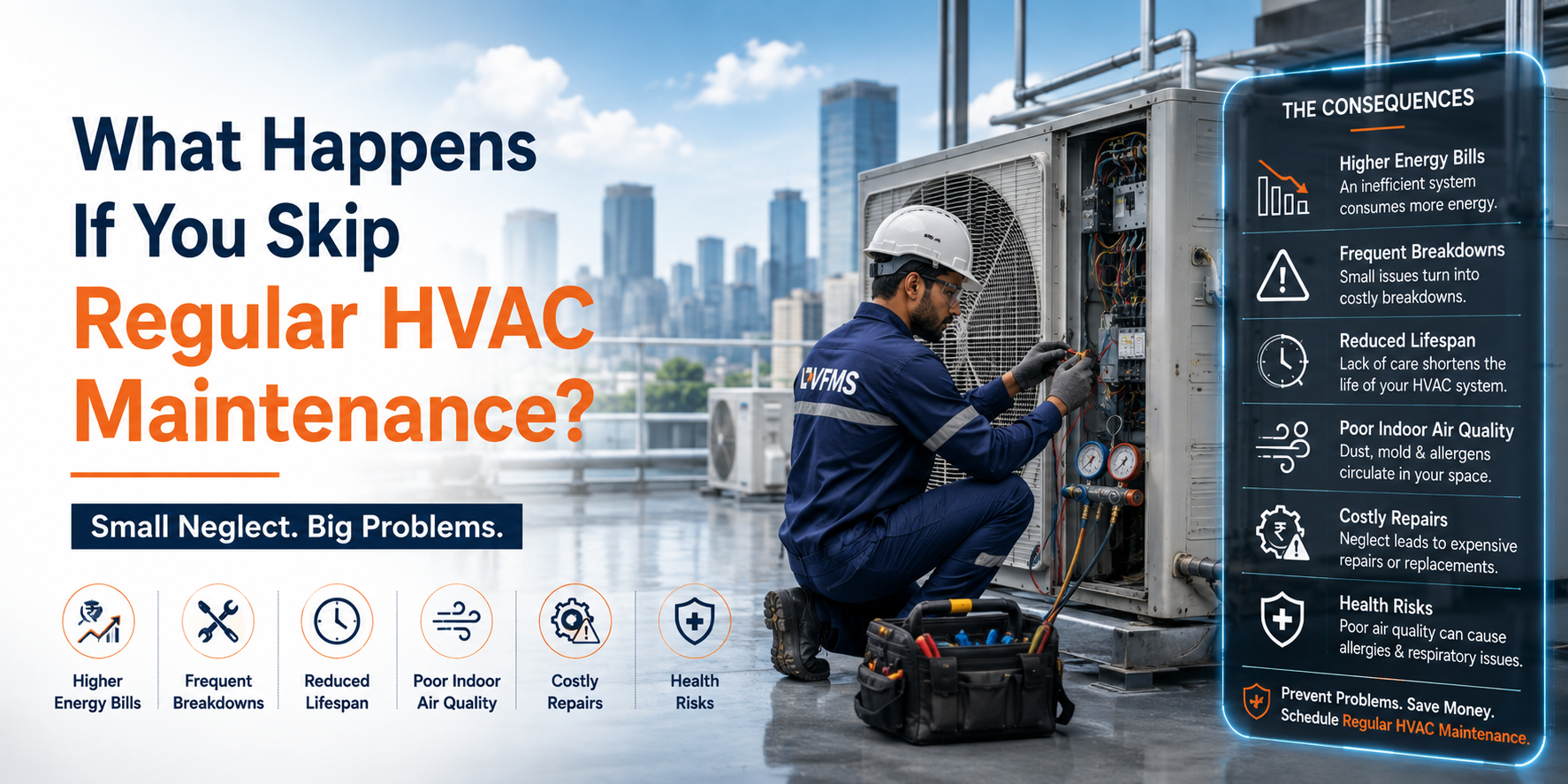
What Happens If You Skip Regular HVAC Maintenance?
A heating, ventilation, and air-conditioning system rarely fails without warning. In almost every case, it sends signals for weeks, sometimes months, before a breakdown finally forces a building offline. Skipping regular HVAC maintenance doesn’t just risk discomfort; it quietly drives up energy costs, shortens equipment life, and turns small, inexpensive repairs into major capital expenses. This is why building owners increasingly turn to structured mechanical solutions to keep systems running reliably. This guide walks through what actually happens when HVAC servicing is deferred, the warning signs to watch for, a preventive-maintenance checklist you can act on, and realistic examples of the downtime and cost impact of neglect.
Why HVAC Maintenance Gets Deferred in the First Place
In most commercial buildings, HVAC maintenance is postponed for the same handful of reasons: the system is still running, the budget is tight this quarter, or maintenance has been treated as an operational afterthought rather than a planned expense. The trouble is that an HVAC system that is technically running is not the same as one that is running efficiently or safely.
Compressors, coils, filters, ductwork, and control boards degrade gradually. By the time occupants notice uneven temperatures or a spike in the electricity bill, the underlying wear has usually been building for a long time. A qualified mechanical service company inspects these components on a schedule specifically so that gradual wear is caught before it becomes an emergency.
1. Energy Bills Climb Quietly, Then Sharply
A dirty coil, a clogged filter, or low refrigerant charge forces the compressor and fans to work harder to deliver the same amount of cooling or heating. This shows up first as a small, easy-to-miss increase in the utility bill — often 5 to 10 percent within the first few months of neglect.
Left unaddressed, that inefficiency compounds. Restricted airflow raises head pressure, increases motor strain, and can push energy consumption 20 to 30 percent above baseline within a year. For a mid-sized commercial building running rooftop units or a central plant, that translates into real money leaving the budget every single month without a single visible fault on the system.
2. Warranties and Insurance Cover Get Compromised
Most HVAC manufacturers require documented, scheduled servicing as a condition of warranty coverage. Skipping maintenance — or being unable to produce service records — is one of the most common reasons commercial warranty claims are denied.
Insurers reviewing property and business-interruption claims may ask the same question: was the equipment maintained according to manufacturer guidelines? Without that paper trail, a compressor failure that should have been a straightforward warranty repair can turn into a full out-of-pocket replacement.
3. Indoor Air Quality and Occupant Health Suffer
Filters, coils, and ductwork that aren’t cleaned on schedule become a breeding ground for dust, mould, and bacteria. Poor indoor air quality is linked to higher rates of headaches, fatigue, allergic reactions, and respiratory irritation among building occupants — issues that are easy to dismiss individually but add up in absenteeism and complaints.
In healthcare facilities, food processing units, laboratories, and data centres, air quality and humidity control are not optional extras — they are operational requirements. Deferred HVAC maintenance in these environments carries compliance risk on top of comfort risk.
4. Equipment Lifespan Shrinks Dramatically
A well-maintained commercial HVAC system typically delivers 15 to 20 years of reliable service. Systems that run on a reactive, fix-it-when-it-breaks basis often need major component replacement — or full system replacement — five to seven years earlier than that.
The mechanism is straightforward: minor issues like worn belts, slipping refrigerant charge, or dirty condenser coils force other components to compensate. That extra strain accelerates wear across the entire system, not just the neglected part.
5. Small Repairs Turn Into Major Capital Expenses
This is where the cost of skipping maintenance becomes most visible. A refrigerant leak caught early might cost a few thousand rupees to seal and recharge. Left unaddressed, low refrigerant causes the compressor to overheat and fail — and compressor replacement on a commercial unit is one of the most expensive single repairs in HVAC ownership.
Illustrative Cost Comparison
Issue | Cost If Caught Early | Cost If Ignored |
|---|---|---|
Dirty air filter | Filter replacement — low cost, routine | Reduced airflow, frozen coil, blower motor strain |
Minor refrigerant leak | Leak seal + recharge — moderate cost | Compressor burnout — major replacement cost |
Loose electrical connections | Tightening + inspection — low cost | Component failure, potential fire risk |
Clogged condensate drain | Drain flush — low cost | Water damage, mould growth, ceiling/floor repair |
Worn belts and bearings | Belt/bearing replacement — low cost | Motor seizure, unplanned system-wide shutdown |
6. Downtime Disrupts Operations — and Revenue
Unplanned HVAC downtime rarely happens at a convenient time. A rooftop unit failure during peak summer occupancy, or a chiller going down in a server room, can force partial or full closure until a technician arrives, diagnoses the fault, and sources replacement parts.
Realistic Downtime Scenarios
Scenario | Typical Cause | Realistic Downtime |
|---|---|---|
Retail store cooling failure in summer | Neglected coil cleaning, refrigerant loss | 1–3 days for diagnosis, parts, and repair |
Office building AHU breakdown | Deferred filter and belt servicing | 4–8 hours for emergency callout and fix |
Server room precision cooling failure | Missed inspection of backup/redundant unit | Minutes to hours before overheating risk begins |
Compressor burnout, full unit replacement | Ignored refrigerant and electrical warning signs | 1–2 weeks for sourcing, installation, commissioning |
Beyond the direct repair bill, downtime carries hidden costs: lost sales, idle staff, spoiled inventory in temperature-sensitive businesses, and emergency callout premiums that can run well above standard scheduled-service rates. Facilities that rely on professional mechanical services for planned upkeep largely avoid this category of cost altogether.
Warning Signs an HVAC System Is Overdue for Service
Most HVAC failures are preceded by observable symptoms. Recognising them early is one of the simplest ways to avoid the downtime and cost scenarios above.
- Uneven temperatures between rooms or floors served by the same system
- A gradual rise in energy bills with no change in usage patterns
- Unusual noises — grinding, squealing, rattling, or banging — from indoor or outdoor units
- Musty or burning smells coming from vents
- Weak or inconsistent airflow at diffusers and grilles
- Frequent short-cycling, where the system turns on and off more often than normal
- Visible ice or frost forming on refrigerant lines or coils
- Water pooling near indoor units or stains on ceiling tiles below ductwork
- Rising humidity indoors despite the system running
- Thermostat readings that don’t match how the space actually feels
Preventive Maintenance Checklist
Preventive maintenance doesn’t need to be complicated, but it does need to be consistent. The checklist below reflects the core tasks a professional mechanical service company typically covers across quarterly and annual visits for commercial HVAC systems.
Monthly Tasks
- Inspect and replace or clean air filters
- Check thermostat calibration and programmed schedules
- Visually inspect for leaks, corrosion, or unusual noise
Quarterly Tasks
- Clean condenser and evaporator coils
- Check refrigerant levels and pressures
- Inspect and tighten electrical connections and contactors
- Test condensate drain lines and pans for blockages
- Lubricate motors and check belt tension
- Inspect ductwork for leaks, damage, or insulation gaps
Annual Tasks
- Full system performance test against manufacturer specifications
- Inspect compressor, capacitors, and blower assembly in detail
- Verify control-panel and safety-cutout function
- Review indoor air quality metrics and ventilation rates
- Assess overall system efficiency and remaining service life
- Update maintenance and warranty documentation
Buildings with critical environments — hospitals, labs, data centres, cold storage — typically need a tighter cycle, with some checks performed weekly rather than monthly.
Why Professional Servicing Outperforms In-House Fixes
In-house teams can usually handle filter changes and basic housekeeping. Diagnosing refrigerant pressure issues, electrical faults, or control-board errors safely requires trained technicians, calibrated instruments, and manufacturer-specific knowledge.
Working with an established mechanical service company gives building owners access to documented service history, trained technicians, and the parts inventory needed to resolve issues on the first visit rather than after multiple callouts.
This is where the difference between reactive repairs and structured mechanical solutions becomes clear. A reactive approach treats each fault as an isolated event; a planned approach treats the HVAC system as a single set of interdependent components that need to be tracked over time.
For buildings managing multiple HVAC units across different floors or sites, professional mechanical services bring standardised checklists, consistent reporting, and predictable costs — replacing the unpredictability of emergency repairs with a maintenance calendar that’s planned well in advance.
Getting HVAC Maintenance Back on Track
Skipping HVAC maintenance rarely produces an immediate, dramatic failure. It produces a slow accumulation of higher energy bills, voided warranties, degraded air quality, and equipment wear — until a single point of failure forces an unplanned, expensive shutdown.
The fix isn’t complicated: a documented schedule, trained technicians, and consistent follow-through catch the vast majority of issues while they’re still inexpensive to resolve. Building owners who treat HVAC upkeep as a planned line item rather than a reactive expense consistently see lower lifetime costs and far fewer disruptions to operations.
Reliable, scheduled care keeps HVAC systems running efficiently for their full intended lifespan — and keeps unplanned downtime the exception rather than the norm.
Frequently Asked Questions
How often should commercial HVAC systems be serviced?
Most commercial systems need filter checks monthly, coil and refrigerant checks quarterly, and a full inspection annually. Critical environments such as hospitals, labs, and data centres often require more frequent checks.
What is the first sign an HVAC system needs maintenance?
Uneven cooling or heating between rooms is usually the earliest noticeable sign, often appearing before energy bills or unusual noises become obvious.
How much can neglected HVAC maintenance actually cost?
Costs vary by system size and issue, but a minor refrigerant leak that costs a few thousand rupees to fix early can lead to compressor failure and a replacement bill many times higher if ignored.
Can skipping maintenance void an HVAC warranty?
Yes. Most manufacturers require documented, scheduled maintenance as a warranty condition. Without service records, claims for component failure are commonly denied.
Is preventive maintenance cheaper than reactive repairs over time?
In almost all cases, yes. Preventive maintenance catches issues like worn belts or refrigerant leaks while they’re inexpensive to fix, avoiding the far higher cost of emergency repairs, extended downtime, and premature equipment replacement.
Do smaller offices need the same maintenance schedule as large facilities?
The core tasks are the same, but frequency can scale with system size and usage. A small office may need quarterly professional visits, while a large facility with multiple units typically needs monthly checks across its portfolio.