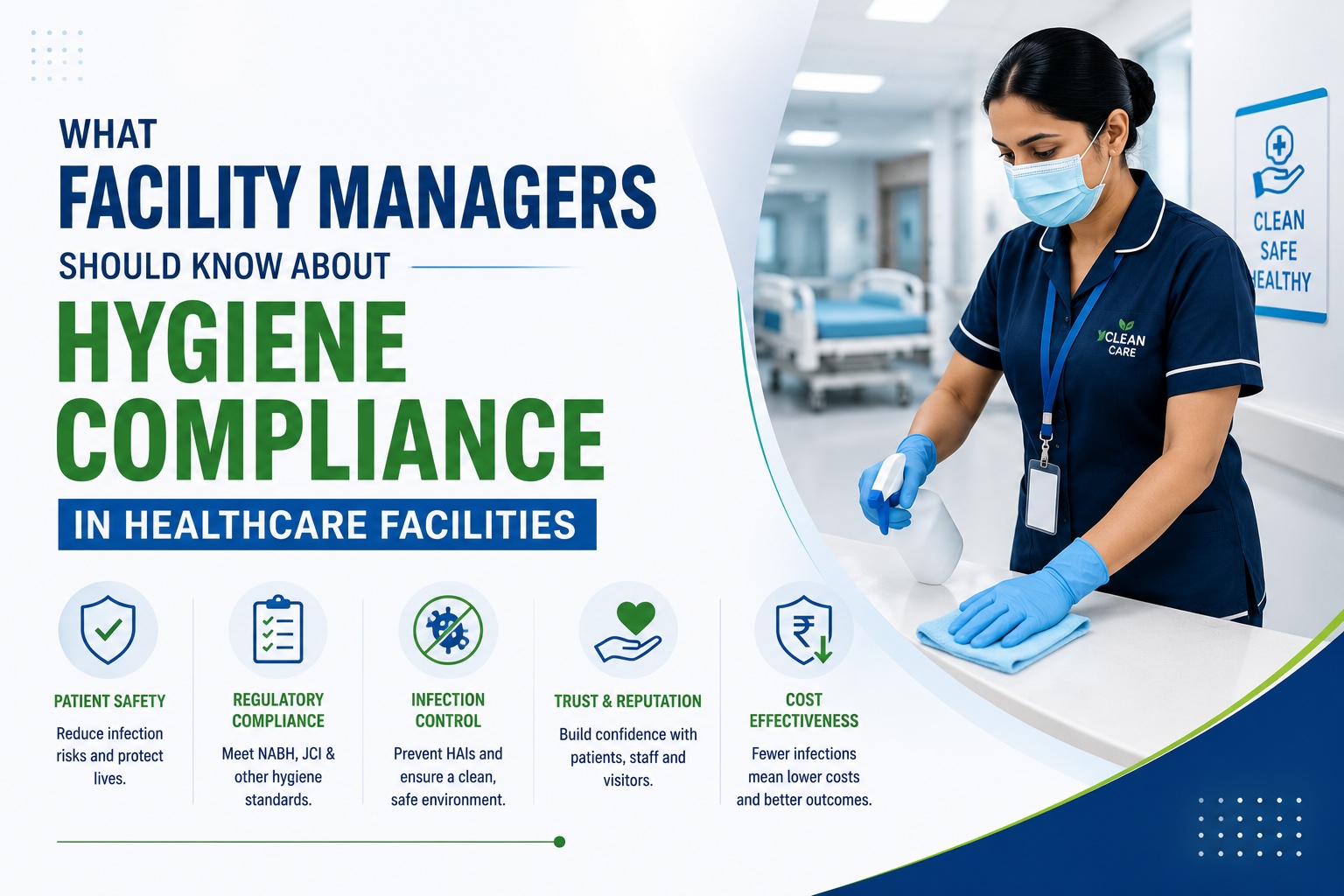
What Facility Managers Should Know About Hygiene Compliance in Healthcare Facilities
Healthcare facilities carry hygiene stakes that no other commercial property does — a missed cleaning step in an office is an inconvenience; the same gap in a hospital ward can contribute to a healthcare-associated infection. For facility managers working in or with hospitals, clinics, and diagnostic centres, understanding where housekeeping responsibilities end and clinical infection control begins is one of the most important — and most commonly blurred — distinctions in the role.
Facility Housekeeping vs Clinical Infection Control: A Critical Distinction
These two functions are frequently discussed together, and they do overlap in practice, but they are not the same discipline, are not governed by the same expertise, and should not be treated interchangeably in policy or in practice.
Facility Housekeeping | Clinical Infection Control | |
|---|---|---|
What it covers | General cleaning, surface disinfection, waste collection, linen handling, and maintaining the physical environment | Clinical protocols for preventing and managing infection: hand hygiene compliance, sterilisation of instruments, isolation procedures, surveillance of healthcare-associated infections (HAIs) |
Who is responsible | Facility management team, housekeeping staff, and their supervisors — typically overseen by the facility or hospital administration | Infection Control Officer (ICO), Infection Control Nurse (ICN), microbiologist, and the hospital’s Infection Control Committee (ICC), as required under NABH’s Hospital Infection Control (HIC) standards |
Type of expertise required | Trained housekeeping supervisors and staff, familiar with healthcare-specific protocols and PPE use | Clinical and microbiological expertise — not something a facility management team is qualified to direct independently |
Where the two connect | Housekeeping executes many infection-control-relevant tasks — zone-based cleaning, colour-coded equipment, disinfectant use — but according to protocols set by the ICC, not decided independently by the facility team | The ICC sets the standards, trains and audits housekeeping performance against them, and owns clinical decisions like isolation precautions |
The practical implication for facility managers: housekeeping is an execution function within a larger infection prevention and control (IPC) programme, not a parallel or independent hygiene authority. Facility teams should follow the protocols set by a facility’s Infection Control Committee, not substitute their own general commercial cleaning standards in a clinical environment.
Frameworks That Apply — What’s Actually Verified
Several frameworks govern hygiene-related expectations in Indian healthcare facilities. This section covers only frameworks that are independently verifiable through official or well-documented sources; facility managers should confirm current requirements directly against the source, since standards are periodically revised.
NABH Hospital Infection Control (HIC) Standards
The National Accreditation Board for Hospitals & Healthcare Providers (NABH) includes a dedicated Hospital Infection Control chapter within its accreditation standards. It requires facilities to maintain an infection control manual, establish an Infection Control Committee, appoint an Infection Control Officer and Infection Control Nurse, and monitor cleaning and disinfection practices as part of a broader infection prevention programme. NABH accreditation is voluntary in India, though many hospitals adopt its standards regardless of whether they pursue formal accreditation.
Biomedical Waste Management Rules, 2016
Notified by the Ministry of Environment, Forest and Climate Change (MoEFCC) and subsequently amended, these rules are a binding legal requirement, not a voluntary standard. They establish a four-category, colour-coded waste segregation system (yellow, red, white/translucent, and blue), covering everything from human anatomical waste to sharps and contaminated glass. Housekeeping staff handling waste in a healthcare setting must be trained on this segregation system specifically, since incorrect segregation is both a compliance violation and an infection risk. Facilities are legally required to work with an authorised common biomedical waste treatment facility or maintain compliant captive treatment infrastructure.
State and Local Health Department Requirements
Beyond national frameworks, healthcare facilities are subject to state-specific clinical establishment regulations and municipal health department requirements, which can vary by location. Facility managers working across multiple states or cities should confirm local requirements rather than assuming a single national standard covers every jurisdiction.
This guide intentionally does not cite specific numeric standards, testing thresholds, or step-by-step clinical protocols (such as exact hand hygiene technique, disinfectant contact times, or sterilisation parameters), since these details are protocol-specific, change with updated guidance, and fall within clinical/IPC authority rather than facility management scope. For these specifics, refer to the facility’s own Infection Control Committee and current NABH/regulatory documentation directly.
What Falls Within Facility Housekeeping’s Scope
- Executing cleaning and disinfection schedules as defined by the facility’s infection control protocols, not general commercial cleaning standards.
- Maintaining zone-appropriate practices — using separate, designated equipment for different risk areas (such as general wards versus operating theatres) as instructed by the facility’s IPC programme.
- Correct segregation and handling of biomedical waste according to the four-category colour-coded system, with staff trained specifically on this requirement.
- Proper use of personal protective equipment (PPE) appropriate to the area and task, following the facility’s specified protocol.
- Maintaining documentation of cleaning schedules and completion, which supports the facility’s broader compliance and audit records.
- Reporting any observed gaps, damaged equipment, or supply shortages that could affect infection control, rather than working around them independently.
What Falls Outside Facility Housekeeping’s Scope
- Setting infection control policy, disinfectant selection standards, or cleaning protocols — these are determined by the Infection Control Committee and clinical leadership, not the facility management team.
- Clinical decisions such as isolation precautions, outbreak response, or surveillance of healthcare-associated infections.
- Sterilisation of medical instruments and clinical equipment, which is a distinct clinical/technical function, not a housekeeping task.
- Interpreting or modifying regulatory requirements — facility teams should follow documented protocol, not independently interpret NABH or Biomedical Waste Management Rules requirements.
When these lines blur — for example, a facility management contract that implies housekeeping alone can “ensure infection control” — it creates real risk: a false sense of coverage that leaves the clinical side of infection prevention under-resourced or unclear on accountability.
Practical Questions for Facility Managers to Ask
- Does our facility have a functioning Infection Control Committee, and are housekeeping protocols formally aligned with and approved by that committee?
- Are housekeeping staff trained specifically on biomedical waste segregation, not just general cleaning, with training records maintained and current?
- Is there a clear, documented distinction in our contracts and job descriptions between housekeeping’s execution role and the ICC’s clinical oversight role?
- Are cleaning and disinfection schedules for different zones (general areas, wards, high-risk clinical areas) explicitly defined by the facility’s IPC programme, rather than a generic commercial cleaning schedule?
- Is there a clear escalation path for housekeeping staff to report a gap — a missing supply, damaged equipment, unclear protocol — up to the Infection Control Officer or Nurse?
- Are our biomedical waste transporter and treatment facility arrangements current, documented, and with an authorised common biomedical waste treatment facility (CBWTF) or compliant captive facility?
Working With a Housekeeping Provider in a Healthcare Setting
For facilities that outsource housekeeping, the distinction between facility housekeeping and clinical infection control should be explicit in the service agreement itself — what the provider is responsible for executing, and what remains under the Infection Control Committee’s direction. A provider unfamiliar with healthcare-specific requirements — zone-based protocols, biomedical waste segregation, PPE standards — is a meaningfully different proposition from one experienced in commercial or residential settings only.
Facility managers evaluating or managing a housekeeping services provider for a healthcare environment should confirm the provider’s staff have specific healthcare and biomedical waste training, not assume general housekeeping experience transfers directly to a clinical setting.
Frequently Asked Questions
Is facility housekeeping the same as infection control in a hospital?
No. Housekeeping executes cleaning, disinfection, and waste-handling tasks, but it operates according to protocols set and monitored by the facility’s Infection Control Committee. Infection control is a clinical discipline covering surveillance, clinical protocols, and outbreak response, which sits outside housekeeping’s scope and expertise.
What is NABH’s role in healthcare hygiene compliance?
NABH accreditation includes a dedicated Hospital Infection Control chapter that requires facilities to maintain an infection control manual, establish an Infection Control Committee, and monitor cleaning and disinfection practices. NABH accreditation itself is voluntary in India, though many facilities align with its standards regardless.
Are the Biomedical Waste Management Rules legally binding?
Yes. Unlike NABH accreditation, which is voluntary, the Biomedical Waste Management Rules, 2016 (as amended) are a binding legal requirement issued by the Ministry of Environment, Forest and Climate Change, and non-compliance can carry legal consequences.
Can a general commercial housekeeping provider work in a healthcare facility?
Only with specific healthcare and biomedical waste training. General commercial cleaning experience does not automatically transfer to a clinical environment, given the additional requirements around zone-based protocols, PPE, and legally regulated waste segregation.
Who should review hygiene compliance content before it’s published or used as internal guidance?
Any content addressing healthcare hygiene compliance should be reviewed by a qualified infection prevention and control professional — such as an Infection Control Officer, Infection Control Nurse, or microbiologist — before being published or used as operational guidance, given the regulatory and patient-safety stakes involved.