
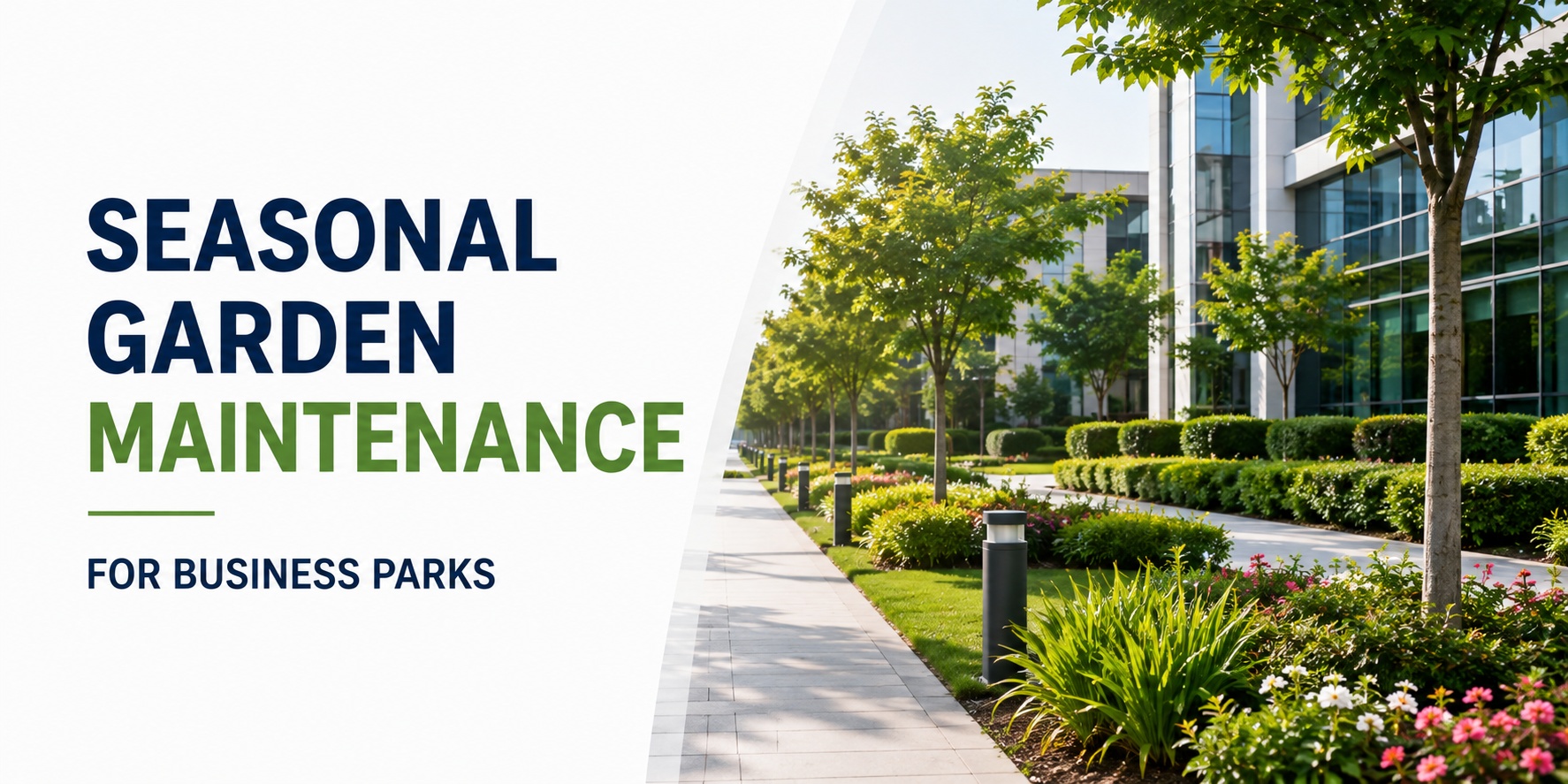
Seasonal Garden Maintenance for Business Parks in India
A business park’s grounds don’t stay in the same condition year-round, even with a fixed maintenance budget — India’s seasonal swings are simply too extreme for a single, unchanging care routine to work across all twelve months. What keeps a lawn healthy in December can leave it patchy by May, and what protects plantings during the monsoon is irrelevant in peak summer heat. This guide breaks down what landscaping and gardening services for a business park actually need to adjust across India’s four meteorological seasons, so grounds stay presentable and healthy through the full year rather than just the easier months.
Why Business Parks Need a Seasonal Approach, Not a Fixed One
Business park landscaping tends to be larger in scale and more visible than a single office’s grounds — expansive lawns, tree-lined walkways, and entrance plantings that many tenant companies and their visitors pass daily. That visibility raises the cost of letting seasonal maintenance slide, since a patchy lawn or waterlogged walkway reflects on every business operating within the park, not just the facilities team responsible for it.
A fixed, year-round maintenance routine also tends to waste resources — over-watering during the monsoon, under-watering in peak summer, or missing the narrow planting windows when new growth actually establishes well. Aligning maintenance activity to India’s actual seasonal calendar is more efficient, not just more effective.
India’s Broad Seasonal Calendar
The India Meteorological Department recognises four broad seasons, though exact dates shift by region. This guide uses these as the planning framework for seasonal grounds care.
Season | Typical Months | General Character |
|---|---|---|
Summer | March to June | Rising heat, peaking in May–June across most of the country; heatwave conditions common in northern and central India |
Monsoon | June to September | Heavy rainfall, especially along the western coast and northeast; timing and intensity vary significantly by region |
Post-Monsoon / Autumn | October to November | Retreating rains, moderating temperatures, generally favourable growing conditions |
Winter | December to February | Cool to cold in northern India, mild in southern regions; low humidity and clearer skies |
Summer Maintenance (March to June)
Peak summer is the most demanding season for business park grounds, particularly in northern and central India where temperatures regularly exceed 40°C. The priority shifts almost entirely to water management and heat stress prevention.
- Increase irrigation frequency, ideally shifting watering to early morning or early evening to reduce evaporation loss during peak heat hours.
- Check irrigation systems for even coverage before peak summer arrives — dry patches often trace back to a sprinkler or drip line fault that goes unnoticed until heat exposes the gap.
- Apply mulch around trees, shrubs, and flower beds to reduce soil moisture loss and moderate soil temperature.
- Prioritise heat-tolerant and drought-resistant plant varieties for any new summer plantings, since this isn’t the season to introduce delicate or water-intensive species.
- Monitor lawns for heat stress and adjust mowing height slightly higher, since longer grass shades its own root zone and retains moisture better than a very short cut.
- Watch for pest activity, which often increases as plants become heat-stressed and more vulnerable.
Monsoon Maintenance (June to September)
Monsoon conditions bring the opposite challenge — excess water, drainage stress, and rapid, sometimes uneven growth. Maintenance priorities shift to drainage, disease prevention, and controlling growth that can otherwise get away from a fixed mowing schedule.
- Inspect and clear drainage channels, storm drains, and any low-lying areas prone to waterlogging before the rains intensify, not after standing water has already appeared.
- Reduce or pause supplemental irrigation, since overwatering on top of consistent rainfall increases root rot and fungal disease risk.
- Increase mowing frequency during the monsoon’s peak growth period, since grass and weeds both grow considerably faster with consistent rain and warmth.
- Watch for fungal disease and mould on lawns and plant beds, which thrive in the sustained humidity of the season, and treat early rather than waiting for visible spread.
- Stake or support young trees and larger shrubs that may be vulnerable to wind and heavy rain, particularly in coastal regions with monsoon storms.
- Clear fallen leaves and debris regularly, since decomposing organic matter in standing water can become a mosquito breeding concern in a business park setting with regular foot traffic.
Post-Monsoon / Autumn Maintenance (October to November)
As rains recede and temperatures moderate, this period offers some of the most favourable growing conditions of the year, making it the priority window for new planting and structural garden work.
- Take advantage of the moderate temperatures for new tree, shrub, and lawn planting, since roots establish more easily than during summer heat or monsoon saturation.
- Assess monsoon damage across the grounds — waterlogged patches, fungal patches on lawns, storm damage to trees — and address repairs while conditions are favourable for recovery.
- Resume a more standard fertilisation schedule, since plants entering this period are typically in active growth and more responsive to feeding than during summer stress or monsoon saturation.
- Prune and shape trees and shrubs that grew rapidly and somewhat unevenly during the monsoon.
- Plan and prepare flower beds for winter-blooming seasonal colour, since this is the planting window for many winter annuals in most Indian regions.
Winter Maintenance (December to February)
Winter conditions vary the most by region — cold and dry in the north, mild and pleasant across much of the south. Maintenance generally becomes less intensive, but a few tasks are winter-specific.
- Adjust irrigation downward in most regions, since evaporation and plant water demand both drop significantly in cooler, lower-humidity conditions.
- Protect frost-sensitive plants in northern regions where nighttime temperatures can approach freezing, particularly in Delhi NCR and parts of northern and hill-adjacent states.
- Take advantage of lower growth rates to catch up on structural pruning, hedge shaping, and any hardscape repairs that were deprioritised during the busier growing seasons.
- Maintain seasonal flower displays established in autumn, since winter is typically when these plantings are at their most visually established.
- Use the comparatively lighter maintenance season to review the year’s overall grounds performance and plan changes — irrigation upgrades, replanting decisions — ahead of the next summer.
A Year-Round Task Checklist
Some tasks aren’t strictly seasonal but should be checked consistently across the year, adjusted in intensity rather than skipped entirely.
- ☐ Irrigation system inspection — monthly, with more frequent checks heading into summer
- ☐ Pest and disease monitoring — ongoing, with particular attention during summer stress and monsoon humidity
- ☐ Walkway and hardscape safety checks — ongoing, especially after monsoon rains or winter fog affecting visibility
- ☐ Entrance and signage-area upkeep — ongoing, since this is the most visible area to visitors and tenants year-round
- ☐ Tree health and structural checks — at least twice a year, and immediately after any significant storm
- ☐ Waste and organic debris clearance — weekly, more frequently during monsoon leaf-fall and after storms
Why Multi-Site Business Parks Need Consistent Standards
Business parks with multiple buildings or phases developed at different times often end up with inconsistent grounds care — one section maintained on a rigorous schedule, another neglected simply because responsibility wasn’t clearly assigned. Seasonal maintenance planning works best when it’s applied uniformly across the entire property, not building by building, since visitors and tenants experience the park as a single environment regardless of internal management boundaries.
This is where working with a single provider of horticultural services across the full property tends to outperform a patchwork of vendors or in-house teams handling different sections independently, since seasonal transitions are planned and executed on the same schedule everywhere.
Building a Seasonal Plan for Your Property
The most effective seasonal maintenance plans are built in advance, not adjusted reactively once heat stress, waterlogging, or frost damage is already visible. Mapping out irrigation changes, planting windows, and structural work against India’s seasonal calendar — adapted to your specific city’s climate patterns — gives grounds staff a clear plan to execute rather than a set of reactive decisions made under pressure.
A qualified provider of garden landscaping services can help build that seasonal calendar around your specific property, plant inventory, and regional climate, rather than applying a generic maintenance schedule that doesn’t account for your local conditions.
Frequently Asked Questions
What is the most demanding season for business park landscaping in India?
Summer (roughly March to June) is generally the most resource-intensive, due to high water demand and heat stress risk, particularly in northern and central India where temperatures regularly exceed 40°C. Monsoon presents a different but comparably demanding set of challenges around drainage and disease control.
Should irrigation be increased or decreased during the monsoon?
Supplemental irrigation should generally be reduced or paused during the monsoon, since consistent rainfall combined with continued watering increases the risk of waterlogging and fungal or root disease.
When is the best time to plant new trees or shrubs in a business park?
The post-monsoon period (roughly October to November) is generally the most favourable planting window across most Indian regions, since temperatures are moderate and soil moisture from the monsoon supports root establishment without the stress of summer heat.
Does seasonal maintenance timing vary significantly across Indian cities?
Yes, considerably. Northern cities like Delhi experience more extreme summer heat and winter cold than southern cities like Bengaluru or Chennai, and monsoon timing and intensity vary by region as well. Any seasonal maintenance calendar should be adapted to local climate patterns rather than applied uniformly across the country.
How often should business park lawns be mowed across the year?
Mowing frequency should increase during the monsoon’s peak growth period and can generally be reduced during winter, when growth slows considerably in most regions. Summer mowing should also account for heat stress, with a slightly higher cut height helping the lawn retain moisture.