Why Corporate Landscaping Is Part of Your Brand Image
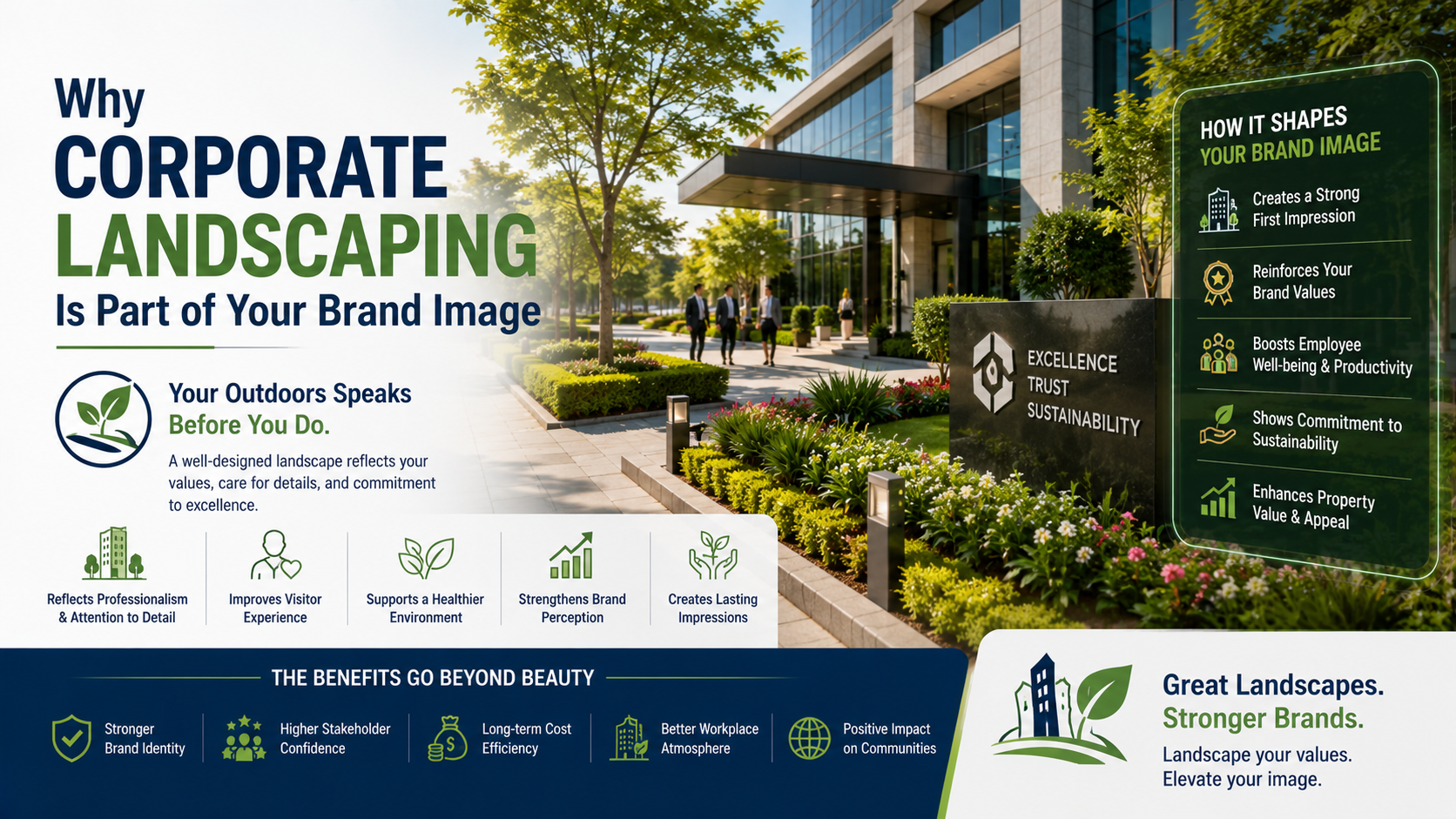
Brand image usually gets discussed in terms of logos, messaging, and digital presence — rarely the parking lot hedges or the entrance planters. But for anyone actually arriving at your office, the exterior grounds are the brand’s first and most literal impression, seen before a receptionist says a word or a website loads. This guide looks at why corporate landscaping deserves a place in brand strategy conversations, not just the facilities budget, and what separates landscaping that reinforces a professional image from landscaping that quietly undermines one.
The Exterior Is the First Data Point, Not an Afterthought
Visitors, clients, job candidates, and delivery partners all form an impression of a business before they reach the reception desk. That impression is built from the building’s exterior — the state of the entrance, the grounds, the walkways — well before anyone interacts with staff or sees internal spaces.
Unlike a website or a brochure, a company doesn’t fully control when someone encounters its landscaping. A prospective client driving past on a Tuesday afternoon sees whatever state the grounds happen to be in that day, which is exactly why consistency, not a single impressive redesign, is what actually protects brand perception over time.
What Well-Maintained Grounds Communicate
Landscaping condition functions as a proxy signal — people reasonably infer things about how a business operates from how carefully its physical space is kept, even when that inference isn’t strictly logical.
- Consistency and attention to detail: a trimmed hedge and a clean walkway suggest the same standards likely apply inside the building, in ways a visitor can’t yet see.
- Financial stability: overgrown or neglected grounds can read as a business cutting corners, even when the underlying reason is unrelated to landscaping specifically.
- Care for people, not just property: well-kept outdoor spaces — shaded seating, clear walkways, tidy entrances — signal that a business considers the experience of the people who use the space, not just the appearance from the road.
None of these signals are stated outright by a business; they’re inferred, which is exactly what makes them powerful and also easy to damage through neglect rather than active mismanagement.
The Research Behind “Nature at Work” and Perception
The link between green environments and how people experience a workplace isn’t purely anecdotal. A field study by researchers at Cardiff University, comparing office workers in “green” spaces with greenery present against “lean” spaces without it, found a 15% rise in reported productivity over three months for workers in the greener environment. The Human Spaces global report on biophilic design in the workplace, drawing on data across 16 countries, found that natural light and nature-linked design consistently ranked among the most requested workplace elements by employees surveyed.
These studies focus primarily on indoor biophilic elements and employee experience rather than exterior corporate landscaping specifically, so the findings shouldn’t be read as a direct claim about client-facing curb appeal. What they do support is a broader, well-established pattern: environments with visible greenery are consistently associated with more positive perceptions of comfort, care, and quality — the same qualities a well-kept exterior aims to project to anyone approaching a building.
Where Landscaping Shapes Perception Across Different Audiences
Audience | What They Notice | What It Signals |
|---|---|---|
Clients and visitors | Entrance condition, walkway upkeep, seasonal freshness of plantings | Professionalism and consistency of standards |
Prospective employees | Outdoor break areas, general grounds condition during a site visit or interview | Whether the employer invests in the day-to-day environment, not just the office interior |
Existing employees | Ongoing condition, not just a one-time impression | Whether the business follows through on upkeep, or lets appearances slide once nobody’s watching |
Tenants (multi-tenant buildings) | Common area grounds, seasonal maintenance consistency | Property management quality — directly tied to willingness to renew a lease |
Passersby and neighbours | General visibility from the street or road | Ambient brand awareness, even without direct interaction with the business |
Common Landscaping Mistakes That Undermine Brand Image
- Inconsistent seasonal upkeep: grounds that look sharp in spring but are left to decline by late summer send a message of effort without follow-through.
- Mismatched maintenance across a multi-building or multi-site portfolio, where one location looks polished and another looks neglected under the same company name.
- Overgrown signage sightlines: shrubs or trees that have grown to partially obscure building signage or entrance visibility undercut the very branding they surround.
- Treating landscaping as purely decorative rather than functional, and neglecting practical elements like clear walkways, adequate lighting, and accessible entrances that also shape visitor experience.
- A one-time landscape redesign with no ongoing maintenance plan behind it, which fades within a season or two and reverts to the same neglected appearance it replaced.
Building Landscaping Into Brand Strategy, Not Just Facilities Budget
Treating landscaping purely as a facilities line item tends to result in it competing for budget against more “essential” maintenance, like plumbing or electrical work, and losing. Reframing it as a brand and client-experience investment changes that calculus, particularly for client-facing offices, corporate campuses, and any property where first impressions have a direct bearing on business outcomes.
In practice, this means treating landscaping and gardening services as an ongoing, scheduled part of facility upkeep rather than an occasional project — aligned with the same seasonal and maintenance rigor applied to other building systems, since the same building that gets its HVAC serviced on a schedule benefits from grounds care on a comparable one.
What Consistent Corporate Landscaping Actually Involves
- Seasonal planting rotation so entrance areas don’t look bare or dated for months at a time between growing seasons.
- Routine lawn, hedge, and tree maintenance on a fixed schedule, rather than reactive trimming only when growth becomes visibly excessive.
- Irrigation system checks to prevent both under-watering (dead or patchy grass) and over-watering (waterlogging, walkway damage).
- Attention to entrance-specific details — planters, signage sightlines, and walkway edges — since this is the area visitors interact with most directly.
- A clear point of contact or provider accountable for consistency across a multi-site portfolio, so brand presentation doesn’t vary noticeably by location.
Making the Case Internally
For facilities or operations teams making the case for investing in professional landscaping, the strongest argument usually isn’t a single dramatic statistic — it’s the fact that the exterior is a brand touchpoint the business doesn’t fully control the timing of, which makes consistent baseline quality more valuable than an occasional impressive overhaul.
Working with an established provider of garden landscaping services on a scheduled, seasonal basis is typically what closes the gap between a business that occasionally looks presentable and one that consistently does, regardless of when a client, candidate, or tenant happens to arrive.
Frequently Asked Questions
Does landscaping really affect how clients perceive a business?
Exterior condition functions as a visible proxy for a business’s broader standards, since it’s often the first thing a visitor sees before any direct interaction. While this is more of an inferential effect than a measured statistic, it’s a consistent theme across commercial property and workplace-design research.
Is corporate landscaping worth the investment for a single-location office?
For any client-facing or employee-facing site, yes — the exterior is encountered by everyone who visits, regardless of business size. The scale of investment should match the site and visitor volume, but consistent basic upkeep matters even for smaller offices.
How often should commercial landscaping be maintained to protect brand image?
This depends on climate and plant selection, but most commercial properties need routine attention on a weekly-to-monthly cycle for lawns and hedges, with seasonal planting changes a few times a year to avoid the entrance looking dated or bare between growing seasons.
What’s the difference between landscaping for aesthetics and landscaping for brand image?
Aesthetic landscaping focuses purely on visual appeal at a point in time. Landscaping tied to brand image is maintained consistently, aligned with how the business wants to be perceived, and treated as an ongoing commitment rather than a one-time design project that’s later left to decline.
Should landscaping be handled by the same facility management provider as other building services?
It can be, particularly for businesses that prefer a single point of accountability across housekeeping, maintenance, and grounds care. Some organisations prefer a specialised horticultural provider instead — either approach works, provided landscaping is on a defined, recurring schedule rather than handled reactively.