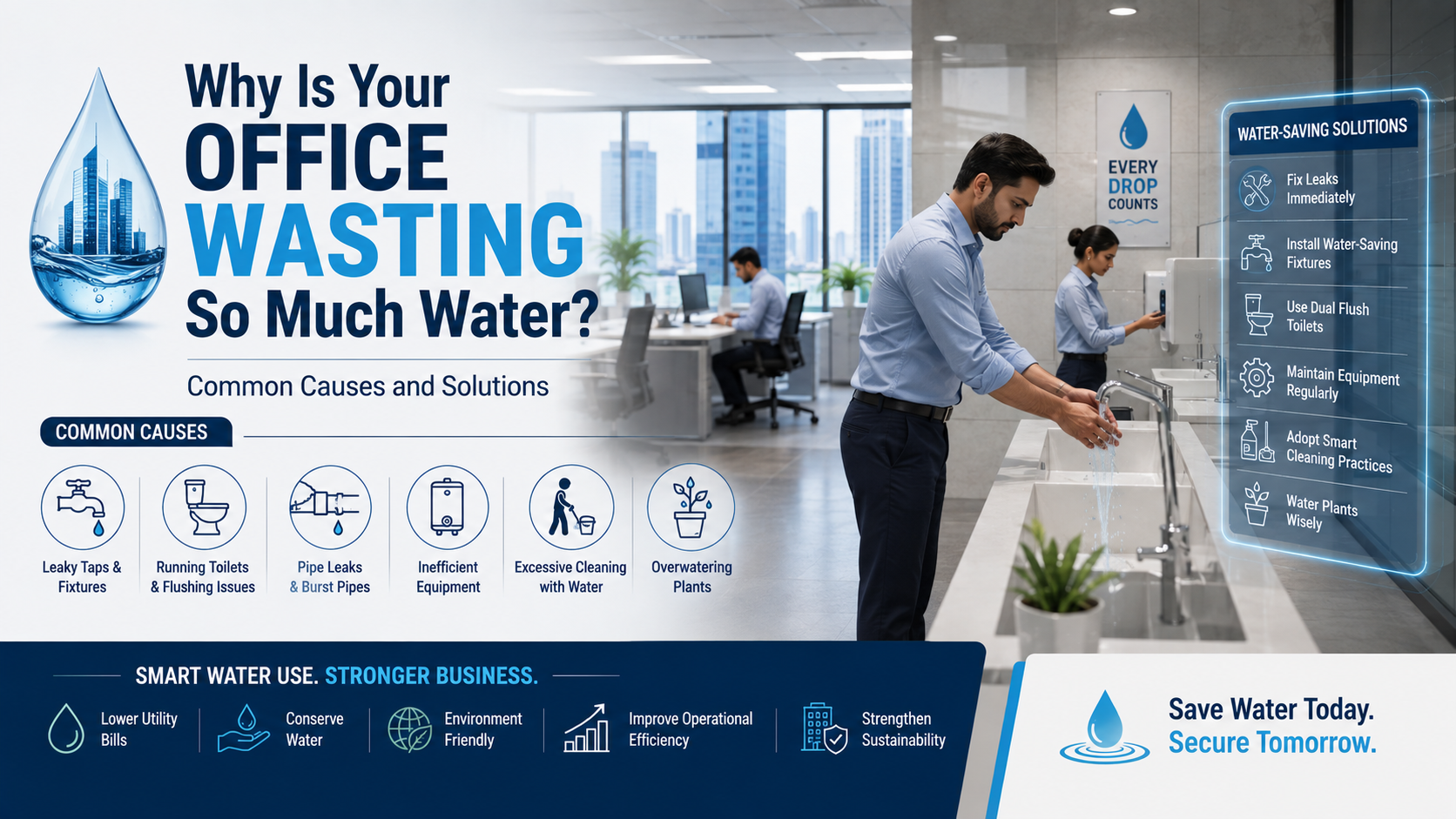
Why Is Your Office Wasting So Much Water? Common Causes and Solutions
Water waste in an office rarely comes from one dramatic event — it’s usually a handful of small, ongoing leaks and habits that never show up on anyone’s radar until the water bill spikes. A running toilet, a dripping tap, or an aerator that was never fitted can quietly waste thousands of litres a month without a single visible sign.
This guide walks through the most common causes of office water waste, a checklist you can run this week, and realistic cost-impact examples, along with when it’s worth calling in plumbing services rather than letting a small leak sit.
A note on the figures below: exact water waste depends on fixture type, water pressure, and how long an issue has gone unnoticed. The ranges cited here are drawn from EPA WaterSense and industry plumbing data, converted to litres, and are meant as planning estimates rather than a guarantee of your specific savings.
Why Office Water Waste Goes Unnoticed
Most commercial water bills are paid centrally, often by a facilities or admin team with no direct visibility into which floor, washroom, or pantry is actually driving usage up. Unlike a home, where a resident notices a dripping tap daily, an office washroom might see high traffic with no single person responsible for flagging a fault.
Add to that the fact that many leaks — inside a cistern, behind a wall, under a sink — are completely silent and invisible unless someone is specifically checking for them. By the time a leak shows up as a cost anomaly on a utility bill, it may have been running for weeks or months.
Common Causes of Office Water Waste
1. Running or Leaking Toilets
This is consistently one of the largest sources of water waste in any building, office or residential. According to the U.S. EPA, a single leaking toilet can waste up to 200 gallons (roughly 750 litres) of water per day, and the American Water Works Association estimates that roughly one in five toilets has some form of leak at any given time.
In an office with multiple washrooms and several toilets per floor, even one or two silently running cisterns can add a meaningful volume to the monthly bill without anyone noticing a visible problem.
2. Dripping Taps and Worn Washers
A dripping tap is easy to dismiss as a minor annoyance, but the EPA notes that a single leaky faucet can waste up to 3 gallons (roughly 11 litres) of water per day, and industry plumbing data puts a typical slow drip at around 1 gallon (close to 4 litres) per day. Multiply that across every washroom and pantry tap in a multi-floor office, and the daily total adds up quickly.
Worn washers, loose valve seats, and ageing tap cartridges are the usual culprits, and they tend to get worse gradually rather than failing all at once.
3. Faulty Flush Valves and Sensor Taps
Automatic sensor taps and flush valves, common in modern offices, are convenient but can malfunction in ways that are easy to miss — a sensor that stays triggered, or a solenoid valve that doesn’t fully close, can leave water running intermittently throughout the day without anyone present to notice.
4. Pantry and Kitchenette Leaks
Under-sink pipework in office pantries and kitchenettes is rarely inspected as part of routine housekeeping, since it’s out of sight behind cabinet doors. Slow leaks here can go undetected until they cause visible water damage to cabinetry or flooring.
5. Water-Cooler and RO System Overflow
Reverse osmosis (RO) purification units, common in Indian offices, typically reject a portion of input water as part of the filtration process, but a faulty float valve or overflow mechanism can cause continuous wastage well beyond the system’s normal reject ratio.
6. Ageing Pipework and Corroded Fittings
In older buildings, corroded joints, degraded washers, and ageing pipe sections are more prone to slow, hard-to-detect leaks — often inside walls or below flooring — that only become visible once staining, dampness, or a drop in water pressure appears.
7. Unmetered or Unmonitored Usage
Offices without sub-metering by floor or zone have no way to isolate where water use is unusually high. Without that visibility, a leak on one floor is invisible against the building’s total consumption until it becomes large enough to move the overall bill noticeably.
Office Water-Use Checklist
A short, regular walkthrough can catch most of these issues before they become expensive. This checklist is designed to be run monthly by a facilities or housekeeping team.
- ☐ Listen for running water in every washroom cistern for a few seconds after flushing — water that continues to trickle after the tank refills usually signals a worn flapper or fill valve.
- ☐ Check all taps for drips after being fully closed, including low-traffic washrooms and pantry taps that may go unused for hours.
- ☐ Inspect visible pipework under sinks and around water coolers for damp patches, staining, or corrosion.
- ☐ Confirm sensor taps and auto-flush valves fully stop water flow after a few seconds of no activity.
- ☐ Check RO/water purifier units for continuous drainage beyond what’s expected for the reject-water cycle.
- ☐ Record the water meter reading at a fixed time weekly, and flag any reading that’s meaningfully higher than the same period last month with no change in occupancy.
- ☐ Review the monthly water bill against occupancy and working days, rather than just the total amount, to catch weekend or holiday usage that shouldn’t be occurring.
- ☐ Confirm any previously reported leak has actually been fixed, not just logged as reported.
Realistic Cost-Impact Examples
The table below translates common leak types into approximate daily and monthly water volumes, based on the EPA and industry figures cited above. Actual costs will depend on your local water tariff and whether your building is billed for water, sewage, or both, so treat the rupee figures as an illustrative range rather than a fixed calculation.
Issue | Approx. Waste Per Day | Approx. Waste Per Month | Assumption Used |
|---|---|---|---|
One running toilet cistern | ~750 litres | ~22,500 litres | EPA estimate: up to 200 gallons/day per leaking toilet |
One dripping tap (steady drip) | ~4–11 litres | ~120–330 litres | EPA estimate: 1–3 gallons/day per leaky faucet |
Three dripping taps across one floor | ~12–33 litres | ~360–990 litres | Multiplied from single-tap EPA estimate |
RO unit overflow fault | Varies by unit | Varies by unit | Site-specific — depends on RO reject ratio and fault duration |
A single running toilet left unrepaired for a month, at the EPA’s cited waste rate, is a meaningful volume of water for any billing cycle — and that’s before accounting for the fact that a facility with multiple washrooms often has more than one such issue running simultaneously. The exact rupee cost depends entirely on your municipal or private water tariff, which varies significantly across Indian cities, so this guide intentionally avoids quoting a fixed savings number and instead recommends checking the volume figures against your own utility rate.
Why These Issues Are Better Prevented Than Repaired
Every leak in the checklist above starts small and gets worse. A slow drip today is often a fully worn washer in a few months; a slightly running cistern today can become a constantly running one once the flapper degrades further. None of these require major intervention if caught early — but left alone, they eventually mean a full fixture replacement, water damage repair, or a plumber visit under emergency conditions rather than a planned one.
This is why the most cost-effective approach to office water waste isn’t a one-time fix — it’s a regular inspection cycle backed by professional plumbing services that can catch a worn washer or a slow cistern leak before it turns into a larger repair.
When to Call a Plumber vs Handle It In-House
- A dripping tap or a toilet that keeps running after flushing is usually a simple washer or flapper replacement — this is a reasonable candidate for plumbing repair scheduled during routine maintenance rather than an emergency callout.
- Damp patches, staining, or a musty smell near pipework usually indicate a leak that’s already inside a wall or under flooring — this needs a professional assessment rather than a DIY fix, since the visible damage is often smaller than the underlying leak.
- A sudden, sharp spike in the water bill with no change in occupancy or usage pattern is a strong signal to request a full site leak audit rather than checking fixtures one at a time.
- Persistent RO unit overflow or drainage issues typically need the unit’s specific technician or installer, since the fault may be in the internal float mechanism rather than general plumbing.
Building Water Efficiency Into Ongoing Maintenance
Reducing water waste in an office isn’t a single project with a defined end point — it’s an ongoing part of facility upkeep, the same way electrical or HVAC systems need periodic checks rather than a one-time inspection. Building the checklist above into a regular maintenance routine, rather than only responding after a bill spike, is what actually prevents these small leaks from becoming expensive ones.
If your last plumbing inspection was more than a few months ago, or you can’t recall the last time washroom fixtures were checked floor by floor, that’s usually a sign it’s time to schedule one. Reliable online plumber services make it straightforward to book a preventive inspection rather than waiting for a visible problem to force the issue.
Frequently Asked Questions
How much water can a single leaking toilet waste in an office?
Based on EPA estimates, a single leaking toilet can waste up to roughly 750 litres of water per day, or around 22,500 litres a month. In an office with several washrooms, more than one leak running simultaneously is common.
How do I know if my office has a hidden water leak?
The most reliable signs are a water bill that rises without a corresponding increase in occupancy, a water meter that keeps moving during a period when no fixtures are in use, or damp patches and staining near pipework. A weekly meter reading, checked against usage patterns, is one of the simplest ways to catch a hidden leak early.
Is a dripping tap really worth fixing, or is the waste too small to matter?
A single dripping tap wastes a modest amount on its own — roughly 4 to 11 litres a day by EPA estimates — but offices typically have many taps across multiple washrooms and pantries, and drips tend to worsen over time as washers degrade further. Fixing them early is a low-cost repair compared to the fixture replacement that’s often needed once a worn part fails.
Should office water use be checked daily, weekly, or monthly?
A brief visual and audible check of washrooms can be part of daily housekeeping, but a structured checklist covering taps, cisterns, pipework, and meter readings works well on a weekly to monthly cycle for most offices, with more frequent checks in high-traffic buildings.
Can water-saving fixtures fully eliminate office water waste?
Water-efficient fixtures reduce baseline consumption, but they don’t prevent leaks from worn parts, faulty valves, or ageing pipework — even efficient fixtures can leak once components degrade. Regular inspection remains necessary regardless of fixture type.
What’s the difference between routine plumbing maintenance and emergency plumbing repair?
Routine maintenance covers scheduled inspections and small fixes — like replacing a worn washer or flapper — caught before they cause damage. Emergency plumbing repair addresses leaks or failures that have already caused visible damage or service disruption, and typically costs more due to the urgency and scope of the fix required.