What Does Facility Management Cost in India? Key Cost Drivers and Budgeting Guide
Budgeting for facility management is harder than it should be, mainly because pricing varies so widely by city, building size, and service scope that a single number rarely tells the full story. This guide breaks down what facility management actually costs in India today, the factors that move that number up or down, and how to build a realistic budget instead of guessing. Every figure below is sourced or clearly labelled as an estimate, so you can use it as a starting point for your own planning rather than a fixed quote.
A note on the numbers: facility management pricing is not standardised in India the way construction or real estate costs are. The ranges below are drawn from published industry data, brokerage cost assessments, and vendor pricing pages current as of 2026. Actual quotes from a facility management company in India will vary based on your specific site, service scope, and contract terms — treat these figures as planning benchmarks, not binding quotes.
What Facility Management Typically Costs Per Square Foot
Facility management costs in India are usually quoted on a per-square-foot, per-month basis, tied to the built-up or carpet area being serviced. Published ranges vary depending on service scope:
- Basic housekeeping-only contracts: roughly ₹12–25 per sq ft per month, based on a 2026 industry cost breakdown.
- Broader facility management services (cleaning, maintenance, security, support functions): roughly ₹15–40 per sq ft per month, according to a 2026 vendor pricing guide for large offices.
- Full integrated facilities management services (hard FM, soft FM, and energy management combined): can extend up to ₹60 per sq ft per month at the high end, per the same 2026 industry breakdown.
These figures are broadly consistent with each other but come from different publishers, so treat the ₹12–60 per sq ft per month range as the outer boundary rather than a precise average — your actual cost will sit somewhere inside it based on the drivers covered below.
City-Wise Benchmark: Office Facility Management Costs
Knight Frank India’s 2026 facility management cost assessment across major office markets offers one of the more granular, size-segmented benchmarks available. For Mumbai, Bengaluru, and Gurugram specifically, reported costs were:
Office Size | 12-Hour Operations | 24×7 Operations |
|---|---|---|
10,000–30,000 sq ft | ₹25.52 per sq ft/month | ₹27.52 per sq ft/month |
30,000–50,000 sq ft | ₹27.65 per sq ft/month | ₹29.65 per sq ft/month |
50,000–100,000 sq ft | ₹24.80 per sq ft/month | ₹26.80 per sq ft/month |
300,000–500,000 sq ft | ₹13.65 per sq ft/month | ₹15.65 per sq ft/month |
Source: Knight Frank India facility management cost assessment, as reported by MENAFN, 2026. The pattern is consistent across the dataset — smaller offices pay meaningfully more per square foot than large campuses, because fixed costs like a site supervisor or a minimum security detail don’t shrink proportionally with space.
Key Cost Drivers Behind Facility Management Pricing
Per-square-foot averages are a useful starting point, but the real number for your building depends on several variables stacking together.
1. Manpower and Statutory Compliance Costs
Manpower is typically the largest single line item in an FM contract, and it’s driven by statutory minimum wages rather than open-market negotiation. As of the April 2026 revision, India’s Code on Wages framework puts unskilled worker wages at roughly ₹14,000 per month and skilled roles up to roughly ₹28,000 per month in metro areas, according to India Briefing’s 2026 minimum wage guide.
On top of base wages, compliant contracts must factor in statutory add-ons: Provident Fund (employer contribution of 13% of wages up to a ₹15,000 cap), Employee State Insurance (3.25% of gross wages for workers earning up to ₹21,000), an annual statutory bonus of at least 8.33% of wages, and gratuity after one year of service — as outlined in a 2025 compliance breakdown of security staffing costs in India.
This is why a security guard’s all-in monthly cost to a client is typically well above the headline salary. One 2026 industry guide notes that security agencies typically bill 40–60% above a guard’s cost-to-company to cover supervision, overheads, and margin.
2. City and Location
Facility management costs are consistently higher in Mumbai, Bengaluru, Delhi NCR, Chennai, and Hyderabad than in tier-2 cities, driven primarily by higher manpower costs and stricter local compliance requirements, per the 2026 industry cost breakdown cited earlier. Tier-2 cities such as Jaipur, Ahmedabad, and Kochi are increasingly adopting integrated FM contracts as well, but generally at lower per-square-foot rates.
3. Building Size and Scale Economies
As the Knight Frank data above shows, per-square-foot cost drops sharply as building size increases. A 300,000+ sq ft campus can achieve nearly half the per-square-foot rate of a 10,000–30,000 sq ft office, largely because centralised infrastructure, shared supervisory staff, and automated systems spread fixed costs across a much larger area.
4. Operating Hours
Extending from standard 12-hour operations to 24×7 coverage adds a consistent premium across every size band in the Knight Frank dataset — typically an additional ₹2 per sq ft per month, reflecting the extra shifts, night differentials, and supervision required for round-the-clock coverage.
5. Service Scope: Soft FM vs Hard FM vs Integrated FM
Housekeeping-only contracts sit at the lower end of the pricing spectrum. Adding hard FM components — electrical, mechanical, plumbing, and fire safety maintenance — raises cost because these require licensed technicians rather than general service staff. Full integrated facilities management services, which bundle hard FM, soft FM, security, and energy management under one contract, carry the highest per-square-foot rate but typically reduce total cost versus hiring multiple vendors separately, since overheads and management layers are shared rather than duplicated.
6. Building Class and Systems Complexity
Class A properties with advanced HVAC, building management systems (BMS), and life-safety infrastructure cost more to maintain than mid-tier buildings with simpler systems, according to a 2026 benchmarking report compiled from IFMA, BOMA, and Plant Engineering data. More complex systems require more frequent, more specialised maintenance — which shows up directly in the maintenance line of an FM budget.
7. Technology and Automation Investment
IoT-enabled monitoring, access automation, and centralised surveillance can reduce ongoing manpower costs — the same Knight Frank assessment notes that large campuses keep security costs lower partly through access automation and integrated surveillance, compared to smaller offices relying on higher guard deployment. These systems typically carry a higher upfront or setup cost, which should be budgeted separately from the recurring monthly FM rate.
Sample Budget Structure: Where the Money Typically Goes
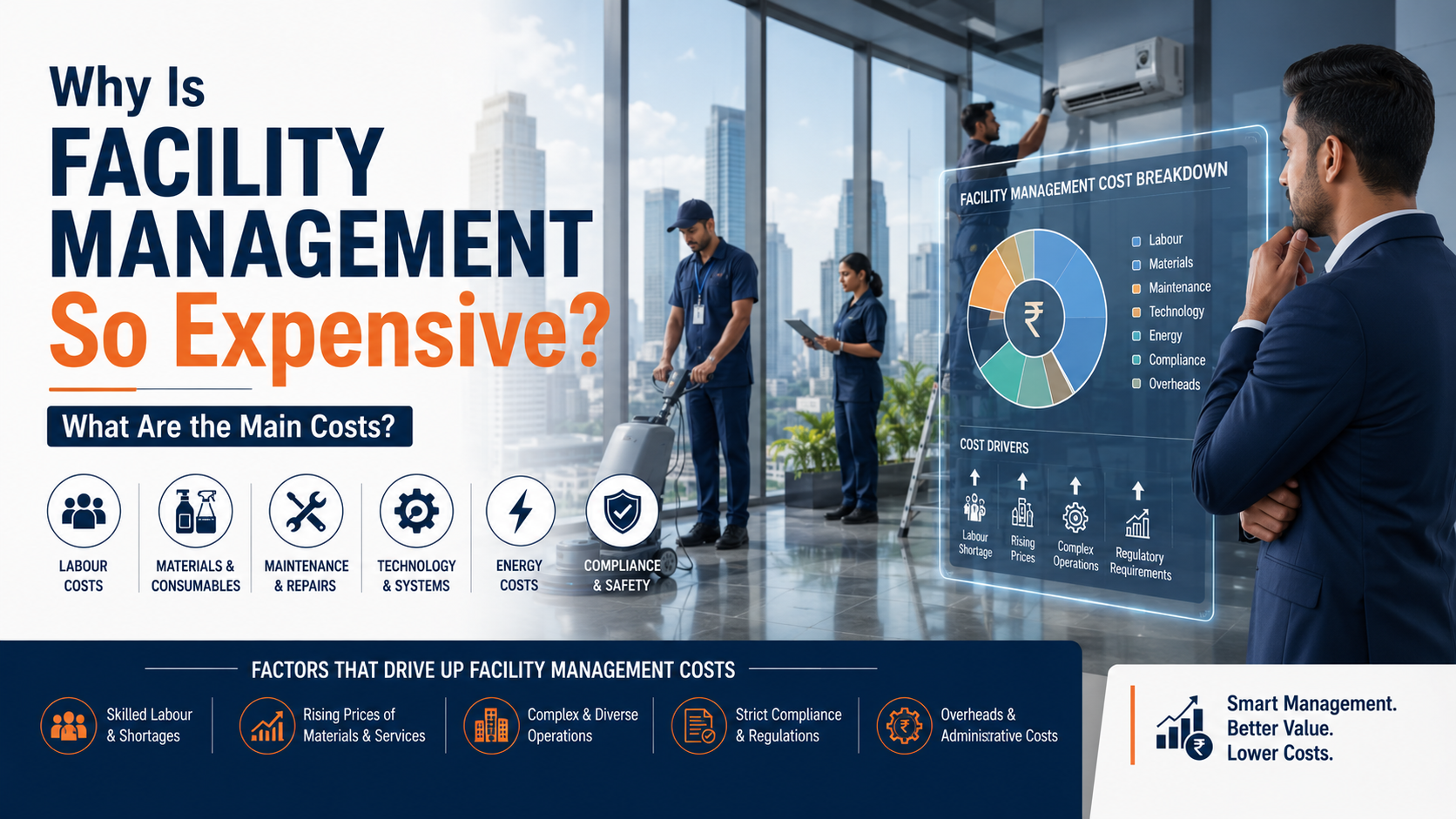
While exact splits vary by contract, a broadly integrated FM budget in an Indian commercial building typically allocates spend across these categories. This breakdown is illustrative, based on the cost drivers above, rather than a single cited statistic — use it as a checklist for your own budget rather than a fixed formula.
Category | What It Covers | Typical Weight in Budget |
|---|---|---|
Manpower (soft FM) | Housekeeping, security, reception, pantry, waste handling | Largest single share — often 40–55% |
Hard FM maintenance | Electrical, mechanical, plumbing, fire safety, lifts | Significant, especially in older or complex buildings |
Consumables and materials | Cleaning supplies, spares, PPE, signage | Smaller but recurring |
Technology and systems | BMS, access control, monitoring software | Higher upfront, lower recurring |
Management overhead | Supervision, reporting, compliance administration | Built into vendor margin on outsourced contracts |
In-House vs Outsourced Facility Management: Cost Considerations
A common early-stage question is whether to build an in-house FM team or outsource to a facility management company in India. The comparison is rarely as simple as “outsourcing has a margin, so in-house is cheaper.”
- In-house teams carry the full statutory compliance burden directly — PF, ESI, gratuity, bonus, and health and safety obligations — without the buffer an outsourced vendor’s scale provides, as outlined in the compliance breakdown referenced earlier.
- Outsourced contracts bundle supervision, training, backup staffing, and compliance management into the quoted rate, which can offset the visible margin, particularly for smaller sites that can’t justify a full-time in-house FM manager.
- Larger campuses with predictable, high-volume needs sometimes find in-house teams more cost-effective at scale, since fixed management overhead spreads across more square footage.
There isn’t a universally cheaper option — the right structure depends on site size, service complexity, and how much internal management bandwidth your business already has.
Practical Steps for Building an FM Budget
- Start with your actual built-up or carpet area, not a rough estimate — per-square-foot pricing is sensitive to this number.
- Decide your required operating hours (standard business hours vs 24×7) before requesting quotes, since this alone can shift cost by roughly 7–10% based on the Knight Frank benchmarks above.
- List out required services explicitly — housekeeping-only, hard FM, or fully integrated — rather than asking for “facility management” generically, since scope is the single biggest driver of quoted price.
- Ask vendors to itemise manpower, materials, and management overhead separately, so you can compare quotes on a like-for-like basis rather than a single bundled number.
- Factor in a compliance buffer if evaluating unusually low quotes — rates that fall meaningfully below published minimum-wage-plus-statutory-cost benchmarks are a signal of compliance risk, not a bargain.
- Revisit your budget annually, since minimum wages in India are revised twice yearly through the Variable Dearness Allowance mechanism, which directly affects manpower-heavy FM contracts.
Putting the Numbers to Work
Facility management pricing in India spans a wide range for a reason — a 15,000 sq ft office running standard hours with basic housekeeping and a 400,000 sq ft campus running 24×7 integrated operations are simply not comparable line items. The published benchmarks in this guide give you a realistic starting range, but the drivers — location, size, hours, scope, and building complexity — are what will actually determine your number.
The most reliable way to budget accurately is to get quotes structured against your specific site rather than relying on a headline per-square-foot figure. Working with an established facility management company in India that can itemise costs against the drivers above will generally produce a far more usable budget than a single blended rate.
Frequently Asked Questions
What is the average cost of facility management per square foot in India?
Published 2026 industry estimates put facility management costs roughly between ₹12 and ₹60 per square foot per month in India, depending on service scope — from basic housekeeping at the lower end to fully integrated facilities management services at the upper end.
Why do small offices pay more per square foot than large campuses?
Small offices can’t spread fixed costs like a minimum supervisory headcount or baseline security detail across much space, so per-square-foot cost stays high. Knight Frank’s 2026 data shows offices under 30,000 sq ft paying nearly double the per-square-foot rate of campuses above 300,000 sq ft.
How much does 24×7 facility management cost compared to standard hours?
Based on 2026 Knight Frank benchmarks for Mumbai, Bengaluru, and Gurugram offices, 24×7 operations typically add around ₹2 per square foot per month compared to standard 12-hour coverage, across most office size bands.
Is outsourced facility management cheaper than an in-house team?
It depends on site size and complexity. Outsourcing bundles compliance, supervision, and backup staffing into one rate, which often works out more cost-effective for smaller or mid-sized sites. Larger campuses with predictable, high-volume needs sometimes find in-house teams competitive at scale.
What is included in integrated facilities management services pricing?
Integrated FM pricing typically bundles hard FM (electrical, mechanical, plumbing, fire safety), soft FM (housekeeping, security, reception), and often energy or technology management under a single contract, which is why it sits at the higher end of the per-square-foot pricing range compared to single-service contracts.
Why do facility management quotes vary so much between vendors?
Quotes vary based on service scope, manpower deployment levels, compliance standards, technology investment, and how overheads are allocated. A quote significantly below published minimum-wage-plus-statutory-cost benchmarks usually signals reduced compliance coverage rather than genuine efficiency.