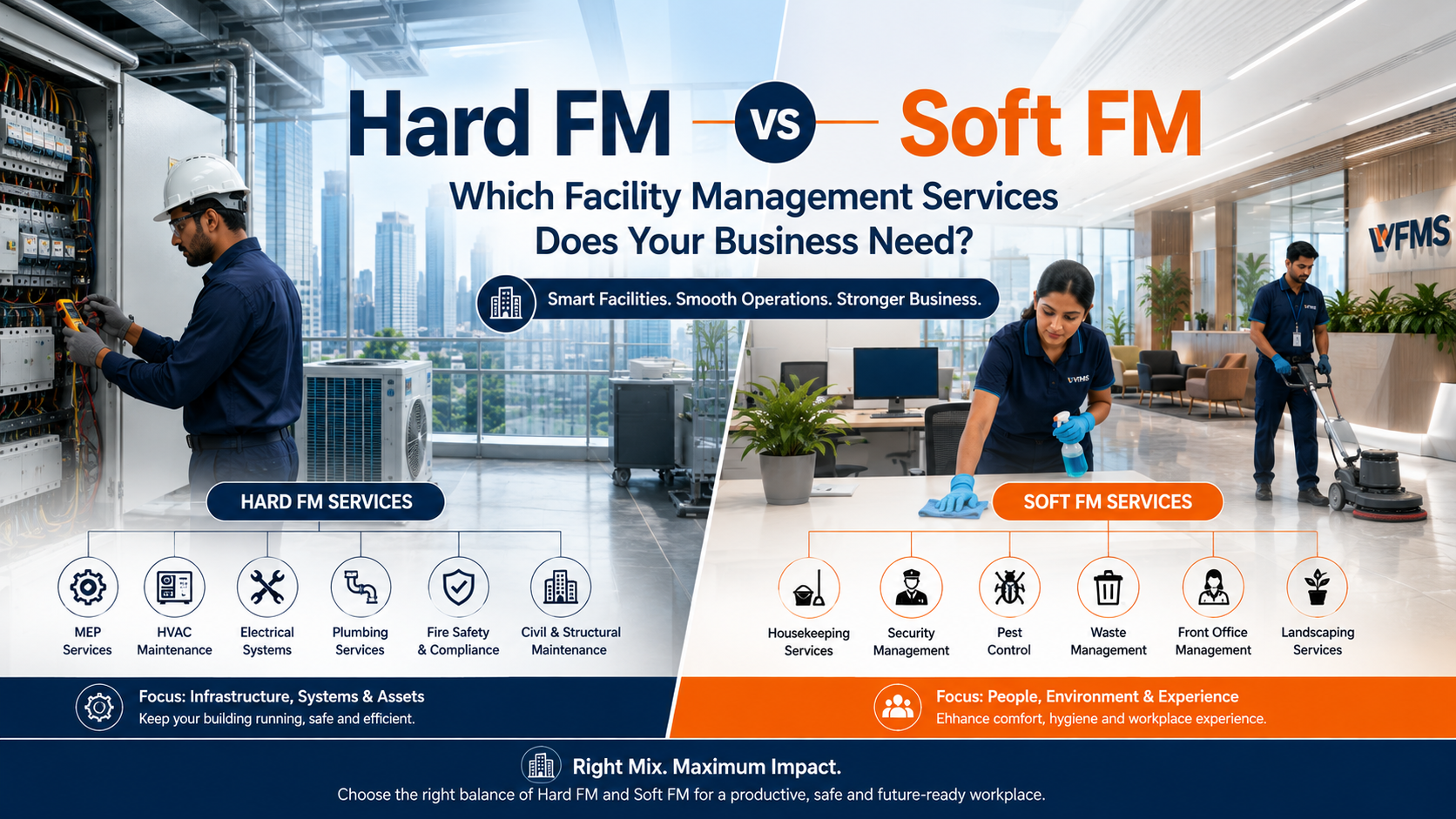
Hard FM vs Soft FM: Which Facility Management Services Does Your Business Need?
Every commercial building runs on two very different categories of upkeep. One keeps the physical structure — wiring, plumbing, machinery — safe and functional. The other keeps the space clean, presentable, and pleasant to occupy. In facility management, these are known as hard FM and soft FM, and understanding the difference is the first step to building a maintenance plan that actually fits your business. This guide breaks down what each category covers, where the line between them gets blurry in real contracts, and how services like electrical maintenance and housekeeping fit into a single, coordinated facility management plan.
What Is Hard FM?
Hard facility management covers the physical, technical, and structural elements of a building — the systems you can’t operate without. This includes electrical wiring, HVAC and mechanical plant, plumbing and drainage, fire safety equipment, lifts, and structural fabric such as roofing and walls.
These services are typically compliance-driven. Faulty wiring, a burst pipe, or a malfunctioning fire panel isn’t just an inconvenience — it can create safety hazards, regulatory violations, or legal liability. Hard FM is generally handled by licensed, technically trained professionals working to defined safety codes and manufacturer specifications.
What Is Soft FM?
Soft facility management covers the services that shape day-to-day comfort, appearance, and experience within a building. This includes housekeeping and cleaning, landscaping and grounds care, pest control, waste management, reception and concierge services, and security staffing.
Soft FM is less about regulatory compliance and more about presentation, hygiene, and occupant wellbeing. A building can technically function with poor housekeeping or an overgrown landscape, but it will struggle to retain tenants, impress clients, or keep employees comfortable.
Hard FM vs Soft FM: Side-by-Side Comparison
The table below outlines the practical differences between the two categories, using common building services as examples.
Aspect | Hard FM | Soft FM |
|---|---|---|
Primary focus | Physical infrastructure and building systems | Occupant comfort, hygiene, and presentation |
Driven by | Safety codes, compliance, manufacturer specs | Service standards, brand image, occupant experience |
Typical services | Electrical, mechanical, plumbing, fire safety, lifts | Housekeeping, landscaping, pest control, security, reception |
Risk if neglected | Safety hazards, equipment failure, legal exposure | Poor hygiene, occupant dissatisfaction, reputational impact |
Skill requirement | Licensed technicians and engineers | Trained service staff and supervisors |
Scheduling style | Planned preventive maintenance, statutory inspections | Recurring routine schedules (daily, weekly, seasonal) |
Budget behaviour | Lower frequency, higher cost per intervention | Higher frequency, steadier ongoing cost |
Why the Line Between Hard and Soft FM Isn’t Always Fixed
Hard FM and soft FM are useful categories, but they aren’t governed by a single universal standard. How a specific service gets classified often depends on the contract, the industry, and the provider drawing up the scope of work.
- Pest control is sometimes bundled into soft FM as a hygiene service, and sometimes treated as a compliance-driven hard FM task in food-processing or healthcare facilities.
- Landscaping and grounds maintenance is usually soft FM, but where it involves structural drainage, irrigation systems, or slope stabilisation, elements of it can shift toward hard FM.
- Fire and safety systems are almost always hard FM, but the staff who monitor alarms and run evacuation drills are often part of a soft FM security or reception team.
- Waste management can sit in either category depending on whether it’s treated as routine housekeeping or as a regulated, compliance-heavy process, such as biomedical or hazardous waste handling.
This is why it’s worth reviewing exactly how your facility management provider defines the scope of each service in your contract, rather than assuming the hard/soft split works the same way everywhere.
Hard FM Services: Practical Examples
Here’s what hard FM typically looks like in a real commercial building, and the risks of leaving each one unmanaged.
Electrical Systems
Wiring, distribution boards, lighting circuits, and backup power systems all fall under electrical services. Faults here are among the leading causes of commercial fires, which makes routine inspection and load testing non-negotiable rather than optional.
Mechanical Systems
HVAC units, compressors, pumps, and other rotating equipment fall under mechanical maintenance. Neglected mechanical systems don’t just fail suddenly — they degrade gradually, driving up energy costs long before a breakdown occurs.
Plumbing and Drainage
Water supply lines, drainage, sump pumps, and sanitary fittings are covered under plumbing services. A slow leak that goes unnoticed for weeks can cause structural damage that costs far more to repair than the original fault.
Fire Safety and Life Safety Systems
Fire alarms, sprinklers, extinguishers, and emergency lighting require statutory inspection on a fixed schedule in most jurisdictions. These checks are rarely optional from a compliance standpoint.
Soft FM Services: Practical Examples
Soft FM tasks are less about avoiding failure and more about maintaining a consistent standard of comfort and hygiene.
Housekeeping and Cleaning
Daily cleaning, washroom hygiene, and floor care fall under housekeeping services. This is usually the most visible soft FM function — occupants notice cleanliness immediately, and it directly shapes first impressions.
Horticulture and Landscaping
Grounds care, lawn maintenance, and seasonal planting are handled through horticulture and landscaping services, which contribute significantly to how a property is perceived from the outside, especially for corporate campuses and retail frontages.
Pest Control, Waste Management, and Security
These recurring services protect hygiene standards and occupant safety without requiring the technical licensing that hard FM demands. They’re typically scheduled more frequently — often daily or weekly — compared to the periodic cycle of hard FM inspections.
How to Decide What Your Business Needs
Most commercial buildings need both categories working together, but the balance depends on the type of facility.
- Manufacturing units and warehouses typically weight budgets more heavily toward hard FM, given the volume of mechanical and electrical equipment in continuous use.
- Retail stores and corporate offices often lean more toward soft FM, since occupant experience and appearance directly affect business outcomes.
- Healthcare facilities and data centres usually need both categories at a high standard simultaneously, since compliance failures and hygiene failures carry equally serious consequences.
- Multi-tenant commercial buildings benefit from having both categories coordinated by a single provider, reducing the communication gaps that occur when different vendors handle each function separately.
Bundled vs Single-Service Facility Management
Many businesses start by hiring separate vendors for each service — an electrician here, a cleaning contractor there. This works at a small scale, but as a facility grows, it creates coordination overhead: multiple invoices, inconsistent service quality, and no single point of accountability when something falls through the cracks.
An integrated facility management provider that delivers both hard and soft FM under one contract removes this friction. Maintenance schedules, staffing, and reporting are consolidated, and issues that cross categories — such as a water leak affecting both plumbing and housekeeping — get resolved faster because one provider owns the full picture.
Bringing Hard and Soft FM Together
Hard FM and soft FM aren’t competing priorities — they’re two halves of the same operational picture. A building with flawless wiring and plumbing but poor cleaning standards will still lose tenants and damage its reputation. A spotless, well-landscaped property with an unmaintained electrical system is a safety risk waiting to happen.
The right approach depends on your facility type, risk profile, and growth plans — but in almost every case, the strongest results come from treating hard and soft FM as one coordinated plan rather than a patchwork of separate vendors. Reviewing services like plumbing, mechanical systems, and grounds care together — rather than in isolation — is usually the fastest way to spot where your current maintenance plan has gaps.
Frequently Asked Questions
What is the main difference between hard FM and soft FM?
Hard FM covers physical building systems like electrical, mechanical, and plumbing infrastructure, which are compliance-driven and safety-critical. Soft FM covers services like cleaning, landscaping, and security that shape comfort and presentation rather than structural safety.
Is HVAC considered hard FM or soft FM?
HVAC is classified as hard FM. It’s a mechanical building system that requires licensed technicians, scheduled inspections, and compliance with manufacturer and safety specifications.
Does every contract define hard and soft FM the same way?
No. The classification can vary by provider and industry. Services such as pest control or waste management are sometimes treated as soft FM and sometimes as hard FM, depending on whether compliance requirements are involved. It’s worth checking how your specific contract defines each scope.
Can one provider deliver both hard FM and soft FM?
Yes. Many facility management companies offer integrated services covering both categories, which reduces vendor coordination overhead and gives building owners a single point of contact for the entire property.
Which matters more for a commercial office — hard FM or soft FM?
Both matter, but for a typical office, soft FM often has a more visible day-to-day impact on occupant experience, while hard FM carries the greater safety and compliance risk if neglected. Neither can be skipped without consequences.
How often should hard FM systems be inspected compared to soft FM services?
Hard FM systems like fire safety and electrical infrastructure typically follow periodic statutory inspection schedules — often quarterly or annually. Soft FM services like cleaning and pest control usually run on much shorter cycles, often daily or weekly, since they address ongoing hygiene rather than periodic risk.