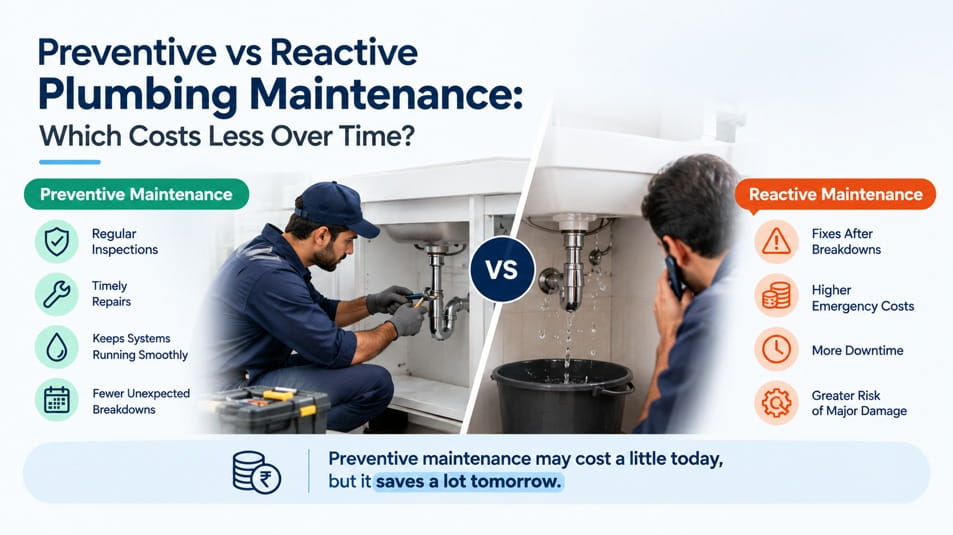
Preventive vs Reactive Plumbing Maintenance: Which Costs Less Over Time?
A commercial building ignores a small water leak for three weeks before it becomes a ceiling repair. A blocked drain keeps returning because the underlying issue was never investigated. A leaking pipe gets repaired repeatedly, but the same section fails again a few months later.
None of these are necessarily major plumbing emergencies when they first appear. The problem is what happens when they are treated only after something goes wrong.
For businesses, the real question is not simply whether preventive or reactive maintenance costs more today. It is which approach keeps total plumbing costs lower over time while reducing disruption, emergency repairs, water damage, and unexpected downtime.
This guide compares preventive and reactive maintenance, explains where each approach fits, and provides a practical checklist for deciding how your business should manage its plumbing requirements.
What Is the Difference Between Preventive and Reactive Plumbing Maintenance?
Preventive plumbing maintenance involves inspecting, servicing, and maintaining plumbing systems before a major failure occurs. The goal is to identify developing problems early and address them before they become expensive repairs.
Reactive plumbing maintenance happens after a plumbing problem has already occurred. This could include responding to a burst pipe, blocked drain, leaking fixture, overflowing toilet, or sudden loss of water supply.
In simple terms:
- Preventive maintenance: Find and fix problems before they become failures.
- Reactive maintenance: Respond when a failure or visible problem occurs.
Reactive maintenance has an obvious advantage: you only spend money when something goes wrong. The problem is that the eventual cost can be much higher when the failure causes secondary damage or requires emergency intervention.
Why Businesses Delay Preventive Plumbing Maintenance
Plumbing systems are often overlooked because much of the infrastructure is hidden behind walls, under floors, or above ceilings. When everything appears to be working, scheduled maintenance can feel like an unnecessary expense.
That’s understandable up to a point.
The problem starts when businesses treat “nothing is visibly wrong” as proof that the plumbing system does not need attention.
A minor leak can become structural damage. A partially blocked drain can become a complete blockage. Corrosion can weaken a pipe long before it starts leaking visibly.
For commercial properties, this means the cost of waiting is not always limited to the plumbing repair itself. It can include water wastage, damaged interiors, business disruption, emergency service charges, and replacement of affected equipment or materials.
The comparison below focuses on total cost over time, rather than the price of an individual maintenance visit.
1. Preventive Maintenance Costs More Regularly but Less Unexpectedly
Preventive maintenance requires planned inspections and scheduled servicing. That means businesses need to allocate a maintenance budget even when the plumbing system appears to be working normally.
What this looks like in practice:
- Scheduled inspection of pipes, valves, fixtures, and drainage systems
- Regular checking for leaks, corrosion, pressure issues, and blockages
- Cleaning and maintenance of drains before serious blockages develop
- Planned replacement of worn components before failure
The advantage is predictability.
Instead of waiting for a plumbing emergency and dealing with an unknown repair bill, businesses can plan maintenance costs as part of their regular operating budget.
For facilities with large plumbing networks, this predictability can make plumbing services easier to manage financially.
2. Reactive Maintenance Can Look Cheaper — Until a Failure Escalates
Reactive maintenance appears cost-effective because the business does not pay for routine inspection or servicing until a problem occurs.
But the actual cost of a plumbing failure can quickly increase.
What this looks like in practice:
- A small pipe leak damages ceilings, walls, or flooring
- A blocked drain causes water to back up into occupied areas
- A burst pipe requires immediate emergency intervention
- A plumbing failure disrupts employees, customers, tenants, or operations
- Emergency call-out requirements increase the repair cost
The plumbing repair may be relatively simple. The secondary damage may not be.
That’s why comparing the price of a preventive inspection with the price of one repair can give businesses the wrong impression. The more useful comparison is the total cost of ownership over time.
3. Preventive Maintenance Helps Identify Problems Before They Become Emergencies
One of the biggest financial advantages of preventive maintenance is early detection.
A professional inspection can identify warning signs that may not be obvious to building occupants.
What this looks like in practice:
- Slow drainage that indicates a developing blockage
- Small leaks around joints or fittings
- Corrosion on exposed plumbing components
- Unusual water pressure changes
- Repeated fixture failures
- Signs of moisture around walls, ceilings, or service areas
Finding these issues early gives the business more control over when and how the repair is carried out.
Instead of calling for online plumber services after a failure has already disrupted operations, the business can schedule the work during a suitable maintenance window.
4. Reactive Repairs Often Repeat When the Root Cause Is Not Addressed
A recurring plumbing problem is one of the clearest signs that reactive maintenance is being used too heavily.
Replacing a damaged component may solve the immediate problem, but it does not always explain why the component failed.
What this looks like in practice:
- The same drain becomes blocked repeatedly
- The same pipe section develops leaks
- A fixture requires repeated repairs
- Water pressure problems keep returning
- Temporary fixes are applied without investigating the underlying cause
This approach can create a cycle:
Problem → Repair → Temporary improvement → Problem returns → Repair again
Over time, the business may spend more on repeated plumbing repair than it would have spent investigating and resolving the underlying issue.
A good maintenance strategy should therefore track recurring failures rather than treating every service request as an isolated incident.
5. Preventive Maintenance Reduces the Risk of Business Disruption
For a commercial property, plumbing failures are not only maintenance issues. They can become operational issues.
A major leak in an office, retail property, hotel, warehouse, healthcare facility, or business park can affect areas that have nothing to do with the original plumbing problem.
What this looks like in practice:
- Washrooms become temporarily unavailable
- Work areas need to be closed because of water damage
- Customers or visitors are redirected
- Employees lose access to essential facilities
- Cleaning and restoration work is required after a major leak
Preventive maintenance cannot eliminate every plumbing emergency. It can, however, reduce the likelihood of known or developing issues becoming major failures.
That makes preventive maintenance particularly relevant when businesses depend on uninterrupted building operations.
6. Professional Plumbing Services Can Make Preventive Maintenance More Effective
Preventive maintenance works best when it follows a defined schedule rather than relying on occasional inspections.
A professional maintenance provider can help businesses establish inspection frequencies based on the building, plumbing infrastructure, usage levels, and known problem areas.
What this looks like in practice:
- Creating a plumbing inspection schedule
- Recording previous repairs and recurring problems
- Prioritising high-risk plumbing assets
- Tracking leaks, blockages, and component failures
- Scheduling repairs before critical components fail
- Maintaining service records for future reference
This turns plumbing maintenance from a purely reactive activity into a planned facility management function.
The goal is not to repair everything unnecessarily. It is to identify which systems require attention and intervene at the right time.
7. Reactive Maintenance Still Has a Place
Preventive maintenance does not mean every plumbing issue can or should be predicted.
Unexpected failures happen.
A pipe can burst suddenly. A fixture can fail without warning. An external event can damage plumbing infrastructure. When this happens, businesses need reliable plumbing repair services that can respond quickly.
Reactive maintenance is therefore necessary for:
- Emergency leaks
- Burst pipes
- Sudden drain blockages
- Fixture failures
- Water supply interruptions
- Unforeseen plumbing damage
The problem is not using reactive maintenance.
The problem is relying on it as the primary maintenance strategy for issues that could reasonably be identified and addressed in advance.
Preventive vs Reactive Plumbing Maintenance: Which Costs Less?
For most commercial properties, preventive maintenance is generally more cost-effective over the long term because it focuses on reducing the frequency and severity of failures.
However, the right approach is usually not “preventive only.”
A stronger strategy combines both:
Preventive maintenance handles known risks and developing problems.
Reactive maintenance handles unexpected failures and emergencies.
The cost advantage comes from shifting as much routine maintenance as practical toward prevention while keeping a reliable reactive response available when something unexpected happens.
A Simple Cost Comparison
|
Maintenance Approach |
Short-Term Cost |
Long-Term Risk |
Cost Predictability |
Business Disruption |
|
Preventive |
Planned and recurring |
Lower |
Higher |
Generally lower |
|
Reactive |
Lower until failure occurs |
Higher |
Lower |
Potentially higher |
|
Preventive + Reactive |
Planned + emergency budget |
Balanced |
Higher |
Better controlled |
The key point is simple: the cheapest maintenance visit is not necessarily the cheapest maintenance strategy.
A small planned repair can be significantly less expensive than an emergency repair combined with water damage, operational disruption, and replacement costs.
Decision Checklist: Is Your Plumbing Maintenance Strategy Too Reactive?
Use this checklist to evaluate your current approach. Consider what has happened at your property over the past 6–12 months.
|
# |
Question |
|
1 |
Have you experienced repeated plumbing failures in the same area? |
|
2 |
Are most plumbing service calls made only after something breaks? |
|
3 |
Have minor leaks previously developed into larger repairs? |
|
4 |
Are drain blockages recurring despite previous repairs? |
|
5 |
Do you have a documented plumbing inspection schedule? |
|
6 |
Are recurring plumbing problems being tracked and analysed? |
|
7 |
Have plumbing emergencies caused operational disruption? |
|
8 |
Are temporary repairs being used repeatedly instead of addressing root causes? |
|
9 |
Do you know which plumbing components or areas are most likely to fail? |
|
10 |
Can your maintenance provider respond quickly when an emergency occurs? |
How to Read Your Results
- 0–2 Yes answers: Your plumbing maintenance approach is likely reasonably structured. Continue monitoring recurring issues and maintaining emergency support.
- 3–5 Yes answers: Your maintenance strategy may be becoming too reactive. Review recurring problems and introduce more scheduled inspections.
- 6+ Yes answers: Your plumbing maintenance approach is heavily reactive. A structured preventive maintenance plan should be considered to reduce recurring failures, emergency costs, and operational disruption.
What to Do Before Changing Your Plumbing Maintenance Strategy
Moving from reactive to preventive maintenance does not require changing everything immediately.
Start by reviewing what is already happening.
- Review your plumbing repair history from the past 6–12 months
- Identify repeated leaks, blockages, and fixture failures
- Calculate how much has been spent on emergency repairs
- Identify areas where plumbing failures have caused business disruption
- Create a preventive inspection schedule based on risk and usage
- Ask your maintenance provider to document recurring issues and root causes
- Keep emergency plumbing services available for unexpected failures
- Review the plan periodically and adjust inspection frequency based on actual failure patterns
The objective is not to eliminate repair costs completely. Plumbing systems require repairs throughout their lifecycle. The objective is to reduce avoidable emergency repairs and make maintenance spending more predictable.
The Bottom Line
Reactive plumbing maintenance can appear cheaper because businesses only spend money when a problem occurs. Over time, however, repeated failures, emergency call-outs, water damage, and business disruption can make the reactive approach significantly more expensive.
Preventive maintenance requires planned spending, but it gives businesses an opportunity to identify problems earlier, schedule repairs more effectively, and reduce the risk of major failures.
For most commercial properties, the most practical approach is a combination of preventive maintenance and reliable reactive plumbing repair.
The question is not whether emergencies will ever happen.
The better question is how many avoidable emergencies your maintenance strategy could have prevented.
Frequently Asked Questions
Which is cheaper, preventive or reactive plumbing maintenance?
Preventive plumbing maintenance is generally more cost-effective over the long term because it can identify developing problems before they become expensive failures. Reactive maintenance may have a lower immediate cost but can become more expensive when emergency repairs, water damage, and business disruption are included.
What does preventive plumbing maintenance include?
Preventive plumbing maintenance can include scheduled inspections, leak detection, drain checks, inspection of valves and fixtures, checking for corrosion or pressure problems, and planned replacement of worn components.
When should I call for plumbing repair services?
You should arrange plumbing repair services when you notice leaks, recurring blockages, unusual water pressure, damaged fixtures, water stains, drainage problems, or other signs that the plumbing system is not operating normally. Emergency support may be required for burst pipes or significant leaks.