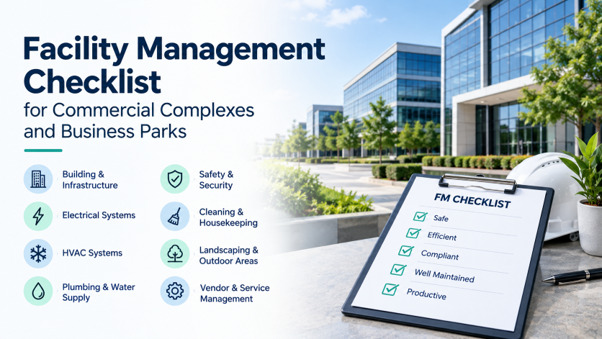
Facility Management Checklist for Commercial Complexes and Business Parks
A commercial complex discovers that its backup generator hasn’t been tested properly for months — just before a power disruption exposes the problem.
A business park has the same housekeeping complaint coming from multiple tenants, but there is no central record showing whether the issue was resolved. At another site, preventive maintenance schedules exist on paper, but equipment failures keep happening because the work is being handled reactively.
None of these are isolated facility problems. They’re signs that day-to-day operations may be running without a structured facility management process.
Managing a commercial complex or business park involves much more than keeping the premises clean and operational. Building systems, housekeeping, security, electrical maintenance, safety, landscaping, vendor coordination, compliance, and tenant support all need to work together.
This guide covers the key areas to include in a practical facility management checklist, followed by a review framework you can use to evaluate your current operations.
Why a Facility Management Checklist Matters
Commercial complexes and business parks have multiple systems, teams, vendors, tenants, and service requirements operating at the same time. Without a structured checklist, important tasks can easily become dependent on individual staff members remembering what needs to be done.
A checklist creates consistency. It helps facility teams track routine activities, identify recurring issues, monitor preventive maintenance, and make sure compliance requirements don’t get overlooked.
The goal isn’t to create paperwork for the sake of paperwork. A useful checklist should help facility management teams identify problems before they become disruptions.
The areas below focus on the operational patterns that matter most across commercial properties.
1. Building and Infrastructure Maintenance
The physical condition of a commercial property directly affects employee experience, tenant satisfaction, safety, and operating costs.
Routine inspections should cover both visible areas and essential building infrastructure.
What this looks like in practice:
- Inspect walls, ceilings, flooring, doors, windows, and common areas for damage
- Check for water leakage, dampness, cracks, or other structural concerns
- Monitor lifts, escalators, staircases, and access points
- Maintain records of repair and maintenance work
- Track recurring infrastructure issues instead of treating every complaint as a new incident
A good facility management process should make it easy to identify what requires immediate attention and what can be scheduled for planned maintenance.
2. Electrical and Power Systems
Electrical systems are among the most critical areas to monitor in a commercial complex or business park. Small maintenance gaps can quickly become operational disruptions.
The checklist should include regular inspection and testing of electrical infrastructure and backup systems.
What this looks like in practice:
- Inspect electrical panels, wiring, switches, and distribution systems
- Schedule preventive maintenance for critical electrical equipment
- Test generators and backup power systems regularly
- Check emergency lighting and power backup
- Record faults, repairs, and equipment downtime
- Monitor recurring electrical failures and investigate their root causes
Facility management services should focus on preventive maintenance rather than waiting for equipment to fail before taking action.
3. HVAC and Indoor Environment
HVAC systems directly influence occupant comfort and the working environment across offices, retail spaces, common areas, and other commercial facilities.
A checklist should cover routine servicing as well as performance monitoring.
What this looks like in practice:
- Schedule regular HVAC inspections and servicing
- Check air-conditioning performance across occupied areas
- Inspect filters, ducts, vents, and related components
- Track repeated temperature or ventilation complaints
- Maintain service records for major HVAC equipment
- Plan preventive maintenance before peak operating periods
If the same HVAC complaint keeps appearing, the objective should be to identify the underlying cause rather than repeatedly sending technicians to perform temporary fixes.
4. Housekeeping and Hygiene
Clean and well-maintained common areas are one of the most visible indicators of effective facility management.
For commercial complexes and business parks, housekeeping needs to cover more than routine cleaning. High-traffic areas, washrooms, food zones, parking areas, and shared facilities may all require different cleaning schedules.
What this looks like in practice:
- Define cleaning schedules for common areas and high-traffic zones
- Inspect washrooms at defined intervals
- Monitor cleaning standards through regular site inspections
- Maintain adequate housekeeping supplies
- Track tenant or occupant complaints
- Review recurring hygiene issues and their resolution
A structured housekeeping checklist makes service standards measurable instead of leaving quality dependent on individual staff members.
5. Security and Access Management
Security is another core component of facility management for commercial properties.
Large business parks and commercial complexes often have multiple entrances, tenants, employees, visitors, contractors, and delivery personnel moving through the property every day.
What this looks like in practice:
- Check security staffing and shift coverage
- Monitor visitor and contractor access procedures
- Inspect CCTV systems and access-control equipment
- Maintain incident records
- Check emergency communication systems
- Review security procedures periodically
The checklist should also identify gaps between documented security procedures and what is actually happening on-site.
6. Fire Safety and Emergency Preparedness
Fire safety should never be treated as a once-a-year compliance activity. Equipment, documentation, emergency systems, and staff preparedness all require ongoing attention.
What this looks like in practice:
- Check fire extinguishers and fire-fighting equipment
- Track inspection and servicing schedules
- Inspect emergency exits and evacuation routes
- Check fire alarms and related systems
- Maintain required documentation and records
- Conduct emergency preparedness activities as required
A reliable facility management process should proactively track upcoming inspections, servicing, and renewals rather than discovering expired requirements during an audit.
7. Plumbing and Water Management
Plumbing issues can move quickly from minor maintenance concerns to major property problems.
Leaks, blocked drains, water pressure issues, and poorly maintained systems can affect tenant areas and common spaces while also increasing operating costs.
What this looks like in practice:
- Inspect plumbing fixtures and water lines
- Check for visible leaks and dampness
- Monitor drainage and sewage systems
- Inspect water tanks and related equipment
- Track recurring plumbing complaints
- Record repair history and replacement requirements
Preventive inspection is particularly important in large properties because a small leak can go unnoticed until it causes significant damage.
8. Landscaping and External Areas
For business parks and commercial complexes, external areas form an important part of the property’s overall appearance.
Landscaping, parking areas, walkways, entrances, and outdoor common spaces should therefore be included in the facility management checklist.
What this looks like in practice:
- Maintain lawns, plants, and landscaped areas
- Inspect walkways and external surfaces
- Check outdoor lighting
- Keep parking areas clean and organised
- Monitor irrigation systems
- Schedule seasonal landscaping activities
Regular inspection helps prevent small external maintenance issues from becoming visible complaints from tenants, employees, or visitors.
9. Vendor and AMC Management
Commercial properties typically depend on multiple external vendors for equipment maintenance, housekeeping, security, pest control, landscaping, technical services, and other requirements.
Without proper vendor tracking, important maintenance schedules can easily slip.
What this looks like in practice:
- Maintain a central record of vendors and service agreements
- Track AMC start and expiry dates
- Monitor scheduled service visits
- Review vendor performance against agreed SLAs
- Maintain service reports and maintenance records
- Escalate recurring vendor performance issues
This is where integrated facilities management services can provide an advantage by bringing multiple operational functions under a coordinated management structure.
10. Compliance and Documentation
Compliance tracking should be treated as an ongoing operational responsibility rather than something prepared only when an audit is approaching.
Commercial facilities often have multiple certificates, inspections, renewals, maintenance records, and statutory requirements to track.
What this looks like in practice:
- Maintain an updated compliance calendar
- Track expiry and renewal dates
- Keep inspection and maintenance records organised
- Maintain relevant equipment certificates
- Document incidents and corrective actions
- Review compliance status regularly
A strong facility management system should proactively flag upcoming deadlines so that the property team isn’t forced to discover gaps after they have already occurred.
11. Tenant and Occupant Experience
A technically well-maintained property can still have an operational problem if tenant concerns aren’t handled effectively.
Facility teams should have a clear process for receiving, assigning, resolving, and closing service requests.
What this looks like in practice:
- Maintain a central system for complaints and service requests
- Track response and resolution times
- Identify recurring complaints by location or category
- Communicate clearly about unresolved issues
- Review tenant feedback periodically
- Measure service performance against agreed standards
The objective is not simply to close tickets. It is to identify patterns that can improve the overall facility experience.
Facility Management Checklist for Commercial Properties
Use this checklist to review your current facility management operations. Check each item that is consistently being monitored across your property.
# | Checklist Item |
1 | Are building infrastructure inspections conducted on a defined schedule? |
2 | Are electrical systems and backup power equipment maintained proactively? |
3 | Are HVAC servicing and performance checks tracked? |
4 | Are housekeeping standards regularly inspected and documented? |
5 | Are security systems, staffing, and access procedures reviewed? |
6 | Are fire safety equipment and emergency systems regularly inspected? |
7 | Are plumbing, drainage, and water systems included in preventive maintenance? |
8 | Are landscaping, parking, lighting, and external areas regularly checked? |
9 | Are AMCs, vendors, SLAs, and service schedules centrally tracked? |
10 | Is there a clear compliance calendar with upcoming renewal dates? |
11 | Are tenant complaints tracked from reporting through resolution? |
12 | Are recurring maintenance issues analysed for root causes? |
13 | Are service reports based on actual site activity rather than repetitive templates? |
14 | Are maintenance records and documentation easily accessible when required? |
15 | Is facility performance reviewed regularly using measurable service standards? |
How to read your results:
- 12–15 Yes answers: Your facility management process is likely well structured. Continue monitoring performance and improving preventive processes.
- 8–11 Yes answers: There are some operational gaps worth addressing. Create an improvement plan with clear owners and timelines.
- 0–7 Yes answers: Your current process may be heavily dependent on reactive maintenance. Consider evaluating broader facility management solutions and a more integrated operating model.
What to Review Before Choosing Facility Management Services
A checklist can identify operational gaps, but choosing the right service partner requires looking beyond the number of services offered.
Before appointing or changing a facility management company in India, evaluate:
- Service coverage: Check whether the provider can manage the functions your property actually requires.
- Preventive maintenance: Ask how the provider tracks equipment, schedules, AMCs, and recurring faults.
- SLA structure: Make sure response and resolution expectations are clearly defined and measurable.
- Compliance management: Understand how renewals, inspections, documentation, and deadlines are monitored.
- Reporting: Ask what information will be included in regular reports and how it will help management make decisions.
- Multi-site capability: If your business operates across multiple locations, confirm that the provider can maintain consistent service standards across sites.
- Escalation process: Understand who will take ownership when an issue isn’t resolved within the expected timeframe.
- Technology and tracking: Check whether service requests, maintenance schedules, inspections, and reports can be tracked systematically.
The right facility management services provider should not simply provide manpower. It should bring structure, accountability, preventive maintenance, and measurable service standards to the property.
The Bottom Line
A commercial complex or business park has too many moving parts to manage effectively through ad-hoc maintenance and informal follow-ups.
Building maintenance, electrical systems, HVAC, housekeeping, security, fire safety, plumbing, landscaping, vendors, compliance, and tenant support all need defined processes and regular monitoring.
Use the checklist above to identify where your current facility management process is strong and where gaps remain.
If several areas depend on reactive fixes, manual follow-ups, or individual staff members remembering what needs to happen next, it may be time to evaluate more structured facility management solutions.
For larger properties or businesses operating across multiple locations, integrated facilities management services can provide a more coordinated approach by bringing different operational functions under one management framework.
The objective isn’t simply to keep the property running today. It is to create a facility management system that is predictable, measurable, and capable of supporting the property as its operational requirements grow.
Frequently Asked Questions
What does facility management include for commercial complexes?
Facility management can cover building maintenance, electrical systems, HVAC, housekeeping, security, fire safety, plumbing, landscaping, vendor coordination, compliance, and tenant service management. The exact scope depends on the property’s requirements.
Why is preventive maintenance important in facility management?
Preventive maintenance helps identify potential equipment and infrastructure problems before they result in breakdowns or major disruptions. It also provides a structured way to monitor maintenance schedules and recurring issues.
What should I look for in facility management services?
Look for clear service coverage, measurable SLAs, preventive maintenance processes, compliance tracking, reporting, escalation procedures, vendor management, and the ability to maintain consistent service quality.
How can I choose a facility management company in India?
Evaluate providers based on their experience with similar commercial properties, service capabilities, SLA structure, compliance processes, reporting systems, multi-site capability, and approach to preventive maintenance.
What are integrated facilities management services?
Integrated facilities management services bring multiple facility functions under a coordinated management structure. Depending on the property, this can include housekeeping, technical maintenance, security, landscaping, compliance, vendor management, and other support services.
How often should a commercial facility management checklist be reviewed?
The checklist should be used regularly for operational inspections, while the overall facility management process should be formally reviewed periodically. Recurring complaints, equipment failures, compliance gaps, or changes in property requirements should trigger an earlier review.