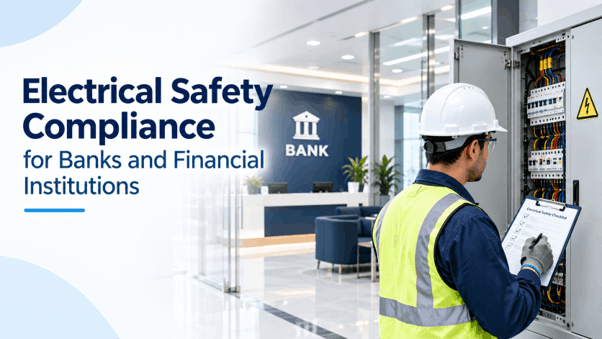
Electrical Safety Compliance for Banks and Financial Institutions
A bank branch experiences a power failure during business hours — the UPS switches over, but one of the critical circuits doesn’t. A financial institution discovers during an internal audit that its electrical inspection records are incomplete and several maintenance reports haven’t been updated. Another branch keeps experiencing recurring tripping in the same distribution board, with the issue being reset rather than properly investigated.
None of these are simply electrical maintenance issues. They’re warning signs — and in a bank or financial institution, electrical safety failures can affect employees, customers, critical banking systems, security infrastructure, and business continuity at the same time.
Electrical safety compliance in financial institutions is expected to remain consistent because even a short disruption can affect ATMs, servers, networking equipment, surveillance systems, access control, lighting, fire-safety systems, and day-to-day banking operations.
This guide covers the key areas banks and financial institutions should monitor for electrical safety compliance, followed by a practical checklist and FAQs you can use to evaluate your current electrical safety programme.
Why Electrical Safety Gets Overlooked
Electrical systems are often out of sight and therefore out of mind. Panels are inside electrical rooms, cables run through concealed spaces, and most problems remain invisible until a breaker trips, equipment fails, or an electrical fault occurs.
There is also a tendency to treat electrical maintenance as a periodic activity rather than an ongoing compliance responsibility.
That’s where the problem starts.
For banks and financial institutions, the objective should be more than simply keeping the lights on. It should be maintaining a documented, inspected, tested, and properly managed electrical system that supports safe and continuous operations.
1. Electrical Inspections and Compliance Records Are Not Up to Date
One of the clearest signs of an electrical safety compliance gap is incomplete or outdated documentation.
If inspection reports, testing records, equipment history, or statutory documentation are missing, the organisation may not have a reliable view of the actual condition of its electrical infrastructure.
What this looks like in practice:
- Electrical inspection reports cannot be produced when requested
- Testing records are incomplete or maintained inconsistently
- Previous electrical faults have no documented corrective action
- Equipment maintenance history is scattered across different vendors or teams
- Compliance documents are updated only when an audit is approaching
A reliable electrical services provider should help maintain a clear record of inspections, testing, faults, corrective actions, and upcoming maintenance requirements — rather than leaving the facility team to reconstruct the history later.
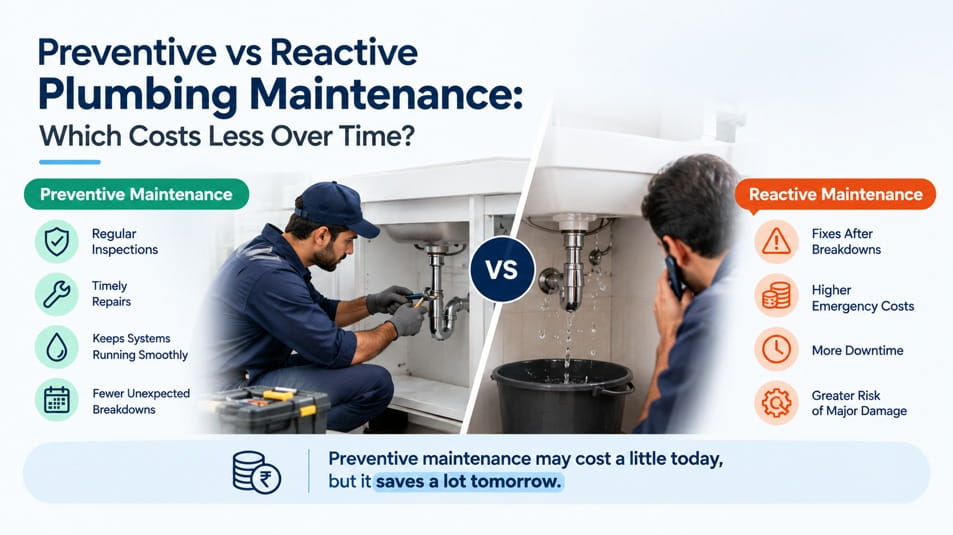
2. Preventive Electrical Maintenance Is Being Replaced by Reactive Repairs
Electrical maintenance should not begin only after a circuit trips or equipment fails.
Banks depend on electrical infrastructure continuously, including distribution boards, UPS systems, generators, emergency power, lighting, HVAC systems, security systems, ATMs, server rooms, and communication equipment.
What this looks like in practice:
- The same breaker or circuit trips repeatedly
- Electrical faults are reset without identifying the root cause
- Panel cleaning and tightening are performed only after a failure
- Preventive maintenance schedules are missed
- Equipment is repaired repeatedly instead of being assessed for replacement
This is one of the clearest indicators that the electrical maintenance programme has become reactive rather than preventive.
A proper preventive electrical maintenance approach identifies deteriorating connections, overheating, insulation problems, overloaded circuits, and other warning signs before they become operational failures.
3. Electrical Panels and Distribution Boards Are Not Being Properly Maintained
Distribution boards and electrical panels are among the most important points in a commercial electrical system.
Loose connections, overheating, damaged components, poor labelling, overloading, or inadequate access can create unnecessary safety and operational risks.
What this looks like in practice:
- Panels show signs of overheating or discolouration
- Circuits are not clearly labelled
- Unused openings or damaged covers are left unresolved
- Panel rooms are used for storing unrelated materials
- Access to electrical panels is obstructed
- Condition-monitoring checks are not part of the maintenance programme
Regular electrical services support can help identify these issues before they develop into serious equipment failures or safety incidents.
Electrical panels should be inspected systematically, with identified defects documented and corrective actions tracked to closure.
4. Backup Power Systems Are Not Tested as Part of Business Continuity
Banks cannot treat backup power as simply a generator or UPS issue.
The electrical infrastructure supporting business continuity can include UPS systems, generators, automatic transfer systems, batteries, emergency lighting, critical distribution circuits, and associated controls.
A backup system that starts during a test does not necessarily mean the entire critical electrical system is ready for an actual outage.
What this looks like in practice:
- UPS batteries are not tested regularly
- Generator performance is checked separately from the actual critical load
- Emergency lighting is not tested
- Automatic changeover systems are not periodically verified
- Critical loads are not clearly identified
- Backup equipment maintenance records are incomplete
The objective should be to verify that critical systems can continue operating when normal power is unavailable — not simply to confirm that individual equipment can start.
5. Electrical Safety Risks Are Not Being Identified Through Regular Testing
Visual inspection alone cannot identify every electrical safety problem.
Depending on the installation and applicable requirements, electrical testing and condition assessment may include checks related to insulation, earthing, protection systems, connections, equipment condition, and other parameters.
What this looks like in practice:
- Testing is performed only after a fault
- Earthing records are incomplete
- Test results are not compared over time
- Abnormal readings are recorded without corrective action
- There is no clear escalation process for critical electrical defects
This is where professional electrical services become important.
Testing should not simply produce a report. The results should help the facility team understand what has changed, what needs attention, and what risks require immediate action.
6. Electrical Work Is Being Performed Without Adequate Professional Oversight
Banks frequently operate across multiple branches, offices, ATMs, data rooms, and other facilities.
That makes consistency difficult when electrical work is handled by different technicians or contractors without a common safety process.
What this looks like in practice:
- Different contractors follow different maintenance practices
- Electrical modifications are made without updating documentation
- Temporary wiring remains in use longer than intended
- Technicians perform work without adequate isolation procedures
- There is no consistent approval process for electrical modifications
A professional electrician should not be treated simply as someone who fixes a fault.
For commercial and financial facilities, electrical work should be planned, controlled, documented, and carried out by appropriately competent personnel.
7. Electrical Compliance Is Not Integrated With Fire and Life Safety
Electrical faults can have consequences beyond electrical equipment.
Electrical safety should therefore be considered part of the wider facility safety and business-continuity programme.
What this looks like in practice:
- Electrical and fire-safety teams work independently
- Fire alarm and emergency systems are not considered during electrical maintenance
- Emergency lighting is not tested as part of the overall safety programme
- Electrical rooms contain avoidable fire loads
- Electrical faults and fire incidents are reviewed separately
A coordinated electrical safety compliance programme helps banks connect electrical maintenance with wider fire, emergency, and business-continuity planning.
Electrical Safety Compliance Checklist for Banks
Use this checklist to evaluate your current electrical safety programme. Check each item that applies to your bank, branch, office, or financial facility.
# | Question |
1 | Are required electrical inspections and compliance records current and readily available? |
2 | Is preventive electrical maintenance scheduled and tracked rather than performed only after failures? |
3 | Are electrical panels and distribution boards inspected regularly for overheating, damage, overloading, and loose connections? |
4 | Are earthing and other applicable electrical tests documented with corrective actions tracked? |
5 | Are UPS, generator, emergency power, and critical electrical circuits tested periodically? |
6 | Are electrical faults investigated for root causes rather than repeatedly reset or repaired? |
7 | Are electrical modifications properly approved, documented, and reflected in updated records? |
8 | Are electrical rooms kept accessible and free from inappropriate storage? |
9 | Are electrical contractors and professional electricians working under a consistent safety and permit process? |
10 | Are electrical safety requirements integrated with fire, emergency, and business-continuity planning? |
How to Read Your Results
- 0–2 Yes answers: Your electrical safety programme may be broadly structured, but continue monitoring inspections, maintenance, and documentation.
- 3–5 Yes answers: Worth conducting a detailed electrical safety compliance review and creating a defined improvement plan with responsibilities and timelines.
- 6+ Yes answers: These indicate structural gaps rather than isolated maintenance issues. Start evaluating the condition of your electrical infrastructure, compliance records, testing programme, and service provider capability.
What to Do Before an Electrical Safety Audit
Recognising the gaps is only the first step. Before starting a formal compliance review:
- Collect available electrical drawings, inspection reports, testing records, maintenance schedules, and equipment histories
- Review the condition and maintenance history of panels, transformers, UPS systems, generators, batteries, and critical circuits
- Identify recurring electrical faults and document their root causes and corrective actions
- Verify that required inspections and applicable statutory requirements are being tracked
- Review whether your current electrical services provider has the technical capability and documentation process required for a financial facility
- Create a priority list separating immediate electrical safety risks from routine maintenance requirements
- Establish a central compliance tracker so inspections, testing, renewals, maintenance, and corrective actions are not missed
The Bottom Line
Electrical safety compliance for banks and financial institutions is not simply about preventing electric shocks or keeping equipment operational.
It is about maintaining a reliable electrical infrastructure that protects people, supports critical banking operations, reduces fire and equipment risks, and helps the organisation maintain business continuity.
Recurring electrical faults, incomplete documentation, missed inspections, poor preventive electrical maintenance, unreliable backup systems, or inconsistent contractor practices are patterns — and patterns should trigger a proper electrical safety review rather than another temporary repair.
The right approach combines electrical services, electrical maintenance, electrical consultation, testing, documentation, and professional electrician support into one structured programme.
For banks and financial institutions, the goal is simple: identify electrical risks before they become operational incidents.
Frequently Asked Questions
What is electrical safety compliance for banks and financial institutions?
Electrical safety compliance involves maintaining electrical installations, equipment, inspections, testing, documentation, maintenance, and safety controls in accordance with applicable regulations, standards, and building-safety requirements.
Why is electrical safety important for banks?
Banks depend on continuous electrical power for critical systems such as ATMs, servers, networking, security, access control, lighting, HVAC, and other operational infrastructure. Electrical failures can therefore create safety risks as well as business interruptions.
How often should electrical maintenance be performed in a bank?
The appropriate frequency depends on the type of installation, equipment, operating conditions, manufacturer requirements, and applicable regulations. Banks should maintain a documented preventive electrical maintenance schedule rather than relying only on breakdown repairs.
What electrical systems should banks monitor?
Critical systems can include electrical panels, distribution boards, transformers, UPS systems, generators, batteries, emergency lighting, earthing systems, critical circuits, and electrical infrastructure supporting IT and security systems.
Why should banks use professional electrical services?
Professional electrical services provide structured inspection, testing, maintenance, troubleshooting, documentation, and technical support. This is particularly important for facilities where electrical reliability directly affects business continuity.
What does a professional electrician do in a commercial banking facility?
A professional electrician can support electrical inspection, troubleshooting, maintenance, installation, repairs, testing, and corrective work within applicable safety procedures and competency requirements.
What is the role of electrical consultation in financial institutions?
Electrical consultation helps banks assess existing infrastructure, identify risks, plan upgrades, review electrical capacity, evaluate critical power requirements, and develop practical maintenance or improvement strategies.
How can banks improve electrical safety compliance?
Start with a documented assessment of electrical infrastructure, inspection records, testing results, preventive electrical maintenance, backup power systems, recurring faults, and contractor practices. Then prioritise risks and track corrective actions to closure.