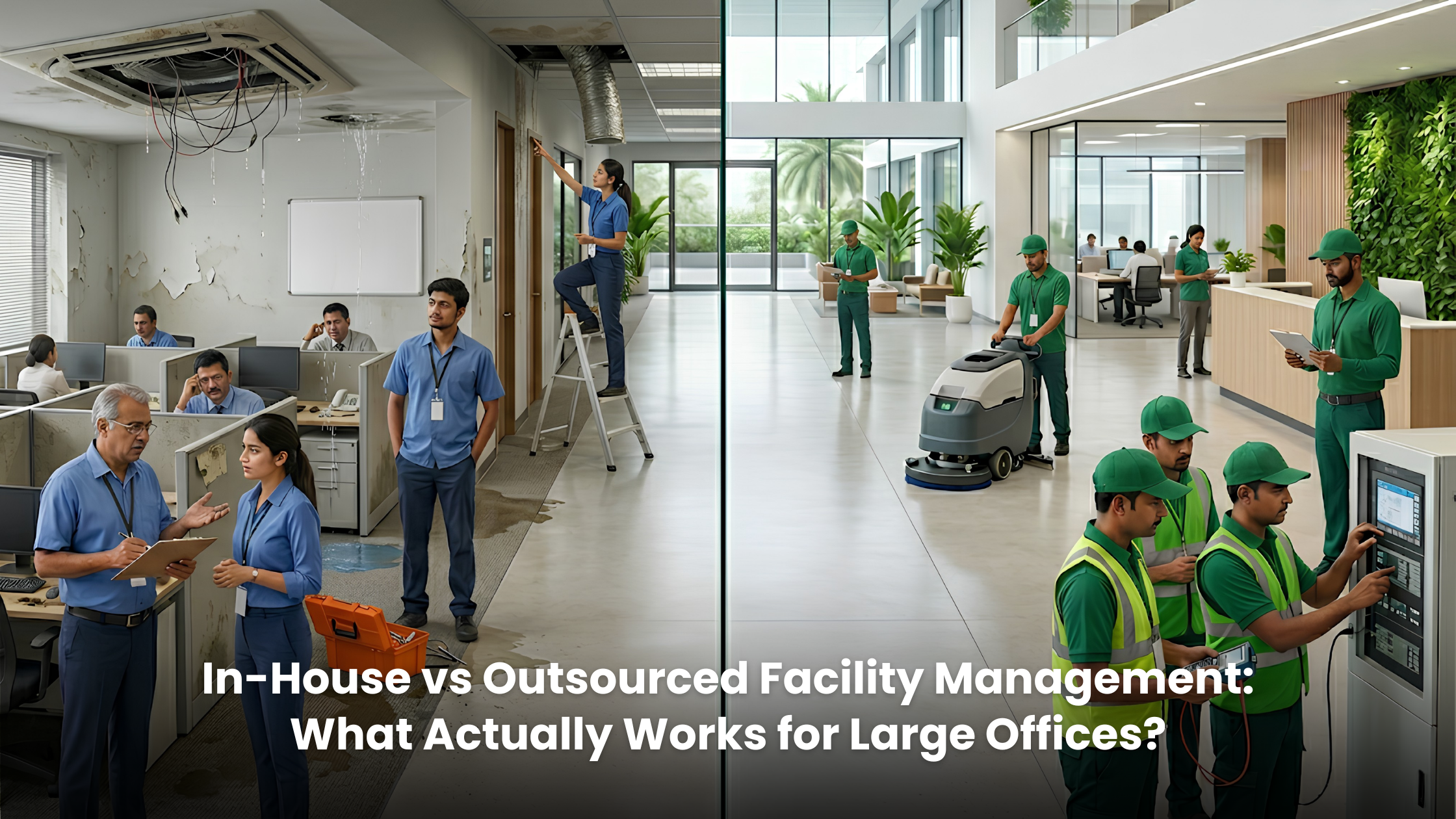
In-House vs Outsourced Facility Management: What Actually Works for Large Offices?
Managing large office spaces is becoming increasingly complex. From maintaining workplace hygiene and managing technical infrastructure to ensuring compliance and employee comfort, organizations need a reliable strategy to keep operations running smoothly.
One of the most common questions businesses face is whether to manage facilities internally or partner with professional facility management service providers. While both approaches have their advantages, experience across corporate offices, commercial properties, and large enterprises shows that a one-size-fits-all solution rarely delivers the best results.
At Virat Facility Management Services, we have observed that the most successful organizations adopt a balanced approach that combines internal oversight with specialized external expertise. Let’s explore what works best for large offices and why.
Understanding In-House Facility Management
In-house facility management involves recruiting, training, and managing an internal team responsible for maintaining office operations.
This model gives organizations complete control over daily activities, workforce management, and operational decisions.
Benefits of In-House Facility Management
Greater Operational Control
Internal teams work directly under company management, making it easier to align processes with organizational goals and workplace culture.
Strong Institutional Knowledge
Over time, in-house staff develop a deep understanding of the building’s infrastructure, operational requirements, and recurring maintenance challenges. This knowledge often leads to faster decision-making and issue resolution.
Enhanced Security and Confidentiality
Organizations operating in highly regulated industries or handling sensitive information may prefer internal teams to maintain tighter control over access, security protocols, and confidential areas.
Challenges of In-House Facility Management
While control is a major advantage, managing facilities internally comes with significant responsibilities.
Organizations must handle:
- Recruitment and workforce management
- Employee training and development
- Payroll and benefits administration
- Equipment procurement
- Compliance and safety requirements
- Leave management and staffing coverage
For large offices, these responsibilities can increase operational costs and divert focus from core business objectives.
Understanding Outsourced Facility Management
Outsourcing involves partnering with professional facility management service providers that specialize in delivering integrated workplace solutions.
This approach has become increasingly popular among corporations seeking operational efficiency, scalability, and access to specialized expertise.
Benefits of Outsourced Facility Management
Cost Efficiency
Professional facility management services eliminate the need for businesses to manage large internal teams. Recruitment, training, equipment maintenance, and workforce supervision are handled by the service provider, helping organizations optimize costs.
Access to Specialized Expertise
Leading providers bring trained manpower, advanced machinery, industry best practices, and technical specialists that may be difficult or expensive to develop internally.
Organizations benefit from expertise in:
- Housekeeping and sanitization
- HVAC maintenance
- Electrical systems
- Industrial plumbing
- Landscaping and horticulture
- Preventive maintenance programs
Scalability and Flexibility
Business requirements often change due to expansion, restructuring, or seasonal demands.
Professional facility management solutions allow companies to scale services up or down without the challenges of hiring or reducing internal staff.
Technology-Driven Operations
Modern facility management companies utilize digital reporting systems, preventive maintenance software, asset tracking tools, and performance dashboards to improve service quality and transparency.
Challenges of Outsourced Facility Management
The primary concern with outsourcing is reduced day-to-day control.
Since facility personnel are managed by an external provider, organizations must rely on clearly defined Service Level Agreements (SLAs), reporting systems, and performance monitoring to ensure consistent service delivery.
Success largely depends on selecting experienced and reliable facility management service providers with proven operational standards.
Why Large Offices Benefit from a Hybrid Facility Management Model
For most large commercial offices, neither a fully in-house nor a fully outsourced model delivers optimal results.
Instead, a hybrid approach combines the strengths of both models while minimizing their limitations.
This strategy enables organizations to retain operational control over critical functions while leveraging external expertise for specialized and resource-intensive services.
What Should Be Managed In-House?
Large offices should consider maintaining a small internal facilities leadership team responsible for:
- Strategic facility planning
- Vendor management
- Tenant and employee coordination
- Compliance oversight
- Asset management
- Performance monitoring
These individuals act as the bridge between organizational objectives and service execution.
Many organizations also retain ownership of facility management software, maintenance records, and operational data to maintain long-term visibility and control.
What Should Be Outsourced?
Specialized and labor-intensive functions are often better handled by experienced facility management service providers.
These typically include:
- Professional housekeeping services
- Deep cleaning and sanitization
- HVAC maintenance and repairs
- Electrical maintenance
- Industrial plumbing services
- Pest control
- Landscaping and horticulture
- Specialized cleaning projects
Outsourcing these services provides access to trained personnel, modern equipment, and established processes without increasing internal overhead.
The Importance of Technology and Data Ownership
One common mistake organizations make is allowing facility operations to be managed entirely through the vendor’s systems.
Regardless of whether services are delivered internally or externally, businesses should retain ownership of operational data, maintenance records, and facility performance metrics.
This approach provides:
- Better SLA monitoring
- Long-term asset history
- Improved maintenance planning
- Vendor performance evaluation
- Enhanced decision-making
At Virat Facility Management Services, we encourage organizations to prioritize transparency, reporting, and measurable performance outcomes as part of their overall facility management solutions strategy.
How to Choose the Right Model for Your Organization
Every organization has unique operational requirements.
An experienced facilities management consultant can help assess factors such as:
- Building size and complexity
- Security requirements
- Compliance obligations
- Workforce requirements
- Budget constraints
- Growth plans
The right strategy should support operational efficiency while aligning with long-term business objectives.
Final Thoughts
When it comes to large offices, the debate between in-house and outsourced facility management is no longer about choosing one over the other.
The most effective approach is often a hybrid model that combines internal oversight with specialized external expertise. This strategy enables organizations to maintain control over critical operations while benefiting from the efficiency, scalability, and technical capabilities offered by professional facility management services.
At Virat Facility Management Services, we help businesses implement customized facility management solutions that balance operational control, cost optimization, workplace safety, and service excellence. By combining skilled manpower, advanced technology, and industry expertise, organizations can create workplaces that are efficient, productive, and prepared for future growth.
For large offices seeking long-term operational success, the hybrid model continues to be the most practical and sustainable path forward.