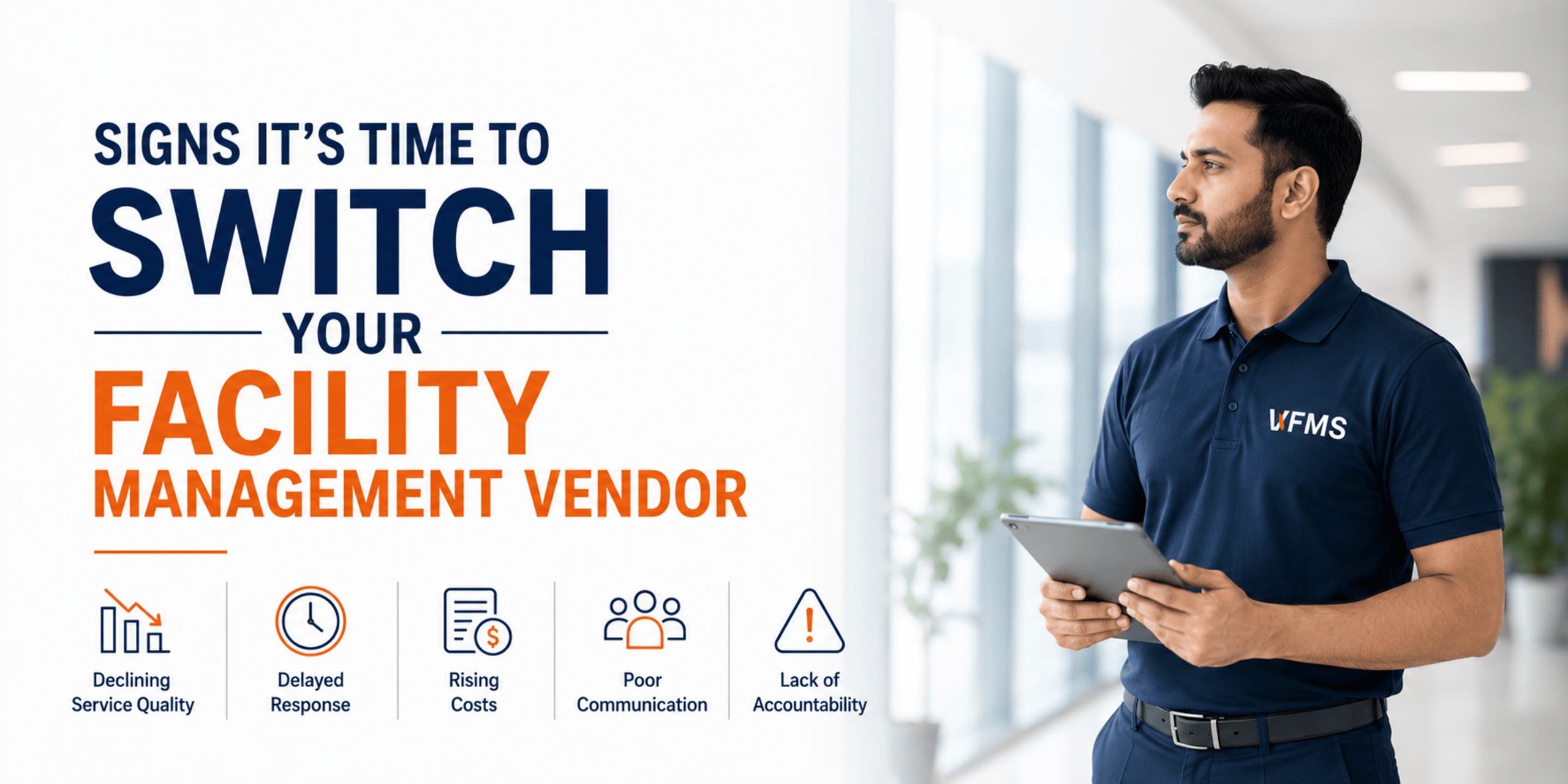
7 Signs It Is Time to Switch Your Facility Management Vendor
A warehouse’s fire extinguisher AMC lapsed for four months before anyone noticed — because the vendor’s compliance tracker hadn’t been updated since the contract started. A corporate office in Bengaluru has raised the same HVAC complaint three times this quarter, and each time gets a different technician with no memory of the previous visit. A retail chain gets a monthly report that looks polished but hasn’t actually changed a single line item in eight months.
None of these are one-off mistakes. They’re patterns — and patterns are exactly what should trigger a vendor review, not a one-time incident.
Switching a facility management company in India is disruptive enough that most businesses put it off until something breaks badly. But by the time something breaks badly, the underlying vendor gaps have usually been visible for months. This guide covers the seven signs worth watching for, followed by a decision checklist you can use to evaluate your current vendor objectively.
Why This Decision Gets Delayed
Switching vendors involves transition risk, contract exit terms, and the effort of re-onboarding a new team — so most businesses default to tolerating known issues rather than dealing with the unknowns of a switch. That’s a reasonable instinct up to a point. The problem is when tolerance becomes the default response to every recurring issue, regardless of severity or pattern.
The signs below are grouped around patterns, not isolated incidents, because a single missed call or late invoice doesn’t mean your provider is failing — but a recurring version of any of these usually does.
1. Compliance and Documentation Gaps Keep Surfacing
If you’re finding out about lapsed AMCs, expired fire NOCs, or missed statutory renewals after the fact rather than being proactively notified, that’s a structural failure in how your vendor tracks compliance — not a one-time oversight.
What this looks like in practice:
- You discover an expired license during an unrelated audit, not from your vendor
- Compliance documentation is inconsistent or has to be specifically requested each time
- The same renewal gets missed more than once
A reliable facility management services provider should be the one flagging renewal deadlines to you — not the other way around.
2. Response Times Are Getting Slower, Not Better
Early in a contract, response times are usually sharp because the vendor is still proving themselves. If response times to breakdowns, complaints, or service requests have noticeably slipped as the relationship has matured, that’s a signal the account is no longer being prioritized.
What this looks like in practice:
- Escalations that used to get same-day attention now take 2-3 days
- You’ve started escalating directly to a manager because the standard process is too slow
- SLA response times exist on paper but aren’t actually being tracked or enforced
3. The Same Issues Keep Recurring Without Root-Cause Fixes
A vendor that keeps sending someone to fix the same HVAC fault, the same recurring housekeeping complaint, or the same electrical fault month after month isn’t solving the problem — they’re managing symptoms.
What this looks like in practice:
- Repeat complaints on the same equipment or area with no clear root-cause investigation
- No pattern analysis being shared with you (e.g., “this is the third failure on this unit, here’s why”)
- Fixes that hold for a few weeks and then recur
This is one of the clearest indicators that a vendor has plateaued into reactive maintenance instead of the preventive approach that should be built into any serious integrated facilities management services contract.
4. Reporting Has Become a Formality, Not a Tool
Monthly or quarterly reports should tell you something you didn’t already know — trends, recurring issues, cost patterns, upcoming risks. If reports have become a templated document that looks the same every cycle regardless of what actually happened on-site, they’ve stopped being useful.
What this looks like in practice:
- Reports feel copy-pasted from the previous month with dates changed
- No mention of incidents, near-misses, or recurring issues you know occurred
- You have to specifically ask for data that should already be included
5. Staffing Turnover Is High and Unexplained
Facility management is a people-heavy function in India, and consistent quality depends heavily on the same trained staff and site supervisors staying on your account. Frequent, unexplained staff changes — especially at the supervisor level — usually signal internal problems at the vendor that will eventually show up in your service quality.
What this looks like in practice:
- You’re introduced to a new site supervisor every few months without explanation
- New staff seem unfamiliar with your site’s specific requirements or history
- Service quality dips noticeably right after a staffing change
6. Costs Are Rising Without a Corresponding Service Improvement
Cost increases aren’t inherently a red flag — inflation, wage revisions, and scope changes are normal. The concern is when costs rise but service quality, responsiveness, or scope stays flat or declines.
What this looks like in practice:
- Annual cost escalation with no corresponding SLA improvement or added scope
- Vendor can’t clearly justify what a cost increase is actually funding
- You’re paying premium rates for what feels like basic reactive service
7. The Vendor Can’t Scale With Your Business
A vendor that worked well for a single office often struggles once you add a second site, a warehouse, or a different service category. If your business has grown or diversified and your vendor hasn’t grown their capability alongside it, you’re likely getting inconsistent service across locations.
What this looks like in practice:
- Different service standards at different sites under the same contract
- Vendor subcontracts new locations to third parties you have no visibility into
- No single point of contact once you’re operating across more than one city
Businesses evaluating broader facility management solutions as they scale often find this is the point where a single-service or single-site vendor simply isn’t built for what the business now needs.
Decision Checklist: Should You Switch Your FM Vendor?
Use this checklist to evaluate your current vendor objectively. Check off each item that applies to your situation over the past 6–12 months.
# | Question | |
1 | Have you discovered a compliance or documentation lapse from someone other than your vendor? | |
2 | Has average response time to service requests noticeably slowed compared to the start of the contract? | |
3 | Has the same issue (equipment, area, or complaint type) recurred three or more times without a clear fix? | |
4 | Do your monthly/quarterly reports feel repetitive or disconnected from what actually happened on-site? | |
5 | Has your on-site supervisor or key staff changed more than twice in the past year without explanation? | |
6 | Have costs increased without a corresponding improvement in service or scope? | |
7 | Has your vendor struggled to maintain consistent service quality as you’ve added sites or services? | |
8 | Do you find yourself escalating issues directly to a manager instead of using the standard process? | |
9 | Would you struggle to name one specific improvement your vendor has made in the last year? | |
10 | Is your renewal decision based on inertia (“switching is a hassle”) rather than genuine satisfaction? |
How to read your results:
- 0-2 Yes answers: Your vendor relationship is likely healthy. Continue monitoring, but a switch isn’t urgent.
- 3-5 Yes answers: Worth a direct conversation with your vendor and a defined improvement plan with timelines, before considering a switch.
- 6+ Yes answers: These are structural issues, not isolated incidents. Start evaluating alternative providers even if you’re not ready to switch immediately — knowing your options changes your negotiating position either way.
What to Do Before You Actually Switch
Recognizing the signs is only the first step. Before terminating a contract:
- Review your exit clause and notice period so the transition doesn’t leave a service gap
- Document specific incidents tied to each sign above — this strengthens any renegotiation conversation and speeds up onboarding a new vendor
- Request a formal improvement plan with your current vendor first, if the relationship is salvageable but underperforming — sometimes the threat of a switch resolves the issue
- Shortlist 2-3 alternative providers and compare their service taxonomy, multi-site capability, and SLA structure against what’s failing today
- Plan the transition window so compliance renewals, AMC schedules, and staff handovers don’t fall through the cracks during the switch itself
The Bottom Line
No single missed call or late report means your vendor relationship is broken. But when the same issues repeat — compliance gaps, slowing response times, recurring faults, hollow reporting, staff turnover, rising costs without value, or an inability to scale — that’s a pattern, and patterns are what should drive the decision, not any single incident.
Run through the checklist above honestly. If it points toward a switch, start the evaluation process before the next renewal deadline forces a rushed decision.
Frequently Asked Questions
How do I know if my facility management vendor is underperforming? Look for patterns rather than one-off incidents: recurring complaints on the same issue, compliance gaps you discover independently, slowing response times, and reports that don’t reflect what’s actually happening on-site.
How often should I review my facility management contract? Most businesses benefit from an annual formal review, but recurring issues should trigger a review immediately rather than waiting for the renewal date.
Is it normal for facility management costs to increase every year? Some increase is normal due to wage revisions and inflation. The concern is when cost increases aren’t matched by any improvement in service quality, responsiveness, or scope.
What should I check before switching to a new facility management company? Verify multi-site capability if relevant, ask for clear SLA terms in writing, check compliance-tracking processes, and request references from clients in a similar sector or site size to yours.
Can I switch facility management vendors mid-contract? This depends on your contract’s exit clause and notice period. Review these terms carefully, since most contracts require a defined notice period, and some may include exit costs or transition requirements.