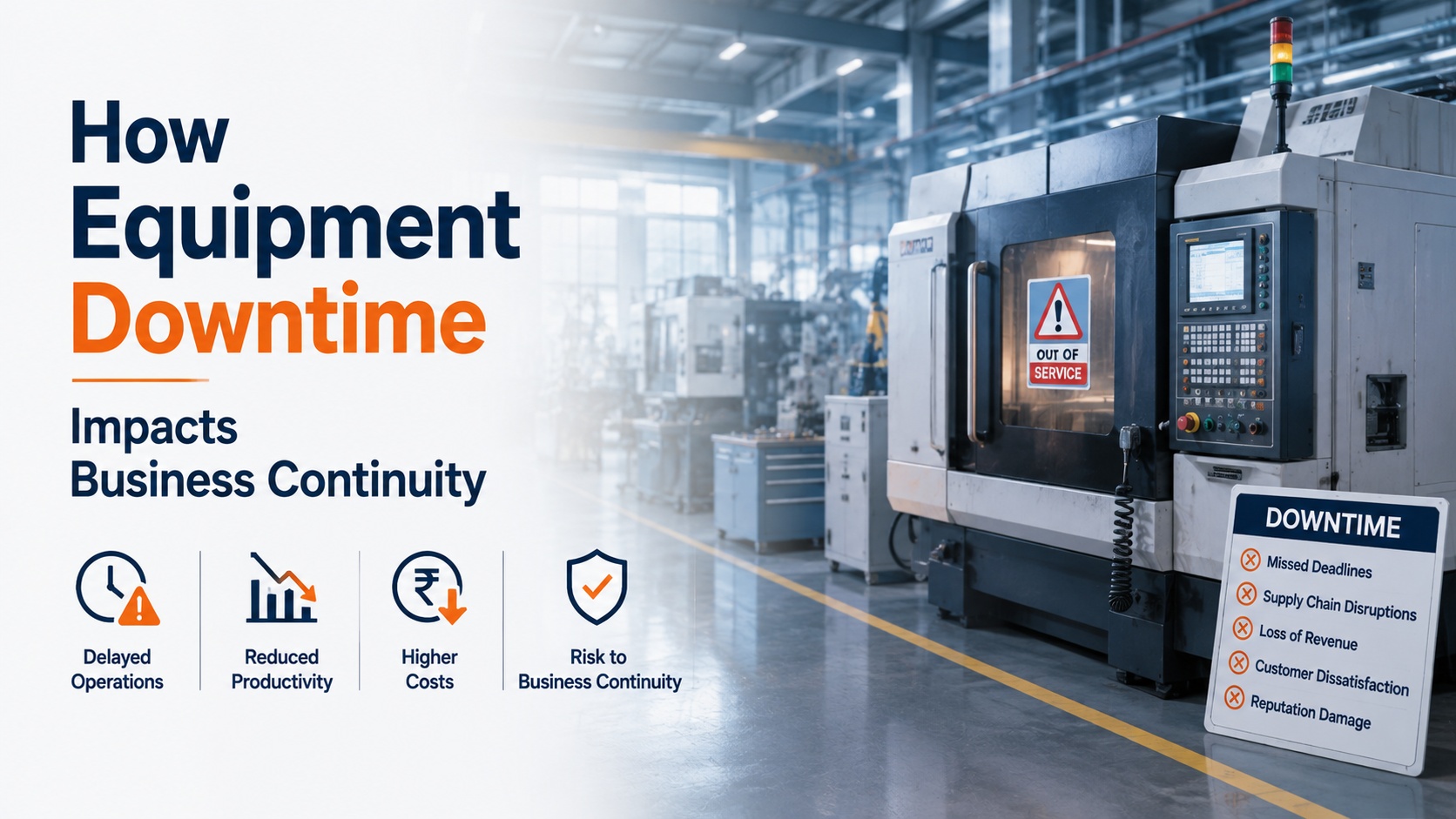
How Equipment Downtime Impacts Business Continuity
A single mechanical failure rarely stays contained to the machine that broke. A compressor that trips, a pump that seizes, or a motor that overheats can stall production, delay client deliverables, and put safety systems at risk — all from one point of failure. This guide breaks down how equipment downtime actually spreads through a business, walks through a cost model you can adapt to your own facility, and outlines the preventive actions that mechanical services are specifically designed to catch before they escalate.
Why Downtime Is a Business Continuity Issue, Not Just a Maintenance One
It’s easy to file equipment downtime under “maintenance problem” and leave it at that. In practice, a mechanical failure of any significance touches far more than the equipment itself — production schedules, client commitments, staff safety, and in some cases regulatory compliance all depend on mechanical systems continuing to run.
Business continuity planning usually focuses on larger-scale risks — fire, flood, cyberattack, power outage. Equipment failure deserves the same structured thinking, because the mechanism is the same: an unplanned interruption that the business wasn’t ready to absorb.
How Downtime Actually Spreads Through a Business
A mechanical failure rarely stays a single, contained event. It typically moves through a business in a predictable sequence, with the visible cost often being the smallest part of the total impact.
- Immediate operational stop: production, service delivery, or building systems relying on the failed equipment stop functioning until a fix is made.
- Labour cost without output: staff and technicians on-site continue to draw wages during the stoppage, whether or not they can do productive work.
- Schedule and delivery slippage: any commitment downstream of the affected equipment — a shipment, a client deliverable, a production run — shifts later, sometimes triggering contractual penalties.
- Emergency repair premium: parts and labour sourced urgently typically cost more than the same work scheduled in advance, since emergency callouts and expedited parts shipping both carry a premium.
- Secondary equipment strain: other systems compensating for the failed unit — a backup pump running longer, a second compressor carrying extra load — wear faster than under normal operating conditions.
- Reputational and relationship cost: repeated or poorly communicated disruptions affect how clients, tenants, or partners view the reliability of the business, which is harder to quantify but real over time.
What the Broader Research Shows About Downtime Cost
Industry research on unplanned downtime, largely drawn from large-scale manufacturing operations, consistently finds two patterns worth noting even for smaller or non-manufacturing facilities.
- Aberdeen Research has estimated the average cost of unplanned downtime across manufacturing sectors at roughly $260,000 per hour, though this figure spans large, high-volume operations and varies enormously by industry and facility size.
- Siemens’ 2024 True Cost of Downtime report found that Fortune Global 500 companies lose a combined figure equivalent to roughly 11% of total annual revenue to unplanned downtime — a proportional figure that’s more transferable across facility sizes than the absolute dollar figures.
- Multiple industry sources report that reactive, unplanned repairs typically cost 3 to 9 times more than the same maintenance work performed on a scheduled, preventive basis — this ratio is the most consistently useful takeaway across the research, regardless of your facility’s absolute scale.
The specific dollar figures above come from large international operations and shouldn’t be treated as representative of a typical Indian commercial facility or SME. The consistent, more broadly applicable finding across this research is structural: unplanned, reactive repair work costs meaningfully more than the same work done on a planned schedule, and the gap between the two grows with the size and criticality of the equipment involved.
A Downtime Cost Model You Can Adapt
Rather than relying on a generic industry average, it’s more useful to build a simple cost model specific to your own facility. The components below are the ones that consistently appear across cost-of-downtime frameworks.
Cost Component | What to Include | How to Estimate It |
|---|---|---|
Lost output or service value | Revenue or output not delivered during the stoppage | Average hourly production value, or hourly revenue tied to the affected system |
Idle labour | Wages paid to staff unable to work during the stoppage | Headcount affected × hourly wage × downtime duration |
Emergency repair premium | Extra cost of urgent vs. scheduled repair | Compare emergency callout/parts pricing against your standard AMC or scheduled rate |
Secondary/compensating wear | Accelerated wear on backup systems carrying extra load | Estimate reduced remaining lifespan of the compensating equipment, if applicable |
Contractual or penalty exposure | Any SLA penalties or client commitments missed | Check specific contract terms tied to the affected process or delivery |
Recovery and ramp-up cost | Time and resources needed to restart normal operations | Estimate hours needed to fully resume, not just the repair time itself |
A Worked, Illustrative Example
This example uses assumed figures for a mid-sized commercial facility with a compressor failure affecting a production or building system for four hours. Treat every number here as illustrative — the structure of the calculation is the useful part, not these specific figures.
Cost Component | Illustrative Assumption | Illustrative 4-Hour Cost |
|---|---|---|
Lost output/service value | Assumed ₹15,000/hour in affected output | ₹60,000 |
Idle labour | 8 staff affected at an assumed ₹150/hour | ₹4,800 |
Emergency repair premium | Assumed 40% premium over a ₹20,000 standard repair | ₹8,000 (premium only) |
Recovery/ramp-up | Assumed 1 additional hour to fully resume normal output | ₹15,000 |
Illustrative total | — | ≈ ₹87,800 |
This worked example deliberately excludes contractual penalties and reputational cost, since those are highly specific to individual businesses and contracts rather than generalisable. Even without those harder-to-quantify categories, the illustrative total is often several times higher than the cost of the repair itself — which is consistently the pattern the broader research points to as well.
Business Continuity Scenarios
How downtime plays out in practice depends heavily on the type of facility and the equipment involved. A few representative scenarios illustrate the range.
Scenario 1: Compressor Failure in a Light Manufacturing Unit
A production line dependent on compressed air stops entirely when the compressor fails. Without a backup unit, the entire line sits idle until repair, and any orders scheduled during that window slip. If the facility has a secondary compressor, the line may continue at reduced capacity, but the backup unit now bears extra load and wears faster, raising the likelihood of a second failure if it isn’t inspected promptly afterward.
Scenario 2: Pump Failure in a Commercial Building’s Water System
A failed booster or transfer pump can affect water supply across multiple floors of an office building, disrupting washroom facilities, pantry access, and, in some cases, fire safety water reserves. Unlike a production line, the continuity risk here is less about revenue and more about occupant safety and regulatory obligations around water and fire-safety availability.
Scenario 3: HVAC-Adjacent Mechanical Failure in a Data Centre or Server Room
Mechanical failures in cooling-support equipment — pumps, chillers’ mechanical components — can escalate quickly in temperature-sensitive environments. Here, continuity risk isn’t measured in hours of lost production but in the much shorter window before overheating threatens equipment integrity, making backup system readiness and rapid response critical rather than optional.
Scenario 4: Motor Failure in a Multi-Tenant Commercial Building
A failed motor driving a lift, ventilation fan, or water system in a shared building affects multiple tenants simultaneously, not a single business. The continuity impact here includes tenant relationship and lease-renewal risk on top of the immediate operational disruption, since the facility owner is accountable to every affected tenant at once.
Preventive Actions That Reduce Downtime Risk
- Scheduled preventive maintenance: routine inspection, lubrication, and component checks catch developing issues — worn bearings, misalignment, early-stage corrosion — before they cause failure.
- Condition monitoring on critical equipment: vibration analysis, thermal imaging, and routine performance checks can flag abnormal readings well before a breakdown, giving time to plan a repair rather than react to one.
- Spare parts planning for critical components: identifying which parts have long lead times and keeping critical spares on hand avoids extended downtime waiting for procurement.
- Redundancy for critical systems: backup pumps, compressors, or motors for genuinely critical functions reduce the chance that a single failure stops an entire operation.
- Clear escalation and response protocols: a defined process for who to call, how quickly, and what temporary measures to take reduces the time between failure and resolution.
- Regular review of maintenance history: recurring issues on the same equipment often signal a root cause — incorrect load, poor installation, inadequate cooling — that a one-off repair won’t fix.
None of these measures eliminate risk — mechanical equipment will eventually need repair or replacement regardless of how well it’s maintained. What preventive maintenance changes is the balance between planned, scheduled work and unplanned, reactive failure, which is exactly the ratio the broader downtime-cost research consistently points to as the most controllable factor.
Building Continuity Into Your Mechanical Maintenance Plan
Reducing downtime risk isn’t a one-time project — it’s an ongoing discipline that pairs routine maintenance with a clear plan for what happens when something does fail despite that maintenance. Both halves matter: prevention reduces how often failures happen, and a defined response plan reduces how much damage occurs when they do.
Working with a dependable mechanical service company that offers both scheduled preventive maintenance and a clear escalation process for emergencies gives a facility the best chance of keeping isolated equipment failures from becoming full-scale continuity events.
Getting Started
The most useful first step isn’t a large capital investment — it’s building the cost model outlined above for your own most critical mechanical systems, so you have a realistic, facility-specific figure to weigh against the cost of a preventive maintenance programme.
A professional mechanical services provider can help assess which systems in your facility carry the highest continuity risk and build a maintenance plan around those priorities first, rather than treating all equipment as equally critical.
Frequently Asked Questions
What is considered equipment downtime in a facility management context?
Equipment downtime refers to any period when mechanical equipment — compressors, pumps, motors, or related systems — is not functioning as intended, whether due to a full failure or a partial performance issue that stops normal operation.
How do I calculate the true cost of downtime for my facility?
Add together lost output or service value, idle labour costs, the premium paid for emergency versus scheduled repair, any contractual penalties, and the time needed to fully ramp back up to normal operations — not just the repair time itself. The cost model in this guide provides a structure to adapt to your specific numbers.
Is preventive maintenance really cheaper than reactive repair?
Multiple industry sources report reactive repairs typically costing 3 to 9 times more than the same work performed on a scheduled basis, largely due to emergency labour premiums, expedited parts shipping, and the wider operational disruption of an unplanned stoppage.
How often should critical mechanical equipment be inspected to reduce downtime risk?
This depends on the equipment’s criticality and operating conditions, but most critical systems benefit from monthly to quarterly inspection at minimum, with condition monitoring for the highest-risk equipment providing earlier warning than a fixed inspection schedule alone.
Should every piece of mechanical equipment have a backup or redundant system?
Not necessarily — redundancy adds cost and should be reserved for equipment where failure would cause a genuinely serious continuity, safety, or compliance impact. A facility-specific risk assessment, rather than a blanket policy, is the more practical approach.