What Should You Check Before Signing a Facility Management Contract?
A facility management contract is the document that determines whether a dispute six months from now gets resolved in an afternoon or drags on for weeks. Most of the friction between building owners and providers doesn’t come from bad service — it comes from a contract that never clearly defined what “good service” meant in the first place. This guide walks through what to check before signing an agreement for facility management services, covering the clauses that matter most: SLAs and KPIs, staffing commitments, compliance evidence, escalation paths, penalties, change control, and exit terms.
This guide is intended as a practical checklist to help you ask the right questions and structure a productive conversation with a provider — it is not legal advice. Facility management contracts carry real financial and liability exposure, so have a qualified lawyer review the final draft before signing, particularly the indemnity, liability, penalty, and termination clauses.
Why Contract Clarity Matters More Than the Sales Pitch
Almost every provider proposal sounds strong during the sales process — professional teams, modern systems, responsive service. What actually gets delivered over the life of a contract is determined by what’s written down, not what was said in the pitch meeting. A vague contract gives a provider room to interpret “reasonable service” generously in their own favour, and gives you very little to point to when performance slips.
The sections below cover the specific clauses worth reading closely — and in several cases, worth pushing back on — before signing anything.
1. Service Level Agreements (SLAs) and KPIs
An SLA is the commitment itself — the specific standard the provider agrees to meet. A KPI is the measurable data used to confirm whether that commitment is being met. A contract that only states SLAs without defining how they’ll be measured is difficult to enforce in practice.
- Check that every SLA has a number attached — “prompt response” is not enforceable; “response within 2 hours during operating hours” is.
- Confirm how each KPI will be measured and by whom — self-reported vendor logs carry less weight than data you can independently verify or spot-check.
- Ask how often SLA performance is reported back to you, and in what format — monthly scorecards are common and far more useful than an annual summary.
- Check whether SLAs differ by service type (housekeeping response time vs. an electrical fault response time, for instance), since a single blanket SLA across very different services is usually too vague to be meaningful.
2. Staffing Commitments
Manpower is typically the largest cost component in a facility management contract, and it’s also where scope tends to quietly erode if it isn’t pinned down clearly.
- Confirm the contracted headcount by role (housekeeping staff, security guards, technicians, supervisors) and the specific shifts they cover.
- Check what happens when contracted staff are on leave — does the provider guarantee like-for-like substitution, or does coverage simply drop?
- Ask whether staff are the provider’s direct employees or subcontracted, since this affects accountability and compliance responsibility.
- Check for a minimum experience or training requirement for supervisory and technical roles, particularly for hard FM tasks like electrical or mechanical work.
- Confirm whether staff replacement (in case of poor performance or attrition) is at no additional cost to you during the contract term.
3. Compliance Evidence
A provider’s compliance obligations fall into two categories: their obligations as an employer (statutory dues for their own staff) and their obligations to keep your building compliant with safety and regulatory requirements. Both need to be verifiable, not just promised.
- Ask for evidence of Provident Fund (PF) and Employee State Insurance (ESI) compliance for staff deployed at your site, not just a general statement of compliance.
- Confirm the provider carries valid labour licences and any state-specific registrations required for contract labour deployment.
- Check what insurance the provider carries — general liability, workers’ compensation, and any property damage coverage — and request certificates, not just a mention in the proposal.
- For hard FM services (electrical, fire safety, mechanical), confirm technicians hold relevant certifications, and that statutory inspection schedules (fire safety, lift certification, electrical audits) are explicitly the provider’s responsibility to track and execute, not left ambiguous.
- Ask how compliance documentation will be shared with you on an ongoing basis, since a one-time check during onboarding isn’t sufficient for a multi-year contract.
4. Escalation Procedures
Every contract should define what happens when something goes wrong, before something actually goes wrong. Without a clear escalation path, issues tend to get stuck with whoever happens to answer the phone.
- Check that the contract names specific escalation contacts at each level — site supervisor, account manager, and senior management — with contact details, not just job titles.
- Confirm defined response and resolution windows at each escalation stage, and what triggers moving from one stage to the next.
- Ask whether there’s a distinction between routine service issues and urgent/safety-critical issues, with faster escalation for the latter.
- Check whether escalations and their resolutions are logged in a way both parties can refer back to later.
5. Penalties and Service Credits
Penalty clauses, sometimes called service credits or liquidated damages, give an SLA real teeth. Without them, a missed SLA is a conversation; with them, it has a defined consequence.
- Check whether the contract includes service credits for missed SLAs, and how they’re calculated — a percentage of the monthly fee tied to the severity or duration of the breach is common.
- Confirm there’s a distinction between a single missed SLA and a pattern of repeated breaches, since chronic underperformance usually warrants a stronger remedy than a one-off lapse.
- Ask whether penalties are capped, and if so, at what percentage of the contract value — this affects how much real leverage the clause provides.
- Check that penalty clauses are specific enough to calculate without dispute — vague language here tends to result in the clause never actually being invoked.
6. Change Control
Facility needs change — a building adds a floor, occupancy increases, a new compliance requirement comes into effect. A change control clause defines how the contract adapts without renegotiating from scratch every time.
- Check how scope changes (adding services, increasing headcount, extending hours) are priced and approved — ideally through a simple written change order process rather than an informal verbal agreement.
- Confirm how cost escalations are handled over a multi-year contract — many agreements tie annual increases to a wage index or inflation benchmark, which should be stated explicitly rather than left open.
- Ask what happens if statutory minimum wages increase mid-contract, since manpower-heavy FM contracts are directly exposed to this and it should be addressed rather than silently absorbed by either party.
- Check whether either party can propose service-level changes, and what process is used to agree on them.
7. Exit Clauses and Termination Terms
How a contract ends matters as much as how it begins. A poorly defined exit clause can leave a building without coverage during a transition, or expose you to costs you didn’t anticipate.
- Check the required notice period for termination by either party, and whether it differs for termination for convenience versus termination for cause (poor performance, breach of contract).
- Confirm what transition support the outgoing provider is obligated to give — handover documentation, asset lists, staff transition support — during the notice period.
- Ask what happens to contracted staff at the end of the agreement, particularly if you’re switching providers, since this can have continuity implications for building operations.
- Check for any exit costs or penalties for early termination, and under what conditions they apply or are waived (for instance, termination due to the provider’s own breach).
- Confirm ownership and handover of any equipment, software licences, or access credentials that were part of the service, so nothing is left in dispute at the point of exit.
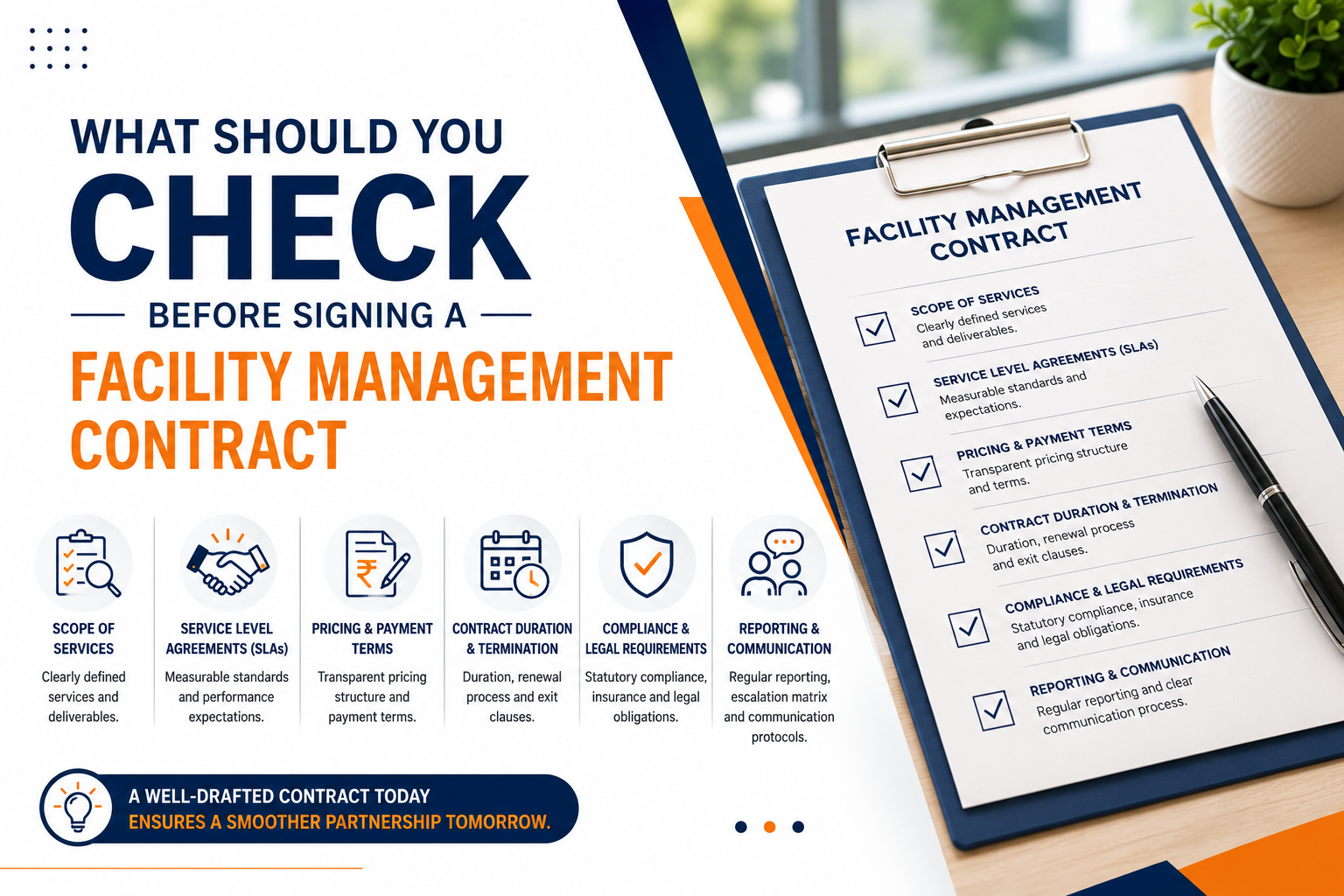
Contract Review Checklist
A condensed version of the points above, useful as a working checklist during contract review or negotiation.
- ☐ Every SLA has a specific, measurable number attached, not vague language
- ☐ KPI measurement method and reporting frequency are defined in writing
- ☐ Staffing levels, roles, and substitution policy for leave/attrition are specified
- ☐ PF, ESI, and labour licence compliance evidence is available and refreshed periodically
- ☐ Insurance certificates (liability, workmen’s compensation) are provided, not just referenced
- ☐ Statutory inspection responsibilities (fire, lift, electrical) are explicitly assigned
- ☐ Escalation contacts and response windows are named at each level
- ☐ Penalty or service credit calculation method is specific and unambiguous
- ☐ Change control process for scope changes and cost escalation is documented
- ☐ Termination notice periods and transition support obligations are clear
- ☐ Exit costs, if any, and the conditions triggering them are defined
- ☐ The final draft has been reviewed by a qualified lawyer before signing
A Note on Legal Review
This guide is designed to help you ask sharper questions and negotiate a more complete contract — it does not substitute for legal advice. Facility management agreements often carry indemnity clauses, liability caps, and termination terms with real financial consequences if something goes wrong on-site. Before signing, have the final contract reviewed by a lawyer familiar with commercial services agreements, particularly the clauses covering liability, indemnity, penalties, and termination.
Putting It Together Before You Sign
None of the checks above are unusual or adversarial to raise with a provider — a reputable facility management partner should be comfortable walking through SLAs, staffing commitments, and compliance documentation in detail before a contract is finalised. Providers who are reluctant to specify these terms clearly are often signalling how the relationship will go once the contract is signed.
Whether you’re evaluating a single-service provider or a broader integrated facilities management services agreement covering multiple functions, working through this checklist before signing is what turns a vague service promise into an enforceable, workable contract.
Frequently Asked Questions
What is the difference between an SLA and a KPI in a facility management contract?
An SLA is the commitment itself — for example, a 2-hour response time for reported issues. A KPI is the measurable data tracked to confirm whether that commitment was actually met, such as the average logged response time over a given period.
Should a facility management contract include penalty clauses?
Most well-structured contracts do, often as service credits tied to missed SLAs. Without a defined penalty mechanism, an SLA breach has no real consequence, which weakens its enforceability in practice.
What compliance documents should a facility management provider be able to show?
At minimum, evidence of PF and ESI compliance for deployed staff, valid labour licences, and relevant insurance certificates. For hard FM services, technician certifications and statutory inspection records for systems like fire safety and lifts should also be available.
How much notice period is typical for terminating a facility management contract?
This varies by contract, but 30 to 90 days is common for termination for convenience, often with a shorter or immediate option for termination due to serious breach. The specific terms should always be confirmed in the contract rather than assumed.
Do I need a lawyer to review a facility management contract?
It’s strongly recommended, particularly for the liability, indemnity, penalty, and termination clauses, since these carry real financial and legal exposure. This guide can help you prepare informed questions, but it isn’t a substitute for a qualified legal review of the final agreement.
What happens if minimum wages increase during the contract term?
This should be addressed explicitly in the change control clause. Many facility management contracts tie annual cost adjustments to a wage index or inflation benchmark; if the contract is silent on this, it’s worth clarifying with the provider before signing rather than after a wage revision takes effect.