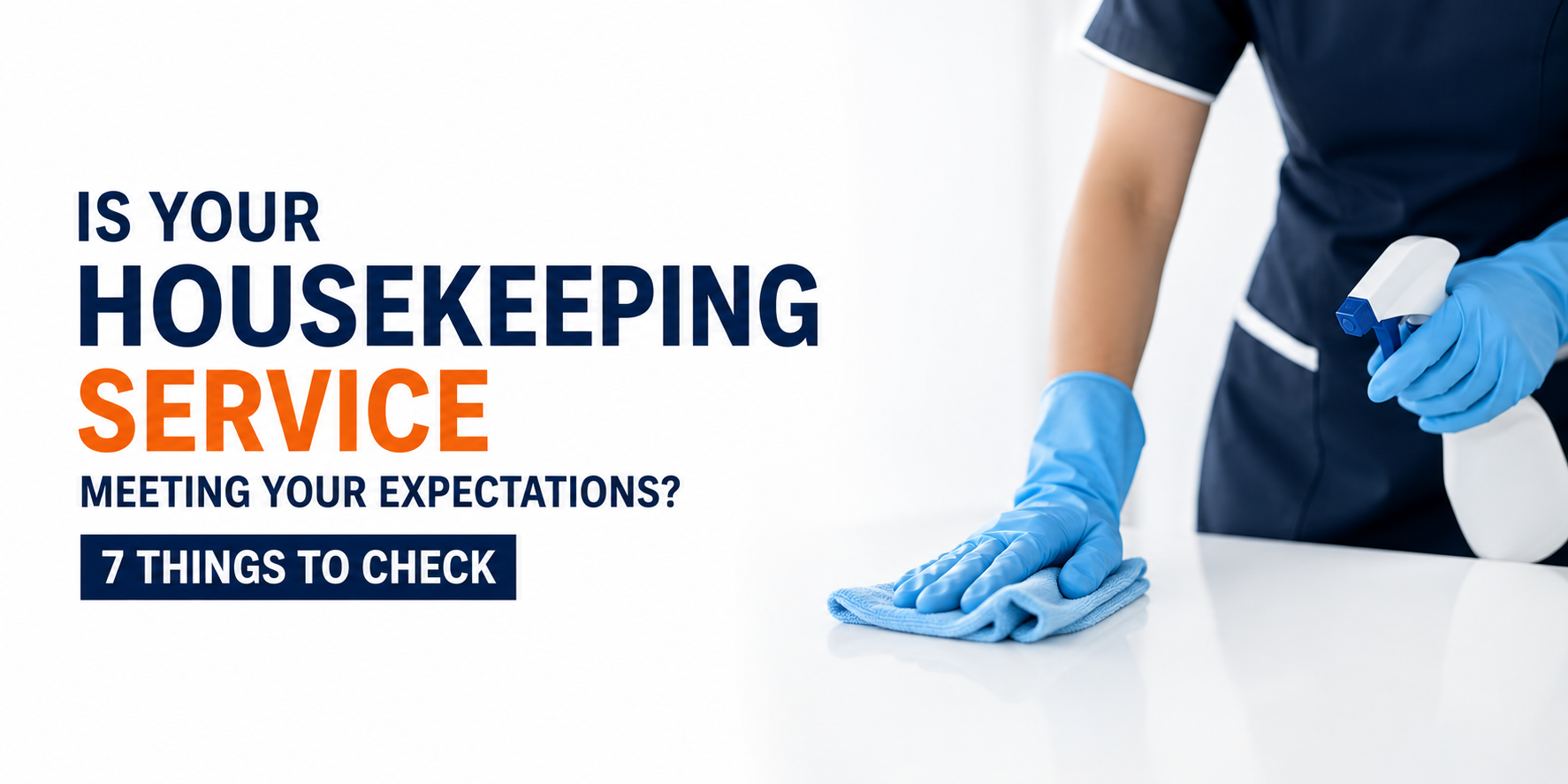
Is Your Housekeeping Service Meeting Your Expectations? 7 Things to Check
Signing a contract with a cleaning vendor is the easy part. The harder, ongoing job is verifying that the service you’re actually receiving matches what was promised — week after week, not just during the first month when everyone is on their best behaviour. This guide is a performance-audit framework for businesses that already have housekeeping services in place and want a structured way to check whether the work is holding up, with measurable SLAs, a scorecard you can run monthly, and clear escalation steps for when standards slip.
This is not a vendor-selection guide. If you’re still choosing a provider, that’s a separate decision involving credentials, references, and pricing comparisons. This article assumes you already have a housekeeping team in place and focuses entirely on measuring and auditing their ongoing performance.
Why Housekeeping Quality Quietly Slips Over Time
Cleaning quality rarely collapses overnight. It erodes gradually — a missed corner here, a skipped weekly task there — until enough small gaps accumulate that occupants start noticing and complaining. By the time complaints reach facility management, the underlying service has often been below standard for weeks.
The reasons are usually operational, not malicious: staff turnover, supervisors spread across too many sites, inconsistent training for new hires, or a contract where task frequency was never clearly defined in the first place. A structured audit catches these gaps before they become visible problems, rather than relying on occupant complaints as the only feedback signal.
7 Things to Check When Auditing Your Housekeeping Service
- Task Completion Against the Agreed Schedule
Every housekeeping contract should specify what gets cleaned, how often, and to what standard. The first audit check is simple: is the crew actually completing every task on the schedule, or are lower-visibility items — under-desk vacuuming, high-touch surface disinfection, storeroom organisation — being quietly skipped?
- Compare the written scope of work against a physical walkthrough on a random day, not an announced inspection date.
- Check whether daily, weekly, and monthly tasks are logged separately, since monthly deep-clean items are the most commonly missed.
- Consistency Across Shifts and Days
A common failure pattern is strong performance on the days a supervisor is present and a noticeable drop on other shifts. Consistency, not peak performance, is what should be measured.
- Spot-check on at least two different days of the week and, where relevant, across morning and evening shifts.
- Track whether standards hold during known staff-shortage periods, such as when a team member is on leave.
- Consumables and Supply Management
Empty soap dispensers, missing hand towels, or unstocked washrooms are among the most visible failures to occupants, even when the actual cleaning is done well. This is also one of the easiest things to audit objectively.
- Check washroom consumables at multiple points during the day, not just first thing in the morning.
- Confirm there’s a reorder process in place rather than reactive restocking only after a complaint.
- Staff Presentation, Conduct, and Identification
Uniformed, identifiable staff following basic conduct standards reflect directly on how professional the service feels to occupants and visitors. This is a softer metric than task completion but still measurable.
- Confirm all on-site staff are wearing visible ID and uniform as specified in the contract.
- Check that staff-to-area ratios match what was agreed, not a reduced headcount covering the same space.
- Equipment and Material Quality
The tools and materials a vendor uses directly affect both cleaning quality and safety. Worn-out equipment, incorrect chemical dilution, or non-standard products can cause surface damage or leave a facility non-compliant with agreed environmental or safety standards.
- Verify equipment matches what was specified in the contract, including any eco-friendly or non-toxic product commitments.
- Check that chemical storage and labelling follow basic safety practices, particularly in facilities with food service or healthcare components.
- Responsiveness to Reported Issues
How quickly a vendor responds to a flagged issue is often a better indicator of service quality than routine task completion. A spill reported at 11 a.m. and still unaddressed at 3 p.m. signals a supervision gap, regardless of how clean the floors looked that morning.
- Log the time between issue report and resolution for a sample of real requests over a month.
- Track whether the same issue recurs, which usually points to a root-cause problem rather than a one-off lapse.
- Documentation and Reporting Accuracy
A vendor that can’t produce accurate logs, checklists, or incident reports makes it difficult to verify anything else on this list. Documentation should be treated as part of the deliverable, not paperwork on the side.
- Cross-check submitted logs against your own spot-checks to confirm they reflect reality rather than being filled in retroactively.
- Confirm monthly or quarterly reports include measurable data, not just a general summary of “services performed as usual.”
Setting Measurable SLAs and KPIs
Auditing only works if there’s a defined standard to audit against. Vague contract language like “maintain high standards of cleanliness” gives a vendor no clear target and gives you no clear basis for escalation. The table below outlines measurable SLA and KPI examples you can adapt into a housekeeping contract or service agreement.
Area | Sample Measurable SLA / KPI | Suggested Target |
|---|---|---|
Task completion rate | % of scheduled tasks completed per audit cycle | 98% or higher |
Washroom consumable availability | % of spot-checks with no stockouts | 100% |
Issue response time | Time from report to resolution for standard requests | Under 2 hours during operating hours |
Staff attendance ratio | Actual staff on-site vs contracted headcount | 100%, or advance notice of substitution |
Occupant complaint volume | Number of valid complaints per month | Downward trend month-on-month |
Documentation accuracy | % of logs verified accurate against spot-checks | 95% or higher |
Deep-clean task compliance | % of monthly/quarterly deep-clean items completed on schedule | 100% |
Targets should be adjusted to your facility type — a hospital or food-processing unit will reasonably demand tighter thresholds than a standard corporate office. What matters is that every SLA is something you can actually measure during a walkthrough or from a log, not a subjective impression.
A Monthly Audit Scorecard You Can Use
A simple scorecard, run on a consistent monthly cycle, turns the seven checks above into a repeatable process rather than an occasional spot-check. Score each area out of 5, based on the SLA targets set for your facility.
Audit Area | Score (1-5) | Notes / Evidence |
|---|---|---|
1. Task completion vs schedule | ||
2. Consistency across shifts | ||
3. Consumables and supply management | ||
4. Staff presentation and conduct | ||
5. Equipment and material quality | ||
6. Responsiveness to reported issues | ||
7. Documentation and reporting accuracy | ||
Total (out of 35) |
- 30–35: Service is meeting expectations. Continue standard monthly audits.
- 22–29: Some gaps present. Flag specific items to the vendor and reassess within 30 days.
- Below 22: Performance is materially below agreed standards. Move to formal escalation.
Escalation Steps When Standards Slip
A clear, staged escalation process protects both sides — it gives the vendor a fair chance to correct issues and gives you documented grounds to act if they don’t.
- Step 1 — Document and flag informally: Record the specific gap with dates, evidence, and reference to the relevant SLA. Raise it directly with the on-site supervisor first, since many issues are resolved at this level.
- Step 2 — Formal written notice: If the issue recurs or isn’t resolved within an agreed window (commonly 7–14 days), send written notice to the vendor’s account manager, referencing the specific SLA breach and prior communication.
- Step 3 — Corrective action plan: Request a written plan from the vendor outlining root cause and remedy, with a defined timeline. This is the stage to reference contract clauses on service credits or penalties, if included.
- Step 4 — Performance review meeting: For recurring or serious gaps, hold a formal review with the vendor’s management, using scorecard history as evidence rather than anecdotal complaints.
- Step 5 — Contract remedy: If corrective action fails, apply any agreed service credits, request a change of on-site team, or begin the process of evaluating alternative vendors, depending on what your contract allows.
Keeping a dated record at every step matters — most service-level disputes are resolved faster when there’s a clear paper trail showing the gap was flagged, communicated, and given a fair chance to be corrected.
How This Differs from Choosing a Vendor
It’s worth being explicit about the distinction this guide is making. Selecting a facility management partner is a one-time (or infrequent) decision based on credentials, references, pricing, and scope of services offered.
What’s covered here is a completely different, ongoing exercise: verifying that a vendor you’ve already hired is actually delivering what was agreed, month after month.
The two are related but shouldn’t be confused. A vendor can look excellent on paper during selection and still drift below standard six months into a contract without a structured audit process in place to catch it. This framework exists specifically to close that gap.
Getting the Most Out of Your Housekeeping Contract
Most disputes with cleaning vendors don’t come from dishonesty — they come from vague expectations that were never written down clearly enough to measure. A contract with specific SLAs, a monthly scorecard, and a defined escalation path turns “the cleaning feels off lately” into a documented, actionable process.
Whether you manage a single office or a portfolio of sites, running this kind of structured audit consistently is usually what separates professional home cleaning services that hold their standard over time from ones that gradually decline once the initial contract enthusiasm fades.
Frequently Asked Questions
How often should I audit my housekeeping vendor’s performance?
A monthly scorecard review works well for most commercial facilities, with informal spot-checks in between. High-compliance environments such as hospitals or food-processing units often benefit from weekly checks on critical items like consumables and documentation.
What’s the difference between an SLA and a KPI in a housekeeping contract?
An SLA (service-level agreement) is the commitment itself — for example, a 2-hour response time for reported issues. A KPI (key performance indicator) is the measurable data you track to confirm whether that commitment is being met, such as the actual average response time logged over a month.
What should I do if my house deep cleaning service consistently misses scheduled tasks?
Start by documenting the specific missed tasks with dates and raising them with the on-site supervisor. If the pattern continues, escalate in writing to the vendor’s account manager and reference the relevant SLA before moving to a formal corrective action request.
Can I use this audit framework if I don’t have a formal contract with SLAs yet?
Yes, though it works best as a starting point — use the SLA and KPI table in this guide to define measurable standards with your current vendor, then begin scoring against those going forward. Retrofitting clear standards is common and usually well received by vendors who want to demonstrate reliability.
Is this audit process different for home cleaning services versus commercial housekeeping?
The core framework applies to both, but the specific SLAs and frequency should scale to context. A single-family home cleaning service might reasonably use a lighter checklist, while a commercial building with multiple shifts, washrooms, and occupants needs closer, more frequent tracking.
What counts as a valid reason to escalate to contract remedies?
Escalation to formal remedies is generally justified when a documented issue recurs after being flagged and given a fair correction window, or when scorecard results fall consistently below agreed thresholds over multiple audit cycles — not from a single isolated incident.